The Complete Bikepacking Gear Guide: Everything You Need for Multi-Day Adventures
20+ years testing gear in Colorado backcountry
Forget the Gear Lists: Focus on What Actually Matters
This isn't bike touring. Touring assumes paved roads, loaded panniers, and the next hotel or campground within reasonable distance. Bikepacking assumes none of that. (Not sure which style suits you? See our Bikepacking vs Bike Touring comparison.) You might be miles from the nearest road, navigating singletrack with thousands of feet of climbing ahead, or setting up camp wherever darkness catches you. Your gear needs to handle all of it while staying light enough to actually ride technical terrain.
As REI's bikepacking experts put it: "Bikepacking involves carrying essential gear—and not much more—on an off-road-capable bike for an overnight or multi-day ride." The emphasis on not much more is intentional. Every gram matters when you're climbing.
That's the fundamental tension every bikepacker confronts: carry enough to be self-sufficient, but not so much that the riding suffers. Get this balance wrong and you're either miserable from lack of essential gear or miserable from hauling a bike that handles like a shopping cart.
This guide covers everything you need to find that balance. We'll work through each gear category systematically—what you need, why you need it, and how the pieces fit together. Whether you're planning your first overnight or optimizing a setup for multi-week expeditions, the principles remain the same.
Let's build your kit.
The Bike: Your Most Important Gear Choice
Before obsessing over ultralight sleeping bags and titanium cookware, start with the machine that carries everything. The right bike makes loaded riding feel manageable. The wrong one makes every mile a chore.
What Makes a Good Bikepacking Bike
Forget the marketing. A bikepacking bike needs three things: appropriate tire clearance for your terrain, enough mounting points for bags and bottles, and geometry that remains stable under load.
Tire clearance matters because bikepacking routes don't stick to pavement. Gravel, dirt, sand, and technical singletrack all demand wider rubber than road bikes allow. Aim for minimum 40mm tire clearance on gravel-focused setups, and 2.2" or wider for mountain bike routes.
Mounting points determine how you carry gear. Frame bags need top tube and seat tube bolts. Fork cages need three-pack mounts on each fork leg. Water bottles need cage mounts—ideally three sets. Bikes designed for bikepacking include all of these. Road bikes converted for bikepacking often lack them.
Geometry affects handling when loaded. Longer chainstays and slacker head angles stay stable with weight. Twitchy race geometry amplifies every bag shift and makes technical descents sketchy. This doesn't mean you need a dedicated bikepacking bike—but it does mean some bikes adapt better than others. Already own a bike you love? See our guide on how to convert any bike for bikepacking.
Frame Types for Bikepacking
Gravel bikes handle paved roads to moderate doubletrack. Drop bars offer multiple hand positions for long days. Most accommodate 45-50mm tires and include mounting points for bags and bottles. Ideal for mixed-surface routes where efficiency matters. Popular options include the Surly Midnight Special and bikes from Salsa and All-City.
Hardtail mountain bikes add front suspension and wider tire clearance for rougher terrain. Flat bars provide better control on technical sections. The front triangle often provides more frame bag space than gravel bikes. Ideal for routes with significant singletrack or rough conditions.
Rigid mountain bikes skip the suspension weight and maintenance in exchange for simplicity. Modern rigid forks with carbon or steel construction absorb more vibration than you'd expect. Popular for long-distance expeditions where mechanical simplicity matters. The Surly Karate Monkey exemplifies this category.
For detailed bike recommendations at every price point, see our Best Bikepacking Bikes for Every Budget guide.
Full-suspension bikes work for bikepacking but present challenges. Rear suspension compresses under saddle bag weight, affecting geometry and reducing suspension travel for actual obstacles. Frame bag space shrinks dramatically. Reserve full-suspension for routes where the terrain genuinely demands it.
Bags & Storage: The Three-Bag System
Traditional panniers hang off racks on either side of your wheels. They work beautifully for touring on roads. They work terribly for bikepacking on trails. The side-mounted weight catches on brush, throws off your balance in technical sections, and requires racks that add weight and complexity.
Modern bikepacking bags solve this by strapping directly to your frame. The weight stays centered and low, preserving your bike's handling characteristics. No racks required—just straps, buckles, and clever design.
The Core Three Bags
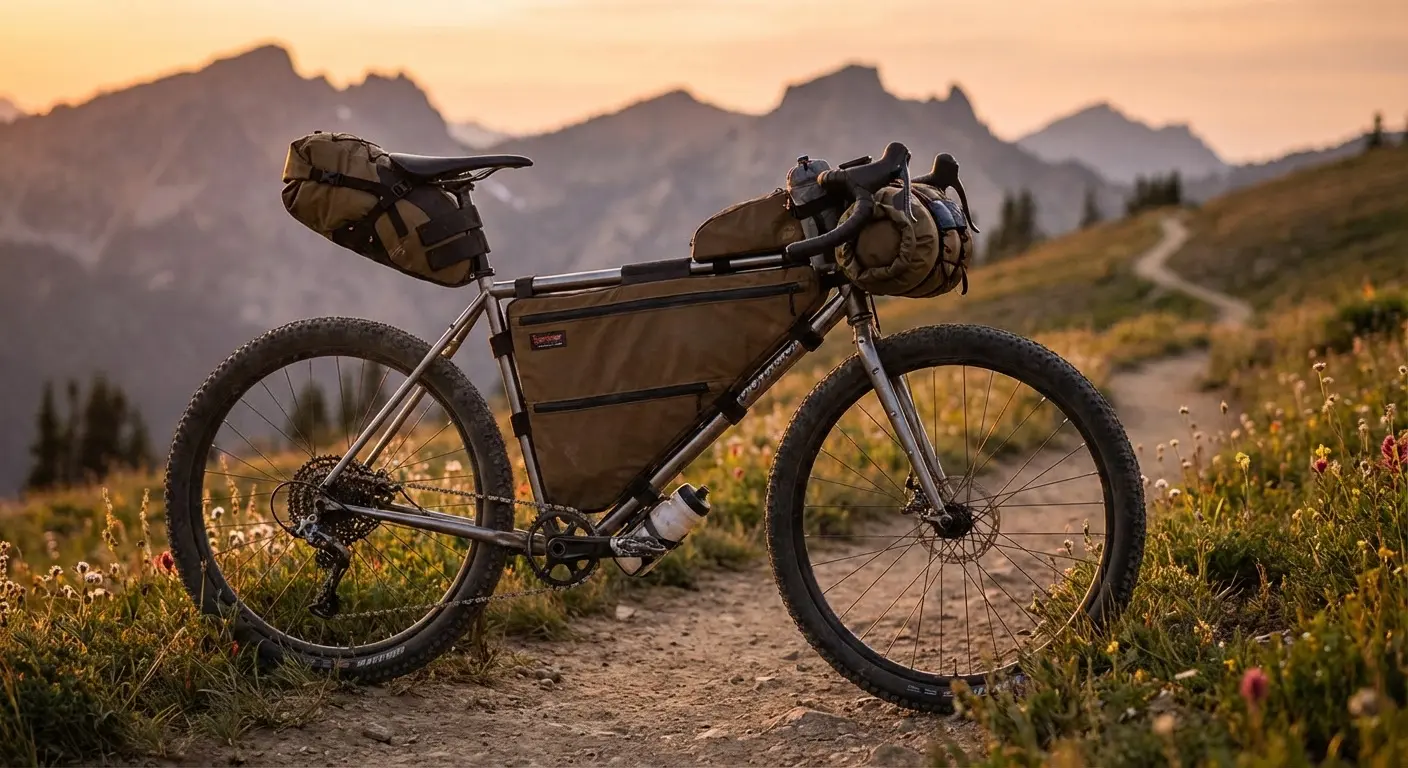
Frame bags occupy your main triangle—the space between top tube, seat tube, and down tube. This is prime real estate for heavy items: tools, water, food, electronics, and anything you'd hate to lose. Weight here has minimal impact on handling because it sits low and centered. Full-frame bags maximize capacity but block water bottle mounts. Half-frame bags like the Topeak Midloader preserve bottle access while still providing meaningful storage. For detailed frame bag options, see our Best Frame Bags for Bikepacking guide.
Saddle bags (also called seat packs) attach to your seatpost and saddle rails, extending behind your seat. They're ideal for lightweight but bulky items: sleeping bags, puffy jackets, spare clothing, and similar compressibles. Look for designs with internal stiffeners—the Topeak Backloader handles this well, while cheap seat packs sway side-to-side on rough terrain and drive you crazy. See our Best Saddle Bags for Bikepacking review.
Handlebar bags carry quick-access items at the front of your bike. Most use a harness system with a removable dry bag—perfect for stuffing in a shelter or layers without unpacking everything. Access is easy, but weight here affects steering. Keep handlebar loads light.
For specific product recommendations, see our guides to The 5 Best Bike Bags for Bikepacking and The Best Handlebar Packs for Bikepacking.
Weight Distribution Principles
Where you put weight matters as much as how much you carry. Follow these principles:
Heavy items go low and centered. Your frame bag should carry the densest items: tools, water, food, electronics. This keeps the center of gravity close to the bike's natural balance point.
Light and bulky items go high and rear. Your saddle bag handles sleeping gear and extra clothing—things that take up space but weigh relatively little.
Quick-access items go front. Your handlebar bag holds what you'll need during the ride: rain jacket, snacks, sunscreen, phone. Avoid heavy items that affect steering.
Balance left-to-right. Uneven loading creates handling problems, especially on technical terrain. Pack symmetrically.
Additional Storage Options
Beyond the core three, several supplementary bags expand capacity:
Top tube bags like the Revelate Designs Gas Tank provide quick access to snacks, phone, and small items without stopping. Essential for eating on the bike during long days. See our Top Tube Bags and Feed Bags guide.
Feed bags mount to your handlebars for grab-and-go nutrition. Less capacity than top tube bags but easier access while riding.
Fork bags and cargo cages use your fork's accessory mounts to carry water bottles, small dry bags, or dedicated fork packs. Salsa Anything Cages are the industry standard. Excellent for adding water capacity on dry routes. See our Fork Bags and Cargo Cages guide.
Anything cages expand where you can mount gear. Strap a dry bag to your fork legs or under your down tube.
For waterproofing solutions across all bag types, see Waterproof Bags for Your Gear.
Shelter Systems: Where You'll Sleep
Your shelter protects you from weather, bugs, and ground moisture. It's often the bulkiest item in your kit and frequently the heaviest. Choose wisely.
Tents
Traditional tents remain the most popular bikepacking shelter. They offer full weather protection, bug netting, and enough space to wait out storms comfortably. Downsides: weight, pack size, and setup time.
Freestanding tents pitch without stakes using crossing pole structures. They work anywhere—rock slabs, platforms, frozen ground. Heavier than non-freestanding options but more versatile.
Non-freestanding tents require stakes and/or trekking poles for setup. Lighter than freestanding designs but limited to stake-friendly ground.
Single-wall tents combine rainfly and tent body into one layer. Lighter and faster to pitch, but condensation becomes a problem in humid conditions.
Double-wall tents separate the breathable inner from the waterproof outer. Better condensation management but heavier and bulkier.
For bikepacking, prioritize packed size over floor space. A tent that stuffs into your handlebar bag beats one that requires a separate stuff sack strapped awkwardly to your frame. Many bikepacking-specific tents feature short poles designed for handlebar roll compatibility. Budget-friendly options like the Naturehike Cloud-Up 1 or premium choices like the Big Agnes Copper Spur HV UL1 both pack down to handlebar-friendly dimensions.
See our detailed analysis in The 5 Best One Person Tents for Bikepacking.
Bivies
Bivy sacks (bivouacs) are essentially waterproof shells for your sleeping bag. They eliminate the tent structure entirely, saving significant weight and pack size. The Outdoor Research Helium Bivy is a popular choice among ultralight bikepackers.
Advantages: Minimum weight, minimum pack size, pitch anywhere including spots too small for tents, setup in seconds.
Disadvantages: Claustrophobic feel, condensation management challenges, no protected space to wait out storms, limited bug protection.
Bivies work best in dry climates or as emergency backup shelter. For wet climates or extended trips, most bikepackers prefer the livability of a tent. See our Bikepacking Bivys: Ultralight Shelter Alternatives for the complete breakdown.
Tarps
Tarp shelters split the difference between tent comfort and bivy minimalism. A properly pitched tarp sheds rain, blocks wind, and provides open-air ventilation that prevents condensation.
Advantages: Excellent weight-to-protection ratio, versatile pitch options, spacious feel, works with trekking poles or natural anchors.
Disadvantages: No floor (pair with groundsheet), limited bug protection, requires practice to pitch effectively, more exposed than tents.
Tarp skills reward practice. A well-pitched tarp keeps you dry in serious weather. A poorly pitched one leaves you soaked.
Hammocks
Hammocks work for bikepacking if your routes pass through forested areas with suitable trees. They eliminate ground comfort concerns—no rocks, roots, or slopes to worry about. Systems like the Warbonnet Blackbird or budget options like the Wise Owl Outfitters hammock offer solid starting points.
Advantages: Comfortable sleep on uneven terrain, no ground pad required (though underquilts replace them), unique camping experience.
Disadvantages: Require appropriately spaced trees, heavy total system weight (hammock + suspension + tarp + underquilt), challenging in open terrain or above treeline, cold underneath without insulation.
Hammocks suit specific conditions perfectly and other conditions not at all. Know your route before committing to hammock-only shelter. See our Hammock Bikepacking: Is It Practical? guide for detailed analysis.
Sleep Systems: Rest That Actually Restores
Poor sleep ruins trips. After a hard day of riding, you need genuine recovery—not shivering through the night or tossing on uncomfortable ground. Your sleep system (bag or quilt plus pad) determines whether you wake up ready to ride or dreading the day ahead.
Sleeping Bags vs. Quilts
Traditional sleeping bags enclose you completely with insulation on all sides. Mummy shapes minimize weight and packed size while maximizing thermal efficiency.
Quilts eliminate the insulation underneath you—which compresses under your body weight anyway and provides little warmth. Instead, quilts strap around a sleeping pad that provides the underneath insulation. The result: less weight, less packed bulk, and more freedom to adjust ventilation.
For side sleepers and people who feel confined in mummy bags, quilts often provide better sleep quality. For cold sleepers or those who tend to roll off their pads, traditional bags provide more consistent warmth.
Temperature Ratings Explained
Sleeping bag temperature ratings indicate survival limits, not comfort zones. A bag rated to 20°F will keep you alive at 20°F—but you won't sleep well.
For comfortable sleep, add 10-15°F to the rated temperature. A 20°F bag works comfortably down to about 30-35°F for most people. Cold sleepers should add even more margin.
EN (European Norm) and ISO ratings provide standardized testing. Bags with these ratings from different manufacturers can be compared directly. Bags without standardized ratings are essentially guesses.
For three-season bikepacking in temperate climates, a 30-35°F comfort-rated bag handles most conditions. Add a liner for colder nights or swap to a warmer bag for shoulder seasons.
Down vs. Synthetic Insulation
Down offers the best warmth-to-weight ratio and compresses smaller than any synthetic. High fill-power down (800+ fill) packs incredibly small while providing serious warmth. Downsides: expensive, loses insulation when wet, requires more care in washing.
Synthetic insulation costs less and retains warmth when damp. Modern synthetics approach down performance but still can't match it in warmth-to-weight or compressibility. Better choice for wet climates or budget-conscious bikepackers.
Hydrophobic down treatments improve water resistance, but even treated down eventually saturates in consistently wet conditions. Pair down bags with waterproof storage regardless.
Sleeping Pads and R-Value
Your sleeping pad provides two things: cushioning and insulation. Cushioning affects comfort. Insulation—measured as R-value—determines how much cold transfers from the ground.
R-value basics: R-1 to R-2 works for summer. R-3 to R-4 handles three-season use. R-5+ addresses winter camping or cold sleepers.
Pad types:
Closed-cell foam pads weigh almost nothing, cost little, and never puncture. They provide modest cushioning and R-values around 2. Many bikepackers use thin foam as a backup or supplement.
Self-inflating pads combine foam with air for better cushioning. Heavier than air pads but simpler to use. Mid-range R-values.
Air pads provide excellent cushioning in the lightest package but require inflation (mouth or pump) and can puncture. Modern insulated air pads like the Therm-a-Rest NeoAir XLite offer R-values exceeding 5 while weighing under a pound.
For most bikepacking, an insulated air pad around R-3.5 to R-4.5 balances weight, comfort, and thermal performance. Carry a small patch kit—punctures happen. See our Best Sleeping Pads for Bikepacking guide for specific recommendations, and don't forget a camp pillow for better sleep quality.
Cooking & Nutrition: Fuel for the Ride
You burn significant calories bikepacking—often 3,000-5,000+ per day on demanding routes. How you resupply and prepare food affects both performance and enjoyment.
Stove Systems
Canister stoves screw onto pressurized fuel canisters containing isobutane/propane mix. They light instantly, simmer well, and weigh very little. The ultralight BRS-3000T weighs just 25 grams and costs under $20—a bikepacking staple. For integrated systems, the Jetboil MiniMo boils water fast with excellent fuel efficiency. Downsides: canisters are expensive, performance suffers in cold weather, and empty canisters create waste disposal challenges. Best for: trips with regular town stops where you can buy fuel.
Alcohol stoves burn denatured alcohol or similar fuels. They weigh almost nothing and fuel is available at hardware stores worldwide. Downsides: slow boil times, no flame adjustment, and wind sensitivity. Best for: ultralight setups and international travel.
Solid fuel tablets (Esbit) provide backup heat in the smallest package. They're slow and smelly but virtually foolproof. Best for: emergency backup or minimalist bikepackers who mostly eat no-cook foods.
Wood-burning stoves use twigs and debris for fuel—no carrying fuel weight. Downsides: require fire-permissible areas, produce soot, and don't work after rain. Best for: remote trips where fuel resupply is impossible.
Essential Cookware
Minimalist bikepacking cookware means one pot. A 750-900ml titanium pot like the TOAKS 750ml handles solo cooking for most meals at just 3.7 ounces. Add a lid that doubles as a plate or cup. Maybe a long-handled titanium spork.
Why titanium? It offers the best strength-to-weight ratio of any cookware material. A titanium pot weighs 40-50% less than aluminum equivalents with superior durability. Yes, it costs more—but you carry it every single mile of every single trip. The weight savings compound.
That's it. Resist the temptation to bring more.
If you need more volume for group cooking or elaborate meals, accept the weight penalty consciously. Most bikepackers find simpler meals at camp mean more time riding. See our Bikepacking Cookware guide for more options.
Water Treatment
Never assume water sources are safe to drink. Even clear mountain streams can harbor invisible pathogens that ruin your trip.
Filters remove bacteria and protozoa by physically straining water through microscopic pores. Squeeze filters like the Sawyer series weigh just ounces and process water quickly. They don't remove viruses—rarely a concern in North American backcountry but relevant internationally. See our Water Filtration Systems for Bikepacking guide for specific recommendations.
Chemical treatment (tablets or drops) kills pathogens but requires wait time and affects taste. Chlorine dioxide works broadly but needs 30+ minutes for full effectiveness. Lighter than filters, slower in practice.
UV treatment (SteriPen and similar) neutralizes pathogens in seconds but requires batteries and works only on clear water.
For most bikepacking, a squeeze filter provides the best balance of weight, speed, and reliability.
No-Cook Strategies
Some bikepackers skip cooking entirely. Cold-soaking dried foods in water works better than you'd expect. Tortillas, nut butters, dried fruit, cheese, and cured meats require zero preparation. Town stops provide hot food when you crave it.
No-cook approaches save stove weight and fuel hassle. They limit menu options but simplify logistics considerably. Consider your priorities and route resupply options.
Clothing & Layering: Dress for Conditions
Bikepacking clothing serves two contexts: riding and not riding. The demands differ dramatically. While pedaling, you generate heat and need breathability. While stopped—especially at camp—you need warmth without producing heat.
The Layering Approach
Layers adapt to changing conditions better than single heavy garments. The classic three-layer system:
Base layer manages moisture. Merino wool or synthetic fabrics wick sweat away from skin. Cotton kills—it absorbs moisture, loses insulation when wet, and takes forever to dry. Never wear cotton bikepacking.
Mid layer provides insulation. Fleece or down jackets trap air for warmth. Pack at least one insulating layer even in summer—evenings get cold.
Outer layer blocks wind and rain. A lightweight shell keeps weather out while remaining breathable enough for active use.
Riding Clothes
Cycling-specific clothing earns its place. Padded shorts prevent saddle sores. Jerseys wick efficiently and include pockets. Cycling shoes with stiff soles improve power transfer.
For multi-day trips, two pairs of cycling shorts (alternating daily) and two jerseys handle most conditions. Rinse and dry the off-duty set overnight. Synthetic fabrics dry faster than you'd expect.
Gloves protect against vibration and cold. Arm and leg warmers extend the temperature range of short-sleeve jerseys and shorts. A cycling cap under your helmet blocks sun and manages sweat.
Camp Clothes
When riding stops, you cool rapidly. Have warm, dry clothing ready.
A puffy jacket (down or synthetic) adds warmth immediately. Lightweight insulated pants extend comfort in cold conditions. A warm hat matters more than you'd expect—significant heat escapes through your head.
Some bikepackers carry dedicated camp shoes—lightweight sandals or slip-ons that let feet recover from cycling shoes. Others skip them to save weight. Personal preference.
Rain Gear
Rain finds you. Plan for it.
A quality rain jacket matters more than rain pants for most conditions. Modern waterproof-breathable fabrics shed water while allowing enough ventilation to prevent soaking from sweat. Budget options often fail the breathability test.
Rain pants add protection for extended downpours or cold rain. Lightweight options pack small enough to justify carrying.
Waterproof gloves and shoe covers complete protection for truly nasty conditions, though many bikepackers simply accept wet extremities in brief showers.
Tools & Repair: Fixing What Breaks
Mechanical failures happen. A bikepacking repair kit handles common problems without weighing you down with a full shop's inventory. The goal: get home or reach the next town, not perform professional overhauls.
The Essential Multi-Tool
A quality multi-tool handles almost every bikepacking repair. Look for:
- Multiple hex keys (4mm, 5mm, 6mm are most common)
- Torx keys for modern components
- Screwdrivers (flat and Phillips)
- Chain breaker
- Spoke wrench
Avoid heavy all-in-one tools that include rarely-needed features. Lightweight focused tools carry better.
For detailed recommendations, see The One Multi-Tool You Need For Your Next Bikepacking Trip.
Tire Repair Essentials
Flats account for most bikepacking mechanicals. Carry solutions for both tubed and tubeless setups:
Tube repair: spare tube, patch kit, tire levers, pump or CO2 inflator. The spare tube gets you moving fast. Patches fix the original tube that night at camp for future use.
Tubeless repair: tire plugs, tire boots for sidewall cuts, sealant (small bottle or bacon strips). Most tubeless punctures seal automatically. Larger holes need plugs. Sidewall damage may require booting from inside.
Learn how these repairs work before your trip. Trailside is not the time to read instructions.
See What Bikepackers Use to Patch Their Tires for our complete guide.
Common Failures and Fixes
Broken chain: Chain breaker removes damaged links. Quick links rejoin the shortened chain. Carry correct quick links for your chain speed.
Loose bolts: Multi-tool hex keys tighten what rattles loose. Check bolts regularly before they disappear.
Bent derailleur hanger: Derailleur hangers bend on impacts. Carry a spare if your route is remote—they're light and sometimes irreplaceable in the field.
Broken spoke: Spoke failures rarely end trips immediately but should be addressed. A spoke wrench lets you true the wheel enough to continue.
The Repair Kit That Saves Trips
A good repair kit is the difference between a smooth bikepacking trip and a long walk to civilization. You don't need to carry a full bike shop—just prepare for the most common mechanical issues:
Essential items (carry every ride):
- Multi-tool with chain breaker and hex/torx keys
- Tire levers (lightweight, essential for stubborn tires)
- Patch kit + spare tube
- Mini pump (CO2 as backup, not replacement)
- Quick link for your chain speed
Extended trip additions:
- Spare derailleur hanger (frame-specific, often irreplaceable in the field)
- Spare brake pads
- Extra quick links
- Duct tape (wrap around pump handle)
- Zip ties (various sizes)
The knowledge matters more than the kit. Practice changing tubes, breaking and rejoining chains, and adjusting derailleurs before your trip. The trailside learning curve is steep and unforgiving.
Pump Selection
Mini pumps weigh little and always work. High-volume designs inflate tires faster but require more strokes. High-pressure designs take more effort but work for road tires too.
CO2 inflators fill tires in seconds but provide limited shots. One or two cartridges work for quick fixes; more cartridges add weight. Consider CO2 as a supplement to a mini pump, not a replacement.
For detailed pump comparisons, see our Bikepacking Pumps: Mini Pumps vs CO2 Inflators guide.
For comprehensive maintenance skills—from chain care to brake adjustment to emergency field repairs—see our Complete Bikepacking Maintenance Guide.
Electronics & Navigation: Staying Found and Powered
Modern electronics add capability but create dependency. Manage power carefully and always have backup navigation.
Power Management
Your phone, GPS, and lights all need electricity. Running out far from outlets creates problems.
Power banks store energy for recharging devices. A 10,000mAh bank charges most phones 2-3 times. Larger banks add range but also weight. Match capacity to your needs and resupply opportunities.
Dynamo hubs generate power from your front wheel while riding. They add initial cost and slight resistance but provide unlimited power on long remote routes. Worth considering for extended expeditions.
Solar panels supplement other charging but work poorly as primary sources. They're slow, require sun, and add weight and hassle. Best as backup for dynamo systems or extended stops.
For power bank recommendations, see Navigating With Power: The Best Portable Charger for Your Phone and GPS.
GPS vs. Phone Navigation
Dedicated GPS units last longer on batteries, work in extreme temperatures, and survive crashes better than phones. Mapping quality varies by manufacturer. Higher cost but purpose-built durability.
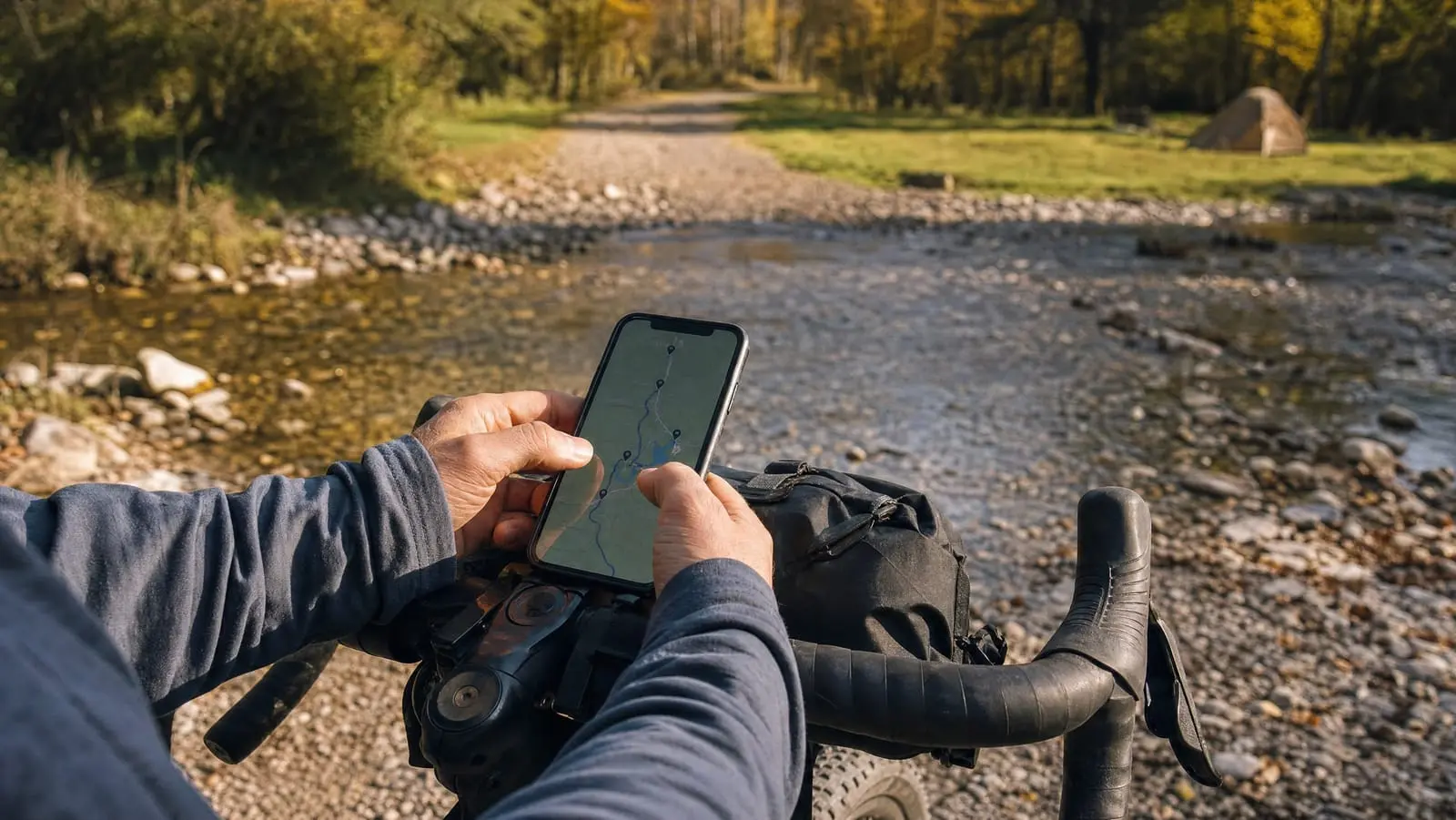
Smartphone navigation uses apps like Ride with GPS, Komoot, or Gaia. Phones offer better screens, easier route planning, and no additional device to carry. Battery life and durability remain concerns.
Many bikepackers use phones as primary navigation with a power bank for recharging. Carry paper maps or downloaded offline maps as backup—electronics fail at inconvenient moments.
For dedicated device recommendations, see our guides to GPS and Navigation Devices and Best Cycling Computers for Bikepacking.
Lighting
Nights come regardless of your plans. Proper lights let you ride safely after dark and handle camp tasks without fumbling.
Headlights illuminate the trail ahead. For night riding, 500+ lumens provides adequate visibility at moderate speeds. Higher output helps on fast descents. Runtime matters as much as brightness—check specs carefully.
Taillights make you visible to traffic. Essential for any riding on or near roads.
Headlamps handle camp tasks hands-free. A lightweight headlamp weighing just a few ounces works for cooking, organizing gear, and midnight nature calls.
For lighting recommendations, see our Best Bike Lights for Overnight Bikepacking guide. Planning to ride after dark? Don't miss our Night Riding on Bikepacking Trips safety guide.
Satellite Communicators
In areas without cell coverage, satellite communicators provide emergency contact and location sharing. Devices like the Garmin inReach send messages via satellite and include SOS functions for genuine emergencies.
They add cost and subscription fees but provide genuine peace of mind on remote routes. Worth serious consideration for solo bikepackers or trips far from help.
Safety & Emergency: Preparing for Problems
Most bikepacking trips proceed without incident. Preparation for incidents that do occur makes the difference between minor inconvenience and serious emergency.
First Aid Essentials
A minimal first aid kit handles common bikepacking injuries:
- Adhesive bandages (various sizes)
- Gauze pads and medical tape
- Antiseptic wipes
- Blister treatment (moleskin or similar)
- Pain relievers (ibuprofen, acetaminophen)
- Personal medications
- Tweezers for splinter removal
- Any allergy medications you require
Customize to your needs and route remoteness. Wilderness first aid training adds skills that no kit can replace. For specific product recommendations, see our First Aid Kits for Bikepackers guide.
Emergency Shelter
Conditions change faster than forecasts predict. An emergency bivy or space blanket weighs almost nothing and can save your life if weather turns severe or injury prevents reaching your intended camp.
The best emergency shelter is one you never need but always carry.
Communication Devices
Cell phones provide emergency contact in coverage areas. Check coverage maps for your route—gaps may be larger than expected.
Satellite communicators work where phones don't. They're worth their weight for remote routes.
Tell someone your plans. Detailed itineraries with expected check-in times provide backup if all electronics fail.
For comprehensive emergency preparedness, see our Emergency Gear Every Bikepacker Should Carry guide.
Wildlife Considerations
Know what animals inhabit your route and how to interact safely:
Bears require proper food storage. Bear canisters are mandatory in some areas, advisable in many others. Never store food in your tent.
Mountain lions and other predators rarely bother bikepackers but exist. Know appropriate responses for your region.
Insects (mosquitoes, ticks) matter more practically than large animals. Insect repellent, permethrin-treated clothing, and bite awareness prevent disease transmission.
Building Your Kit: Practical Considerations
Start Minimal, Add as Needed
First-time bikepackers often overpack dramatically. Every item not used represents weight hauled unnecessarily for entire routes. (Overpacking is just one of the 10 bikepacking mistakes that ruin trips—learn from others' errors before making your own.)
Start with the minimum viable kit. Test it on a short overnighter close to home. Note what you actually needed versus what you brought "just in case." Adjust for the next trip.
This iterative approach builds a personalized kit faster than buying everything on recommendation lists.
What Does a Real Kit Weigh?
As CyclingAbout's detailed breakdown demonstrates, a complete two-week self-supported setup can weigh under 10kg. Their example:
- Bags: ~1kg (frame bag, handlebar pack, seat pack)
- Tools/Spares/Essentials: ~760g (phone, wallet, pump, multitool, spare tube, helmet)
- Sleep System: ~1.5kg (tent, sleeping bag, pad)
- Cooking: ~400g (stove, pot, utensil)
- Clothing: ~1.5kg (riding kit, camp clothes, rain gear)
- Electronics: ~500g (power bank, cables, lights)
This isn't ultralight minimalism—it's thoughtful packing. The key insight: most beginners carry 15-20kg because they pack for contingencies that never happen. Experienced riders pack for what they'll actually use.
Test Everything Before You Leave
As REI's experts emphasize: "You should never find out how any of your gear works, especially camping gear, for the first time on the first night of your trip."
This means:
- Set up your tent at home. Know where every pole goes. Practice in the dark.
- Sleep in your sleeping bag to verify temperature ratings match your body.
- Cook a meal with your stove system before the trip.
- Load and ride your fully packed bike before committing to a remote route.
Problems discovered at home are minor inconveniences. Problems discovered 30 miles from the nearest road become trip-ending emergencies.
Budget Considerations
Quality bikepacking gear costs real money. Fortunately, you don't need everything at once.
Start with what you have. Your existing bike probably works. Your camping gear handles initial trips even if suboptimal. Upgrade strategically based on actual needs revealed by experience.
Invest in sleep quality first. A good sleeping bag and pad matter more than ultralight anything else. Poor sleep ruins trips regardless of how light your pack.
Bags second, shelter third. Good bags last for years and improve every ride. Shelter upgrades wait until you know your preferences.
Weight vs. Comfort Tradeoffs
Ultralight obsession misses the point for most bikepackers. Yes, lighter is easier. But comfort during non-riding hours affects trip enjoyment more than most riders expect.
A slightly heavier sleeping pad that you actually rest on beats a minimalist pad that leaves you tossing. A few extra grams of shelter luxury means nothing on the trail but everything in a storm.
Find your personal balance. Weigh gear to understand where weight lives. Cut where reduction costs nothing in comfort. Accept weight where comfort matters.
Seasonal Adjustments
The same kit doesn't work year-round. Build adaptable systems:
Summer: Lighter sleep systems, minimal layers, high sun protection, maximum water capacity.
Shoulder seasons: Warmer sleep systems, more insulating layers, rain gear on every ride.
Winter: Cold-weather-specific sleeping bags, serious insulation, extended battery management, shorter days with more lighting needs.
Seasonal swaps needn't mean entirely new kits. Strategic additions and substitutions extend core gear across conditions.
FAQ
How much gear weight is too much?
There's no universal limit, but handling suffers noticeably when total gear weight exceeds about 15-20% of your body weight. More practically: if your bike handles poorly on terrain you'd normally ride easily, you're carrying too much. Start lighter than you think necessary and add based on experience.
Can I use my existing camping gear?
Yes, with caveats. Backpacking gear generally works fine—it's already optimized for weight and pack size. Car camping gear typically weighs too much and packs too large. Use what you have for initial trips, then upgrade based on what proves inadequate.
What's the minimum viable kit for an overnight?
Bike, basic bag setup, shelter, sleep system, water, food, minimal tools. You can overnighter with surprisingly little. A frame bag holding essentials plus a sleeping pad and quilt strapped somewhere works for mild-weather micro-adventures close to home.
How do I waterproof everything?
Assume your bags will eventually leak. Use dry bags inside non-waterproof bags. Pack items in plastic bags as extra insurance. Keep electronics in waterproof cases. Dry bags for sleeping items are non-negotiable regardless of outer bag claims.
Should I buy everything at once?
No. Buy the minimum to start riding. Experience teaches what matters for your preferences and routes far better than equipment reviews. Staged purchasing also spreads cost and lets you catch sales on items you've confirmed you want.
What gear should I prioritize upgrading first?
Sleep system first (bag and pad), bags second, shelter third. These three categories affect every trip most directly. Beyond that, prioritize whatever limits your enjoyment most. Comfort problems while riding? Address the contact points (saddle, bars, shoes). Navigation problems? Upgrade electronics. Customize to your experience.
How do I know if my bike works for bikepacking?
If it fits bikepacking bags (most do), clears appropriate tires for your routes, and you can ride it loaded without handling nightmares, it works. Perfect optimization comes later if at all. Bike marketing creates far more upgradeitis than actual need requires.
Does expensive gear make that much difference?
Sometimes. A $400 sleeping bag genuinely outperforms a $150 one in weight, pack size, and durability. But a $150 bag works fine for most conditions. Diminishing returns kick in quickly. Spend where performance gaps are real; save where marketing exaggerates differences.
The Bigger Picture
Gear enables adventures. It doesn't create them.
The perfect kit doesn't make a trip memorable—the route, the experiences, the unexpected moments do. We've all met bikepackers with budget setups having the time of their lives and gear obsessives missing the point entirely.
Get equipment that works reliably for your conditions. Test it before committing to remote routes. Then stop optimizing and start riding.
The trails are waiting.
Ready to start building your kit? Begin with our beginner's guide for first-trip essentials. Women bikepackers may want to check our Women's Bikepacking Complete Guide for gender-specific considerations. Or dive into specific gear categories using the linked guides throughout this article.