Emergency Gear Every Bikepacker Should Carry
20+ years testing gear in Colorado backcountry
Prepare for the Unexpected
Bikepacking takes you far from help. Roads end, cell coverage disappears, and you're left with whatever you carried. Most trips proceed without incident. But when things go wrong—weather turns, mechanical failure, injury, getting lost—the gear in your bags determines whether you wait it out safely or face genuine emergency.
Emergency gear isn't about paranoia. It's about freedom. Carrying the right essentials lets you venture further with confidence, knowing you can handle problems that arise.
This guide covers the emergency items every bikepacker should consider, organized by category and adjusted for trip type.
For first aid specifics, see our First Aid Kit Guide. For complete gear lists, check our Packing List.
Emergency Shelter
Why You Need It
Your tent might work fine. But if it's damaged, lost, or you're caught far from camp when conditions deteriorate, emergency shelter becomes critical.
Hypothermia can develop in surprisingly mild conditions—50°F with rain and wind is enough if you can't get warm and dry.
Emergency Bivy
An ultralight bivy weighs ounces and packs tiny. In emergency, it reflects body heat and blocks wind/rain.
Best options:
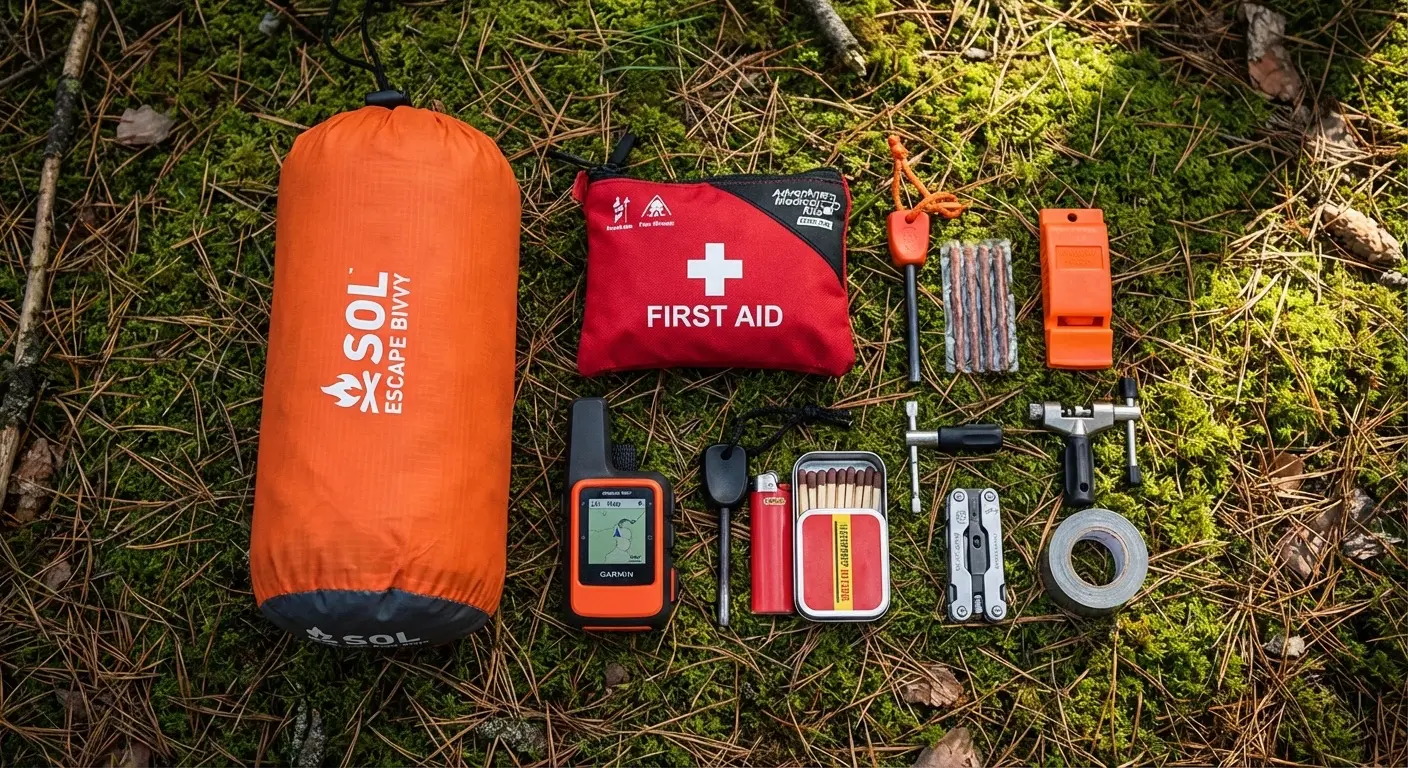
The SOL Escape Bivvy (8.5 oz) uses breathable fabric that reduces condensation while reflecting 70% of body heat. It's comfortable enough for planned use if your primary shelter fails.
The SOL Escape Lite (5.5 oz) is pure emergency weight—minimal comfort but genuine protection. The high-visibility orange aids rescue scenarios.
See our Bivys Guide for detailed coverage.
Emergency Blanket
Space blankets weigh almost nothing (~2 oz) and provide basic wind/heat reflection. Less effective than bivys but better than nothing.
Use cases:
- Wrap around victim in injury scenarios
- Ground insulation supplement
- Improvised shelter with cord/tape
Fire Starting
Why Fire Matters
Fire provides:
- Warmth in emergency
- Signaling for rescue
- Water purification (boiling)
- Morale boost in survival situations
Minimum Fire Kit
Essential:
- Two lighters (Bic mini or similar)
- Waterproof matches as backup
Enhanced:
- Ferrocerium rod (spark in any conditions)
- Tinder (cotton balls with petroleum jelly, or commercial tinder)
Storage: Keep fire-starting items in waterproof container. A wet lighter is useless.
When Fire Isn't Appropriate
Many bikepacking areas prohibit fires. Know the rules for your route. In fire-prone regions, the ability to start fire creates responsibility not to.
Signaling and Communication
Cell Phone
Your phone is your primary communication device—when it works.
Optimizing phone for emergency:
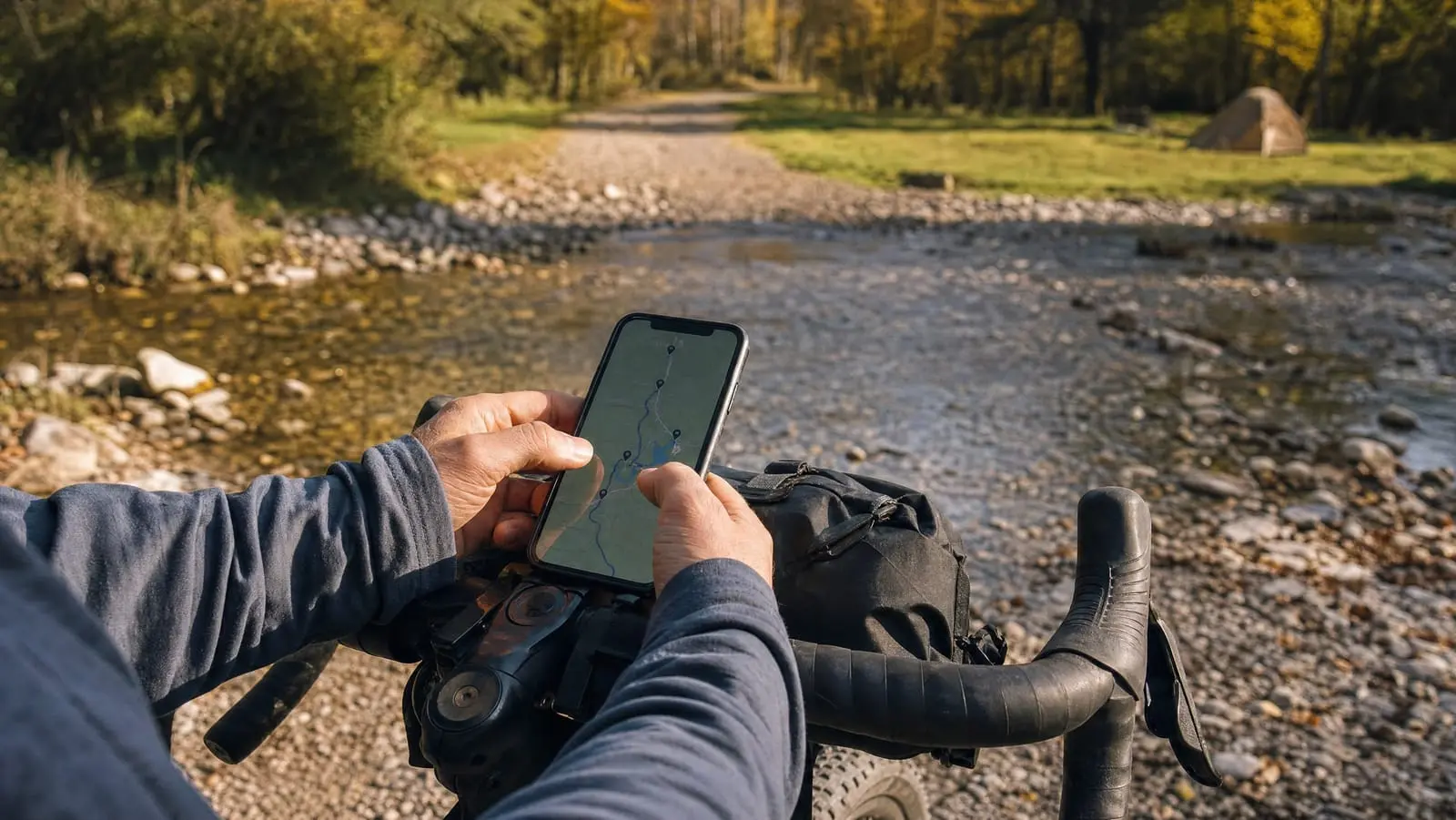
- Download offline maps before departure
- Know how to access emergency SOS features (newer iPhones have satellite SOS)
- Airplane mode extends battery dramatically
- Carry adequate power bank
- Waterproof case or bag
Limitations: No cell coverage in much of the backcountry. Phone alone isn't sufficient for remote routes.
Satellite Communicator
For serious remote travel, satellite communication provides coverage everywhere. Outdoor Gear Lab's communicator comparison provides detailed testing data.
Options:
Garmin inReach Mini 2: Two-way messaging, SOS with rescue coordination, location tracking. Requires subscription. Weighs 3.5 oz. The bikepacker's favorite.
Zoleo: Similar functionality, competitive subscription pricing.
SPOT devices: Simpler, one-way SOS and tracking. Lower subscription costs.
Personal Locator Beacon (PLB): Emergency-only (one button sends SOS with location). No subscription, but only for life-threatening emergencies. Battery lasts years.
Recommendation: For week-long remote trips, a satellite communicator is worth the cost. For weekends with cell coverage available, phone may suffice.
Low-Tech Signaling
Whistle: Three blasts is universal distress signal. Loud whistles carry further than shouting.
Mirror: Signal mirror can be seen for miles in daylight. Effective for attracting aircraft or distant searchers.
Bright colors: Emergency gear in orange/red aids visual detection.
Navigation Backup
When GPS Fails
Electronics fail. Batteries die. Screens crack. Having backup navigation prevents being genuinely lost.
Paper Maps
Carry paper maps covering your route area. They don't need batteries and work in any conditions.
Tips:
- Print relevant sections (full map unnecessary)
- Laminate or store in ziplock
- Learn basic map reading before you need it
Compass
Basic compass skills orient you when trail isn't obvious. Learn to:
- Take a bearing
- Follow a bearing
- Relate map to terrain
You don't need advanced navigation—just enough to find a road or known landmark.
Mental Map
Before each section, review the route mentally:
- Which direction is civilization?
- What major features would you hit walking in each direction?
- Where are the nearest roads?
Repair Beyond Basics
When Standard Kit Isn't Enough
Your normal repair kit handles expected issues. Emergency repair kit handles "get me out of here" situations.
Extended Repair Items
Derailleur hanger: Bike-specific part that bends or breaks easily. Without it, you can't use gears. Carry a spare.
Quick links: Chain breaks require master links. Carry 2-3 for your chain type.
Duct tape: Wrapped around pump handle or lighter. Fixes almost anything temporarily.
Zip ties: Various sizes. Structural repairs, cable routing, bag attachments.
Small wire: Bail wire for emergency repairs. Surprisingly useful.
Spoke: Taped to frame or in bag. Broken spoke replacement prevents wheel failure.
For standard repair items, see our Multi-Tool Guide. For creative improvised repairs when standard tools aren't enough, see our Emergency Field Repairs and Complete Bikepacking Maintenance Guide.
The Walk-Out Strategy
Sometimes bikes can't be ridden. Know that you can:
- Walk to nearest road/town
- Call for pickup
- Have bike transported for repair
Bike shoes walk poorly. Consider route difficulty when choosing footwear.
Water Emergency
Water Backup
Your main water filtration may fail. Backup options:
Water purification tablets: Ultralight, reliable backup. Aquatabs or Katadyn Micropur.
Boiling: If you have stove fuel and time, boiling purifies water. One minute of rolling boil (3 minutes at altitude).
Carrying Extra Capacity
Collapsible water containers: Platypus bags or similar expand carrying capacity for dry sections.
Know water sources: Review route for water before each section. Don't pass reliable water without topping up in uncertain terrain.
First Aid Emergency Items
Beyond your standard first aid kit:
Serious Injury Preparation
SAM splint: Moldable splint for fractures. Lightweight aluminum and foam.
Wound closure strips: Steri-strips for closing cuts too large for bandages.
Tourniquet: For severe bleeding emergencies. Learn proper use before needing it.
Medical Knowledge
Equipment without knowledge has limited value. Consider:
- Wilderness First Aid course: 16 hours covering backcountry medical scenarios
- Online tutorials: YouTube has excellent first aid instruction
- Practice: Review scenarios mentally before trips
Clothing Emergency
Unexpected Cold
Hypothermia occurs when you can't generate heat faster than you lose it. Emergency clothing items:
Puffy jacket: If not already in your kit, add one. Down or synthetic, compressible.
Emergency bivy: Mentioned above—reflects body heat.
Dry base layer: Stored separately, guaranteed dry for emergencies.
Warm hat: Major heat loss through head. Carry always.
Wet Weather
Rain jacket: Should be standard kit. If not, add it.
Dry bag for clothing: Keeping one set of clothes definitely dry matters.
See our Clothing Guide for complete recommendations.
Emergency Kit by Trip Type
Overnighters (Close to Roads)
Essential:
- Cell phone (charged)
- Lighter
- Emergency blanket or small bivy
- Whistle
Nice to have:
- Backup battery
- Paper map of area
Multi-Day (Remote Sections)
Essential (all of the above, plus):
- Full emergency bivy
- Satellite communicator OR definite bail-out plan
- Water purification backup
- Extended repair kit
- Fire starting kit
Expedition (Truly Remote)
Essential (all of the above, plus):
- Satellite communicator with SOS
- SAM splint and advanced first aid
- Multiple fire-starting methods
- Multi-day food reserve
- Knowledge and confidence in self-rescue
The Emergency Mindset
Prevention First
Most emergencies are preventable:
- Check weather obsessively before and during trips
- Don't overextend distance or difficulty
- Tell someone your itinerary and check-in schedule
- Turn back when conditions or feelings suggest problems
Decision Framework
When things go wrong, ask:
- Is anyone injured? (First aid priority)
- Are we in immediate danger? (Move if necessary)
- Can we solve this and continue? (Assess repair/workaround)
- Do we need help? (Communicate if necessary)
- What's our best route to safety? (Plan next steps)
The First 10 Minutes Matter Most
Emergency response research shows that how you handle the first 10 minutes often determines outcomes. Here's what experienced bikepackers do:
Minutes 1-3: Stop and Assess
- Find safe location (off trail/road if possible)
- Take three deep breaths (reduces panic hormones)
- Quick body scan for injuries you haven't noticed
Minutes 3-5: Gather Information
- Where exactly are you? (Check GPS, note landmarks)
- What resources do you have? (Water, food, shelter, communication)
- What's the weather doing? (Deteriorating or improving?)
Minutes 5-10: Make One Decision
- Choose: wait, self-rescue, or call for help
- Commit to the decision (wavering wastes time)
- Begin executing
The goal isn't perfect decisions—it's avoiding panic-driven mistakes. Having a mental framework prevents paralysis.
Stay Calm
Panic makes everything worse. Emergency gear buys time. Time allows thinking. Thinking solves problems.
Weight Considerations
The Weight-Safety Trade
Emergency gear adds weight you hope never to use. Finding the right balance:
Non-negotiable: Fire starting, emergency shelter, first aid basics, communication capability.
Adjust for conditions: Remote routes need more; day trips from town need less.
Shared in groups: Some items can be shared if traveling with partners.
Sample Emergency Kit Weights
Minimal (weekends): ~8 oz
- Emergency blanket (2 oz)
- Lighter x2 (1 oz)
- Whistle (0.5 oz)
- First aid basics (3 oz)
- Zip ties/tape (1 oz)
Standard (multi-day): ~24 oz
- SOL Escape Lite (5.5 oz)
- Fire kit (2 oz)
- First aid kit (6 oz)
- Repair extras (4 oz)
- Water tablets (1 oz)
- Navigation backup (2 oz)
- Signaling items (1 oz)
Extended (expedition): ~40+ oz
- Full bivy (8-10 oz)
- Satellite communicator (3.5 oz)
- Comprehensive first aid (10 oz)
- Full repair kit (8 oz)
- Multiple water methods (4 oz)
- Extended fire kit (3 oz)
FAQ
Do I really need a satellite communicator?
For remote routes where help may be hours or days away, yes. For weekend trips with cell coverage, probably not. Assess your specific routes.
How often do people actually need emergency gear?
Rarely. Most trips proceed without incident. But the consequences of needing gear you don't have are severe. Insurance you hope never to use.
What's the most important emergency item?
Knowledge. Gear is useless without understanding how to use it. Second most important: communication capability to summon help when self-rescue isn't possible.
Can I share emergency gear with a partner?
Some items (fire kit, repair parts, signaling). Others should be individual (personal first aid, emergency shelter—you may get separated).
Quick Checklist
Essential for every trip:
- Cell phone (charged, offline maps)
- Fire starting (2 lighters minimum)
- Emergency shelter (bivy or blanket)
- First aid basics
- Whistle
Add for remote trips:
- Satellite communicator
- Extended first aid
- Water backup
- Extended repair kit
- Paper maps
- Compass
Mindset:
- Someone knows your plan
- Bail-out options identified
- Weather reviewed
- Skills match route difficulty
Be Prepared, Ride Free
Emergency gear isn't pessimism—it's freedom. Knowing you can handle problems lets you venture further, attempt more, and explore with confidence.
Pack the essentials. Learn to use them. Then forget they're there until you need them.
For complete gear recommendations, see our Complete Bikepacking Gear Guide. For trip planning that minimizes risk, check our First Trip Planning Guide.
Prepare well. Adventure boldly.