Managing Fear and Anxiety on Bikepacking Trips
20+ years testing gear in Colorado backcountry
Fear Is Normal—Letting It Control You Isn't
This article contains affiliate links. We may earn a commission if you make a purchase through our links, at no extra cost to you.
When I started the TransAmerica Bike Race, I was terrified. I had no idea what I was doing. I was worried about everything: bears, drivers, my own body, my mental capacity to handle the challenge, and my equipment. My eagerness for the adventure was fortunately stronger than my fear, but my catastrophizing brain was definitely in full activation.
That confession comes from an experienced ultra-distance cyclist—someone who finished the race despite those fears. Her story illustrates a crucial truth: fear is universal among bikepackers. The difference between those who complete their trips and those who quit early isn't the absence of fear—it's the ability to manage it.
This guide covers the specific fears that plague bikepackers, why they occur, and practical strategies for keeping anxiety at productive levels rather than trip-ending ones. For the broader mental framework, see the Complete Mental Resilience Guide.
Understanding Bikepacking Anxiety
Pre-Trip vs. On-Trail Fear
One of the most consistent patterns in bikepacking: anxiety peaks before departure, not during the trip.
"Most fears occur leading up to the ride rather than during it. Once I'm on my bike, I know what to do. My body knows what it needs."
This happens because anticipatory anxiety is about imagination. Your brain, trying to protect you, generates every possible disaster scenario. These scenarios feel real but lack the details that real situations provide.
Once you're moving, abstract fears become concrete problems. And concrete problems have solutions. "What if something goes wrong?" transforms into "This specific thing happened—here's how I'm handling it."
Practical implication: High pre-trip anxiety doesn't predict trip failure. Expect it as normal. Notice it. Don't let it convince you to cancel.
The Categories of Fear
Bikepacking fears cluster predictably:
Environmental fears:
- Wildlife encounters (bears, snakes, aggressive dogs)
- Weather extremes
- Getting lost
- Terrain hazards
Human threats:
- Strangers with bad intentions
- Traffic dangers
- Judgment from others
- Being seen as incompetent
Physical fears:
- Injury far from help
- Equipment failure
- Not being fit enough
- Pain and discomfort
Psychological fears:
- Being alone with your thoughts
- Losing motivation
- Discovering you can't handle it
- The unknown itself
Most riders have several of these active simultaneously. Naming your specific fears—"I'm worried about bears and about not being fit enough"—is more useful than vague dread.
Fear Before You Leave
The Week Before Departure
Anxiety typically intensifies as departure approaches. Your mind, given proximity to the unknown, generates increasing warnings.
Common thought patterns:
- "What am I thinking? I'm not ready for this."
- "I haven't trained enough."
- "Something is definitely going to go wrong."
- "Maybe I should wait and do this another time."
What to recognize: These thoughts are your brain's attempt at protection, not accurate assessments of your preparedness. People with these exact thoughts complete challenging trips every day.
What helps:
- Write down specific fears rather than letting them swirl
- For each fear, identify one concrete preparation or mitigation
- Talk to someone who has done similar trips
- Remember: the feeling of unreadiness is nearly universal
The Night Before
Sleep often suffers before big trips. Lying awake catastrophizing is normal—unpleasant but not predictive of trip failure.
What experienced riders say:
"What I've learnt about myself is that I just have to push through. I know that I'll sleep poorly the night before something big, I'll struggle to eat beforehand, but as soon as I get on my bike at the beginning of the event, I'll feel fine. So I force myself to keep going and I know that I'll be okay once the event begins."
Strategies for the pre-trip night:
- Accept that sleep may be poor; don't add anxiety about not sleeping
- Avoid screens for an hour before bed
- Use guided relaxation or meditation apps
- Have everything packed so nothing remains to remember
- Remind yourself: many successful trips start after poor sleep
Fear on the Trail
When Anxiety Spikes
Certain situations reliably trigger fear:
Approaching darkness: "I was most anxious about where to sleep on my first trip, but every morning I would wake up and feel silly for having been stressed the night before. Darkness does funny things to your fear factor."
The transition from daylight to darkness activates primal fear responses. This is evolutionary, not irrational. See Night Riding Psychology for detailed strategies.
Unfamiliar terrain: New environments lack the familiarity that creates comfort. Your brain can't predict what comes next, so it assumes danger.
Physical low points: When you're exhausted, hungry, or in pain, your capacity to manage fear decreases. Many anxiety spirals are actually blood sugar crashes in disguise.
Unexpected problems: A flat tire isn't scary on a familiar road. The same flat in remote terrain at dusk feels different. Context transforms ordinary challenges into fear triggers.
In-the-Moment Strategies
The STOP protocol:
- Stop what you're doing—don't make decisions while panicking
- Take deep breaths (4 counts in, 6 counts out)
- Observe: What's actually happening vs. what you're imagining?
- Proceed with intention, not reaction
The grounding technique: When anxiety spirals, anchor attention to physical reality:
- Name 5 things you can see
- Name 4 things you can hear
- Name 3 things you can feel
- Name 2 things you can smell
- Name 1 thing you can taste
This interrupts catastrophizing by forcing attention to present sensory reality.
The fear question: Ask yourself: "What's the actual evidence of danger right now?"
Usually, the honest answer is "none" or "very little." Your brain is generating possibility scenarios, not responding to present threat. Recognizing this doesn't eliminate fear but reduces its authority.
Specific Fear Strategies
Wildlife Encounters
Bear anxiety is probably the most common specific fear among North American bikepackers.
Reframe the statistics: Bear attacks on bikepackers are extraordinarily rare. You're far more likely to be injured by poor bike handling than by wildlife. This doesn't mean ignore precautions—it means calibrate concern appropriately.
Take practical steps:
- Learn proper food storage methods
- Carry bear spray in easy reach (not buried in bags)
- Make noise on trail to avoid surprising animals
- Know what to do in actual encounters (different for different species)
Distinguish fear from danger: Having bear spray accessible and knowing procedures means you've done what's controllable. Additional worry doesn't add protection.
Fear of Traffic
Vehicle danger is a more statistically significant risk than wildlife. Healthy respect for traffic is rational; debilitating terror makes you ride worse.
Risk reduction:
- Choose routes with lower traffic
- Ride during low-traffic times
- Use high-visibility lights and clothing
- Take the lane when appropriate
- Maintain predictable road position
Anxiety management:
- Accept the residual risk you cannot eliminate
- Notice that most vehicles pass safely
- Don't interpret close passes as evidence of impending disaster
Fear of Getting Lost
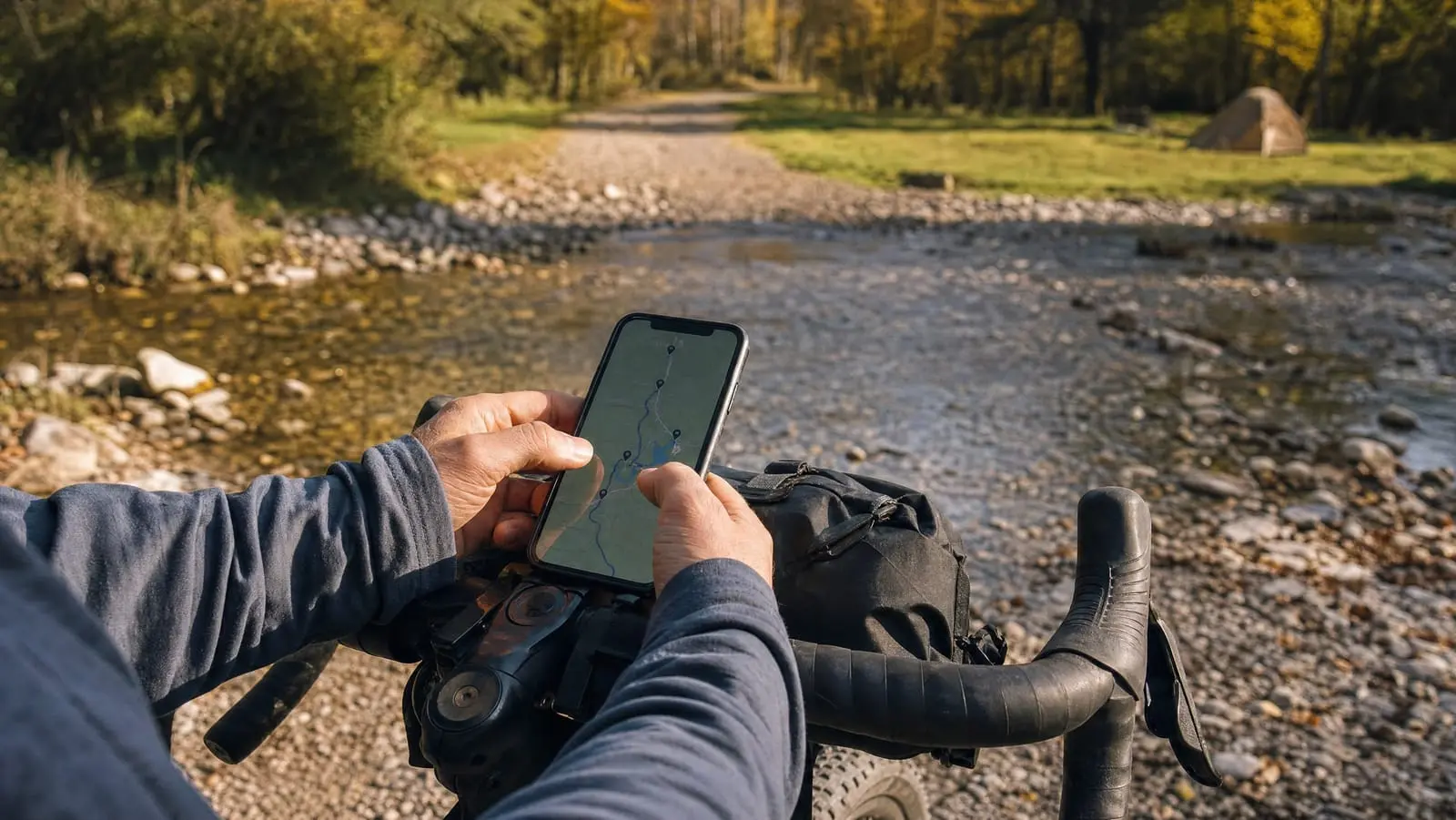
Navigation anxiety afflicts many new bikepackers. Modern GPS devices reduce this significantly, but don't eliminate it.
Preparation:
- Download offline maps for entire route
- Carry backup navigation (paper maps, compass)
- Study the route well enough to recognize landmarks
- Know how to recover if you go off-route
Mindset shift: "Getting lost" is rarely catastrophic. More often, it means riding extra miles or backtracking—inconvenient but manageable. Very few navigation errors create genuine danger.
Fear of Equipment Failure
Mechanical problems feel more threatening in remote areas. The fear is often worse than the reality.
Preparation:
- Master essential repairs before departure
- Carry appropriate tools and spares
- Know your gear's failure points and backup options
- Have a plan for true emergencies (satellite messenger, bail routes)
Perspective: Most breakdowns have field fixes. Those that don't usually allow hiking or hitching to assistance. Total stranding with no options is rare on developed routes.
The Stoic Framework for Cyclists
Stoic philosophy offers one of the most useful mental frameworks for managing fear: focus only on what you control, accept what you cannot.
What You Control
- Your preparation and gear choices
- Your route selection and timing decisions
- Your response to situations
- Your attitude toward difficulty
- Whether and when you seek help
What You Cannot Control
- Weather
- Traffic behavior
- Wildlife decisions
- Mechanical fate
- Other people's actions
The Stoic practice:
When fear arises, ask: "Is this about something I control?"
If yes—take action. Worry translated into preparation reduces fear productively.
If no—acknowledge the concern, then release it. Additional rumination adds nothing useful.
This doesn't mean ignoring danger. It means directing mental energy appropriately—toward what you can affect rather than spinning on what you can't.
When Fear Is Right
Not all fear should be overridden. Sometimes your nervous system correctly identifies genuine danger.
Trust Your Fear When:
Objective danger is present:
- Aggressive animal actually approaching
- Severe weather actually developing
- Actual injury requiring attention
- Terrain actually beyond your skill
Your gut strongly signals: Some experienced bikepackers describe moments when "something felt wrong" without clear evidence—and they later learned they were right. These intuitions deserve respect.
Continuing requires risks beyond your ability: Fear that accurately reflects a mismatch between conditions and competence is protective.
Question Your Fear When:
The danger is entirely imagined: No actual evidence of threat—just your mind generating scenarios.
The same fear recurs without consequence: If you've feared bears for ten trips and never had an encounter, update your probability assessment.
You've handled similar situations before: Memory of prior success is evidence against current catastrophe.
The fear arrived suddenly without triggering event: Often this signals physiological dysregulation (blood sugar, exhaustion) rather than environmental danger.
When Anxiety Becomes Unhealthy
For most bikepackers, fear is manageable—uncomfortable but not destructive. For some, it signals something requiring more attention.
Warning Signs
Cycling used to avoid life problems: "Some people seek out physically difficult activities because they distract from painful internal thoughts. Not only can this behavior create physical risks, but biking can also enable people to force emerging feelings back down where they continue to create self-doubt."
If you're using trips to escape rather than experience, the underlying issues usually follow you.
Fear increasing despite experience: Normal pattern: fear decreases as experience accumulates. Opposite pattern—more fear with more trips—suggests something beyond standard anxiety.
Intrusive thoughts on rides: "What was once a sacred space became something I feared because it meant being alone with myself and my thoughts."
If rides have become psychologically torturous rather than challenging-but-rewarding, that's worth exploring.
Life disruption: When bikepacking anxiety affects daily life—sleep, work, relationships—beyond trip planning periods, professional support may help.
Seeking Help
Anxiety disorders respond well to treatment. Cognitive-behavioral therapy specifically targets the thought patterns that fuel excessive fear. Medication helps some people. Neither is weakness—both are practical tools.
If your fear seems disproportionate, persistent, or life-affecting, consult a mental health professional. Many specialize in performance anxiety or adventure sports psychology.
Building Fear Tolerance
Like physical endurance, fear tolerance develops through graduated exposure. You cannot think your way to courage—you must experience it.
Progressive Exposure Protocol
Level 1: Mild discomfort Ride in conditions slightly outside comfort (light rain, unfamiliar route, alone for a few hours). Experience the discomfort not being catastrophic.
Level 2: Moderate challenge Overnight in conditions you've feared (solo camping, remote area, weather uncertainty). Survive the night. Notice that survival was possible.
Level 3: Significant stretch Multi-day trip with real consequences. Encounter problems without easy exit. Develop confidence through forced competence.
Level 4: Full exposure The trip you've been afraid of. By now, you have accumulated evidence that you can handle difficulty. The fear won't disappear—but it won't control you.
After Each Exposure
Reflect consciously:
- What did I fear would happen?
- What actually happened?
- What did I learn about my capability?
- What would I do differently?
This reflection cements the learning that fear exaggerates danger. Over time, your nervous system updates its threat assessment.
Living With Fear
The goal isn't eliminating fear. Fear-free bikepackers don't exist—or they're dangerously oblivious to real risks. The goal is productive relationship with fear, where it informs without controlling.
Experienced bikepackers still feel fear. They've just learned that fear is survivable, that most worried-about scenarios don't occur, and that the ones that do are usually manageable. They've built confidence not through fearlessness but through fear successfully endured.
One rider captured this well: "It's often the fear, rather than reality, that stops people. Just get out there and do it—it's the only way to show yourself that bikepacking is not as scary as you think!"
The fear doesn't disappear on the other side. But something better happens: you discover you can ride anyway.
For more on mental challenges, see the Complete Mental Resilience Guide.