Building Mental Toughness Before Your First Bikepacking Expedition
20+ years testing gear in Colorado backcountry
The Mind Trains Like the Body
This article contains affiliate links. We may earn a commission if you make a purchase through our links, at no extra cost to you.
There is no way to truly "prepare" for mental challenges other than to be aware that your bikepacking trip will likely be harder than you imagine. Set expectations about the journey, plan for flexibility in the route, and always have a back-up plan if things go south.
Here's what most bikepacking preparation guides miss: you can't just train your legs and expect your mind to follow. Mental toughness—the ability to maintain focus, manage discomfort, and make good decisions under stress—requires specific training just like physical fitness does.
The good news is that mental toughness is trainable. It's not a fixed personality trait; it's a collection of skills that develop through deliberate practice. Every challenging training ride deposits resilience in your mental bank account, available when hard moments come on expedition.
This guide covers how to systematically build the psychological readiness that separates riders who complete challenging trips from those who quit early. For the broader mental framework, see the Complete Mental Resilience Guide.
Understanding Mental Toughness
What It Actually Is
Mental toughness isn't about ignoring pain or suppressing emotions. It's a set of specific capabilities:
Attention control: Directing focus where it's useful (the next pedal stroke) rather than where it's harmful (how much suffering remains).
Emotional regulation: Experiencing fear, frustration, and discomfort without letting them dictate behavior.
Distress tolerance: Continuing to function well enough when things aren't okay.
Cognitive flexibility: Adapting thinking and strategy when plans fail or conditions change.
Motivation maintenance: Sustaining effort toward goals even when immediate rewards are absent.
These skills develop through exposure and practice, not through willpower or personality change.
Why Training Rides Aren't Enough
Physical training creates physical adaptation. But mental adaptation requires deliberate practice—intentionally putting yourself in challenging psychological situations and working through them.
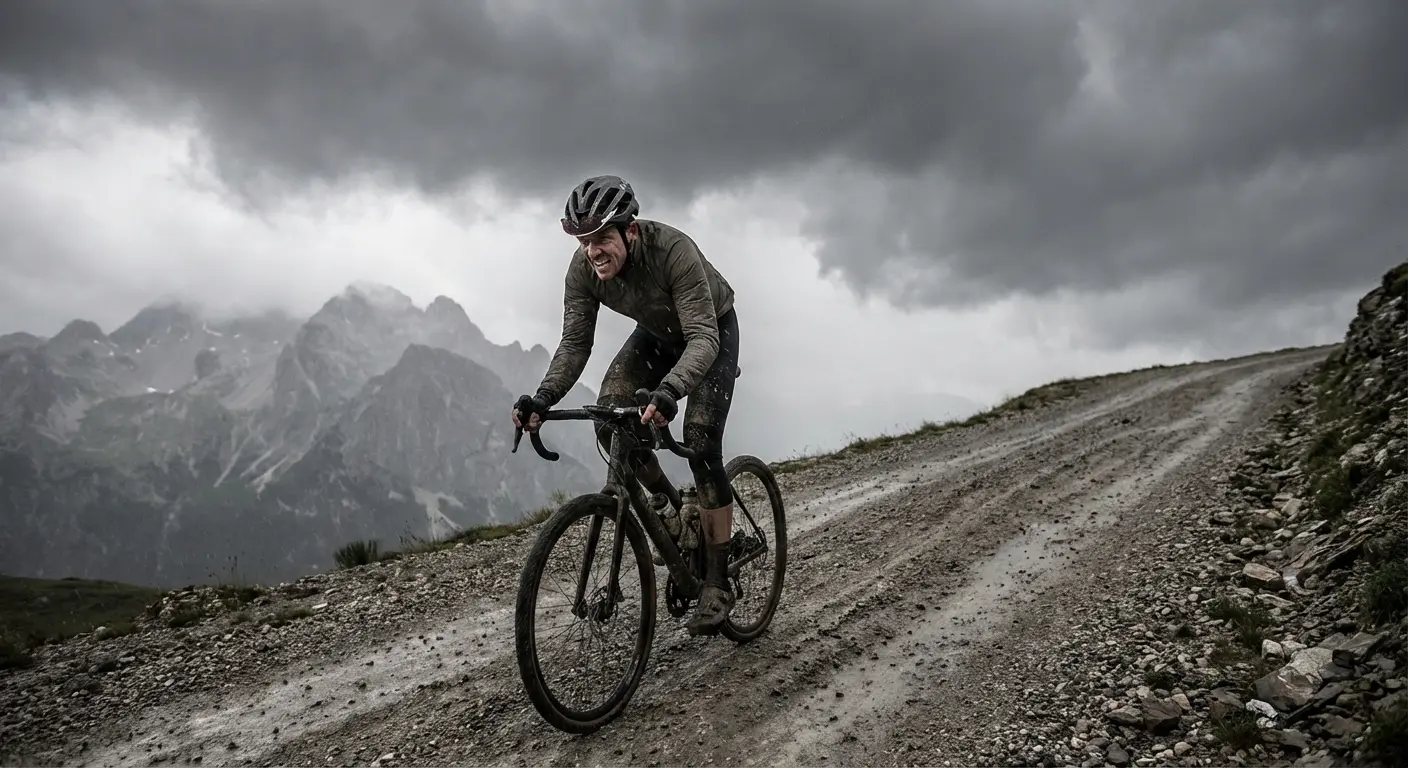
Riding 50 miles in perfect weather trains your legs. Riding 30 miles in rain you didn't expect trains your mind.
Most cyclists accumulate physical fitness while avoiding mental discomfort. Then they encounter psychological challenges on expedition that their training never addressed.
The Progressive Exposure Protocol
Building Block 1: Deliberate Discomfort
Principle: Controlled exposure to discomfort builds tolerance for uncontrolled discomfort.
Practices:
Weather training: Ride intentionally in uncomfortable conditions—light rain, cold mornings, heat. Not dangerous conditions, just unpleasant ones. The goal is learning that discomfort is survivable, not enjoyable.
Fasted training: Occasionally ride longer than comfortable without eating. Experience the mental effects of low energy. Learn to recognize and push through bonking sensations.
Uncomfortable time training: Ride very early or very late. Experience fatigue at unusual hours. Build tolerance for operating outside your comfort zone.
Extended effort: Push rides longer than you normally would. Experience what happens mentally when you're genuinely tired, not just exercise-tired.
Protocol: Start with one discomfort-training ride per week. Keep the challenge manageable—you're building tolerance, not traumatizing yourself. Gradually increase intensity as capacity grows.
Building Block 2: Uncertainty Practice
Principle: Bikepacking constantly presents unknowns. Practice handling uncertainty before it matters.
Practices:
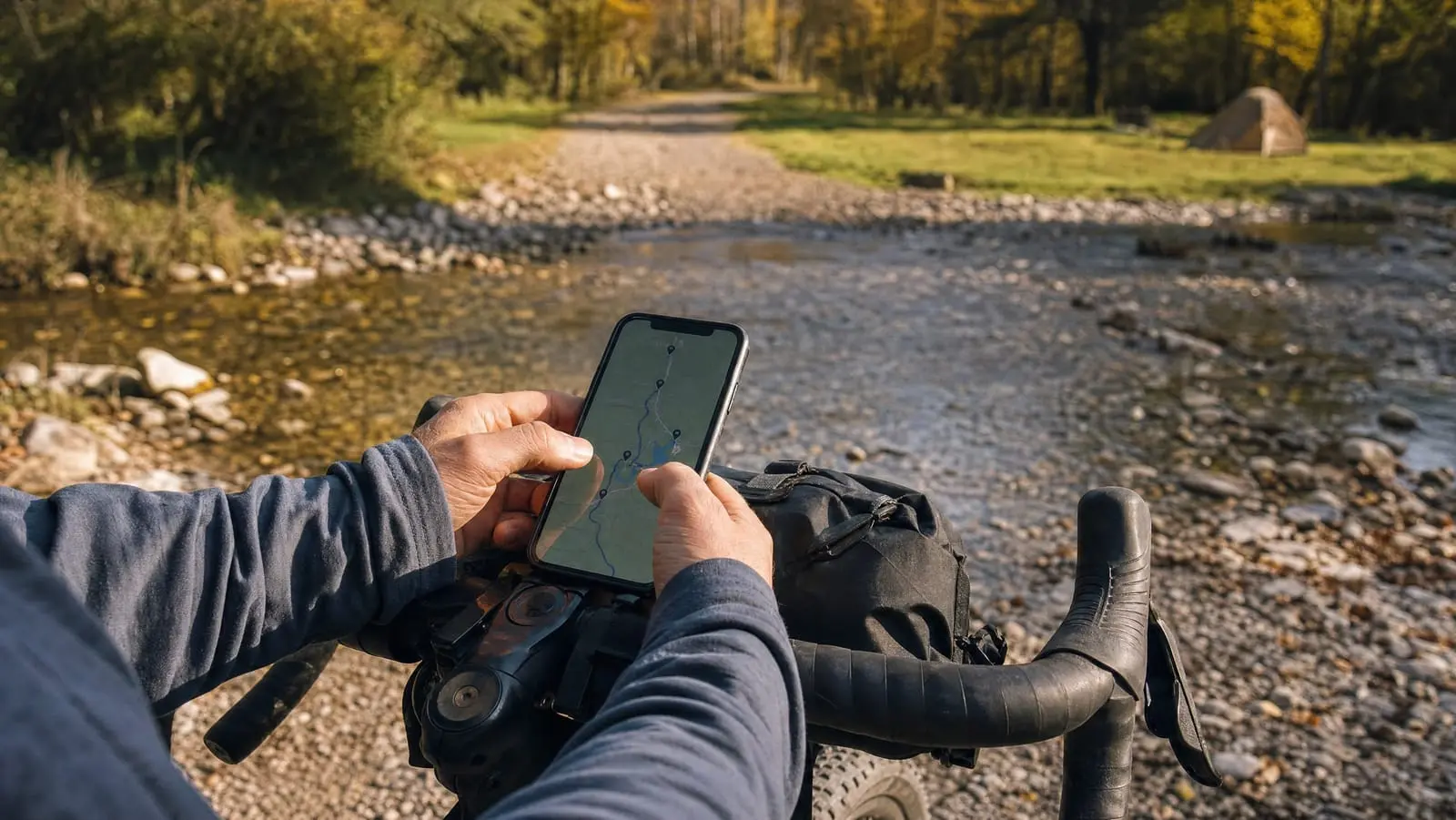
Navigation challenges: Ride unfamiliar routes with minimal preparation. Put your phone away and navigate by map or intuition. Get slightly lost and figure it out.
Plan abandonment: Set a plan, then deliberately change it mid-ride. Practice adapting rather than rigidly executing.
Gear reduction: Intentionally leave behind comfort items. Experience managing without your normal support.
Open-ended rides: Start without knowing exactly when you'll return. Ride until it feels right to stop. Practice making decisions without predetermined answers.
Protocol: Add uncertainty elements to one ride per week. Notice the anxiety that uncertainty creates. Practice tolerating it.
Building Block 3: Solo Practice
Principle: The psychological demands of solo riding are distinct from group riding. Train specifically for them.
Practices:
Solo day rides: Increasingly long rides with no one else. Experience the self-reliance, decision-making, and internal focus that solo travel requires.
Solo overnighters: Camp alone near home. Face the night fears and isolation in low-stakes conditions. A reliable headlamp builds confidence during evening camp setup.
Digital disconnection: Rides without phone (or with phone off and packed away). Experience what your mind does without constant connection option.
Extended solo periods: Gradually increase time alone. Start with hours; build to days.
Protocol: If you're preparing for solo bikepacking, ensure at least 30% of your training is genuinely solo. More is better.
Visualization Training
Why Visualization Works
Your brain can't fully distinguish between vividly imagined experiences and real ones. Visualization activates the same neural pathways as actual experience, making it a form of mental practice.
Elite athletes use visualization because research consistently shows it improves performance. You can apply the same techniques to bikepacking preparation.
Success Visualization Protocol
Daily practice (10 minutes):
- Find a quiet space. Close your eyes.
- Imagine arriving at camp after a successful day of riding.
- Include sensory details: the sound of your stove, the smell of food, the colors of sunset, the feeling of accomplishment.
- Feel the satisfaction of having done something hard.
- Hold this image for several minutes before opening your eyes.
This practice builds positive associations with bikepacking outcomes, counteracting the anxiety and negative anticipation that can accumulate before trips.
Challenge Visualization Protocol
Regular practice (5 minutes, 3-4 times per week):
- Choose a specific challenge you might face: a mechanical problem, navigation confusion, bad weather, fear at night.
- Visualize the situation in detail—where you are, what's happening, how it feels.
- Imagine yourself calmly handling it. See your hands doing the work. Feel your breathing stay steady.
- Visualize the problem resolved and the ride continuing.
This practice builds familiarity with challenging scenarios. When they happen in reality, they feel less foreign because your brain has already "experienced" them.
Worst-Case Acceptance
Once, thoroughly, before major trips:
- Imagine complete failure—whatever that means for your specific trip.
- Let yourself feel the disappointment, embarrassment, or other emotions.
- Notice: you would survive it. Life would continue. This trip is not the last trip.
- Notice that even worst-case outcomes are manageable, not catastrophic.
This practice reduces the fear of failure that can paradoxically cause failure. When you've already accepted the worst possibility, you can engage more freely with the challenge.
Building Your Mental Toolkit
Pre-Built Strategies
In crisis moments, you won't have bandwidth to invent solutions. Prepare specific strategies in advance:
Your mantra: A simple phrase for hard moments. "Just this mile." "I've done harder things." "One pedal stroke at a time." Choose something that resonates for you; practice using it in training.
Your physical anchor: A movement that resets your nervous system. Deep breaths. Shoulder shrugs. Face splash with water. Singing out loud. Identify what works for you.
Your thought interrupt: A phrase that stops spiral thinking. "That's the fear talking, not reality." "Thoughts aren't facts." "Come back to the present." Practice deploying this when anxious thoughts arise.
Your reward system: How you'll celebrate small wins. Special snack at mile markers. Favorite podcast after certain checkpoints. Music as a reward for completing hard sections. Built-in positive reinforcement.
Your exit criteria: Clear conditions under which you'll stop. Not emotional—specific and measurable. "If pain exceeds X for more than Y hours." "If I can't complete basic tasks due to fatigue." Pre-committed criteria prevent in-the-moment rationalization.
Write these down. Carry them on your trip. Review them when you need them.
The Pre-Trip Checklist
Before any significant trip, verify your mental preparation:
- Have I practiced discomfort in training?
- Have I handled uncertainty successfully?
- Am I comfortable being alone for the duration?
- Have I visualized both success and challenges?
- Do I have my toolkit strategies ready?
- Have I identified my support contacts?
- Do I know my exit criteria?
If gaps exist, address them before departure.
Training Through Experience
The Graduated Approach
Mental toughness builds progressively, like physical capacity:
Phase 1: Foundation (Months 1-2)
- Solo day rides with navigation challenges
- One overnight camp within easy bail distance
- Intentional discomfort rides (weather, timing)
- Daily visualization practice
Phase 2: Building (Months 3-4)
- Weekend overnighters in unfamiliar terrain
- Multiple environments (forest, exposed, varied)
- Deliberate getting-lost-and-navigating-out
- Increased solo time
Phase 3: Integration (Months 5-6)
- Multi-day route with real consequences
- 24-hour solo period with no digital contact
- Bad weather riding that tests gear and resolve
- Full dress rehearsal for target trip
Each phase deposits confidence for the next. Skipping phases usually backfires—confidence built on inadequate experience crumbles under pressure.
Learning from Every Ride
After challenging rides, reflect:
- What was hardest mentally?
- How did I handle it?
- What would I do differently?
- What did I learn about my capabilities?
This reflection converts experience into usable knowledge. Without it, you just have memories; with it, you have lessons. A dedicated cycling journal provides structure for capturing these insights.
Physical-Mental Connection
How Body Affects Mind
Your mental state is inseparable from your physical state:
Energy: "Your mood is often related to your energy level, which is normally determined by how much you've been eating recently. Being in a negative mood and lacking motivation is often a major sign that you need to eat more."
Low blood sugar produces anxious, pessimistic thinking. Many "mental" problems are actually nutrition problems.
Sleep: Sleep deprivation degrades emotional regulation, decision-making, and distress tolerance. One bad night tanks mental capacity.
Pain and discomfort: Physical discomfort consumes cognitive resources. Managing body issues frees mind for other challenges.
Fitness: Greater physical reserve means more margin before genuine distress. Well-trained riders face mental challenges from a position of strength.
Training Implications
Mental toughness training doesn't replace physical training—it complements it. The most mentally resilient bikepacker with inadequate fitness still fails. The fittest bikepacker with inadequate mental preparation still fails.
Both systems need development. Neglecting either creates vulnerability.
Stress Inoculation
The Concept
Stress inoculation exposes you to manageable stress levels to build resistance to future stress. Like vaccination, small doses prepare your system for larger challenges.
The key word is "manageable." Overwhelming stress traumatizes; appropriate stress builds capacity.
Application to Training
Identify your stress points: What aspects of bikepacking scare you most? Night camping? Navigation? Solo travel? Bad weather? Physical limits?
Create training scenarios: Design rides that specifically address those stress points—at lower intensity than the real thing.
Expose progressively: Start with minimal challenge. Increase gradually as you adapt.
Debrief thoroughly: After each exposure, process what happened. What was hard? What helped? What would you change?
Example: Night Fear Training
If night camping scares you:
- Camp in your backyard. Process the experience.
- Camp at a familiar, populated campground alone.
- Camp at a less familiar campground alone.
- Camp wild but near civilization.
- Camp wild in increasing remoteness.
Each successful night deposits confidence for the next. By trip time, you've done this many times in escalating conditions.
The Role of Community
Training Partners
While solo competence matters for solo trips, training with others provides benefits:
Accountability: Others help you follow through on challenging training plans you'd skip alone.
Modeling: Watching how experienced riders handle difficulty teaches strategies.
Feedback: Others notice things about your performance and responses you might miss.
Normalization: Hearing that others struggle with the same challenges reduces shame and isolation.
Mentorship
If possible, connect with experienced bikepackers willing to share knowledge:
Before trips: What should you expect? What would they do differently in retrospect? What do they wish they'd known?
After challenges: How do they interpret what happened? What perspective can they offer?
During difficulty: Who can you call when things go wrong? Having a specific person creates a safety net that enables risk-taking.
Managing Pre-Trip Anxiety
Why It's Normal
Anxiety before significant trips is nearly universal. Even experienced riders report pre-departure nerves. This is your brain's protective mechanism, not evidence of unpreparedness.
"What I've learnt about myself is that I just have to push through. I know that I'll sleep poorly the night before something big, I'll struggle to eat beforehand, but as soon as I get on my bike at the beginning of the event, I'll feel fine."
Normalizing Strategies
Accept the feeling: Don't fight it or interpret it as a problem. "I'm feeling anxious before my trip—this is normal and doesn't predict failure."
Maintain routine: Keep training, eating, and sleeping normally in the days before departure. Disrupting routine adds stress.
Limit information intake: Stop reading trip reports and gear reviews in the final days. Additional information often increases rather than decreases anxiety.
Visualize success: Counter anxious thoughts with deliberate positive visualization. Your brain will generate worst-case scenarios automatically; consciously generate best-case ones too.
Trust preparation: Remind yourself what you've done to prepare. The work is complete; now execute.
Long-Term Development
The Trajectory
Mental toughness develops over years, not weeks:
Year 1: Building foundation through beginner trips Year 2-3: Expanding capacity through progressively harder challenges Year 4+: Refining skills through varied experiences and continued learning
Each trip teaches something. Each challenge either strengthens capacity or reveals development needs. The trajectory is upward over time even when individual trips include setbacks.
Maintaining Progress
Mental fitness, like physical fitness, requires maintenance:
Continue training deliberately: Don't let mental skills atrophy during off-seasons or between major trips.
Pursue appropriate challenges: Stay in the zone between too easy (no growth) and too hard (trauma).
Reflect and integrate: Keep processing experiences rather than just accumulating them.
The Long View
The person you're becoming—more resilient, more capable, more self-aware—matters more than any single trip. Each challenge you face, whether you "succeed" or not, contributes to that person's development.
Mental toughness isn't about being tough. It's about being capable of meeting what comes, adapting when necessary, and growing through the process.
That's what you're building. That's what training provides.
For the broader mental framework, see the Complete Mental Resilience Guide.