Complete Mental Resilience Guide for Bikepackers: Build the Mind That Finishes
20+ years testing gear in Colorado backcountry
The Mind Ends More Trips Than the Body
Bike touring or bikepacking long distances isn't just a physical challenge—it's a mental marathon. As any seasoned tourer will tell you, the battle is often won or lost in the mind.
Here's what nobody tells beginners: most bikepackers who quit their trips early don't stop because of mechanical failure, bad weather, or physical exhaustion. They stop because something broke inside their head. The fear became too loud. The loneliness too heavy. The voice saying "just go home" too persuasive.
I've seen riders with elite fitness abandon expeditions on day three. I've watched first-timers with minimal training complete routes that would humble professionals. The difference isn't legs or lungs—it's what happens between the ears when everything goes wrong.
Mental resilience isn't about being tough or ignoring pain. It's about developing specific skills that help you navigate the psychological challenges unique to bikepacking: the isolation of solo travel, the anxiety of sleeping in unfamiliar places, the decision fatigue of constant problem-solving, and the dark moments when quitting seems like the only rational choice.
This guide covers the complete mental side of bikepacking—from preparing your mind before you leave to managing fear on trail to knowing when stopping is wisdom rather than weakness. Whether you're planning your first overnight adventure or training for an ultra-endurance race, understanding these mental frameworks will transform how you experience hard rides.
The good news: mental resilience is trainable. Like building saddle time or developing climbing strength, psychological toughness develops through deliberate practice and accumulated experience. You don't need to be born stoic or fearless. You need tools and the willingness to use them.
Understanding the Mental Challenges
Before solving problems, you need to understand them. Bikepacking presents a unique combination of psychological stressors that most riders underestimate until they're deep in a trip with no easy exit.
The Six Core Mental Challenges
| Challenge | When It Hits Hardest | Impact Level |
|---|---|---|
| Fear & Anxiety | Night camps, remote terrain, before trips | Critical |
| Loneliness | Days 3-7 of solo trips, bad weather | High |
| Decision Fatigue | Multi-day routes, complex navigation | High |
| Motivation Loss | Physical low points, monotonous terrain | High |
| Sleep Deprivation | Ultra events, uncomfortable camps | Moderate |
| Identity Disruption | Extended trips, return home | Moderate |
Each challenge requires different strategies. Treating all mental difficulty as "just push through" misses the nuance that makes interventions effective.
The Mood-Energy Connection
Your mental state is often a direct reflection of your physical state—particularly your energy levels. Low motivation and negative thinking frequently signal one thing: you need to eat.
According to research on ultra-distance cyclists, "Your mood is often related to your energy level, which is normally determined by how much you've been eating recently. Being in a negative mood and lacking motivation is often a major sign that you need to eat more."
Before assuming you're having a psychological crisis, check the basics:
- When did you last eat? (Often the answer reveals the problem)
- How much water have you had in the past two hours?
- When did you last take a real break?
- How many hours since you slept?
The nutrition fundamentals you learn for performance also apply to mental health. Your brain runs on glucose. Starve it, and it produces anxious, pessimistic thoughts as a survival mechanism to make you stop and eat.
Pre-Trip Anxiety vs. On-Trail Reality
One of the most consistent patterns in bikepacking: fears peak before the trip, not during it.
One experienced rider noted: "Most fears occur leading up to the ride rather than during it. Once I'm on my bike, I know what to do. My body knows what it needs."
This disconnect between anticipatory anxiety and actual experience happens because your imagination fills uncertainty with worst-case scenarios. Once you're moving, those abstract fears become concrete problems you can solve.
Understanding this pattern helps in two ways:
- Expect pre-trip anxiety as normal—it doesn't predict trip failure
- When fear spikes on trail, remember it usually passes once you start moving
Building Mental Toughness Before You Leave
Mental resilience training begins long before your bike is packed. The foundation you build at home determines how much psychological stress you can handle on remote trails.
Progressive Exposure Training
Mental strength builds the same way physical strength does: through progressive overload. Start with manageable challenges and systematically increase difficulty.
Month 1-2: Foundation
- Solo day rides with no phone navigation
- One overnight camp within 20 miles of home
- Intentional discomfort (ride in light rain, skip one meal)
Month 3-4: Building
- Weekend overnighters in unfamiliar terrain
- Camp in three different environments (forest, exposed, near water)
- One ride where you deliberately get a bit lost and navigate out
Month 5-6: Integration
- Multi-day route with real consequences for decisions
- Complete 24-hour period solo with no digital contact
- Bad weather ride that tests gear and resolve
Each experience deposits resilience in your mental bank account. When hard moments come on your expedition, you draw from accumulated confidence: "I've handled worse than this before."
Visualization Practice
Elite athletes use visualization because it works. Your brain can't fully distinguish between vividly imagined experiences and real ones, making mental rehearsal a form of training.
Pre-trip visualization protocol:
-
Success visualization (10 minutes daily for 2 weeks before departure)
- Close your eyes and imagine arriving at camp after a perfect day
- Include sensory details: the sound of your stove, the smell of food, the colors of sunset
- Feel the satisfaction of knowing you did something hard
-
Challenge visualization (5 minutes daily)
- Imagine a specific difficulty: flat tire in rain, navigation confusion, fear at night
- Visualize yourself calmly handling it—see your hands doing the work
- End with the problem solved and the ride continuing
-
Worst-case acceptance (once, thoroughly)
- Imagine failing completely—whatever that means to you
- Recognize you would survive it
- Notice that even worst-case outcomes are manageable
The goal isn't eliminating fear but building familiarity with challenging scenarios so they feel less foreign when they happen.
Creating Your Mental Toolkit
Assemble specific strategies before you need them. In crisis moments, you won't have the mental bandwidth to invent solutions—you need pre-loaded responses.
Your Personal Mental Toolkit should include:
- A mantra: Simple phrase you repeat when things get hard ("Just this mile," "I've done harder")
- A physical anchor: Movement that resets your state (deep breaths, stretching, face splash)
- A thought pattern interrupt: What you'll say to stop spiraling ("That's the fear talking, not reality")
- A reward system: How you'll celebrate small wins (special snack at mile markers, podcast at certain times)
- An exit criteria: Clear conditions under which you'll stop (not emotional—specific and measurable)
Write these down. Carry them. Read them when the dark moments come.
Managing Fear and Anxiety
Fear is the emotion that stops the most bikepacking trips. Unlike physical exhaustion, which usually resolves with rest, unmanaged fear compounds—each scary moment making the next worse until the entire trip feels threatening.
Understanding What You're Actually Afraid Of
Fear in bikepacking clusters around predictable themes:
Physical safety fears:
- Traffic and vehicles
- Wildlife encounters
- Injury in remote locations
- Severe weather exposure
Social fears:
- Strangers and their intentions
- Looking incompetent or lost
- Being judged for traveling alone
Performance fears:
- Not being fit enough
- Equipment failing
- Making wrong decisions
- Not finishing what you started
Existential fears:
- Being alone with your thoughts
- Facing parts of yourself you normally avoid
- Realizing limitations you'd rather not acknowledge
Naming your specific fears makes them smaller. The vague dread of "something bad happening" is more paralyzing than the specific concern of "encountering a flat tire far from services"—because specific fears have specific solutions.
The Stoic Framework for Cyclists
Stoic philosophy's core insight applies perfectly to bikepacking: focus only on what you can control, accept what you cannot.
What you CAN control:
- Your preparation and gear choices
- Your response to situations
- Your pace and rest decisions
- Your attitude toward difficulties
- Whether you ask for help
What you CANNOT control:
- Weather
- Other people's behavior
- Mechanical failures
- How hard the terrain actually is
- Whether wildlife appears
Energy spent worrying about uncontrollables is energy wasted. The Stoic cyclist prepares thoroughly for what might happen, then releases attachment to outcomes, focusing entirely on present-moment decisions.
When fear arises, ask: "Is this about something I can control?" If yes, take action. If no, acknowledge the fear and return attention to pedaling.
Fear of the Dark
Night anxiety is one of the most common fears among bikepackers, especially on first solo trips. Our brains evolved to treat darkness as dangerous, and that programming doesn't switch off just because we're carrying a headlamp.
Strategies for night fear:
-
Normalize the fear: You're not being irrational. Humans are naturally wary of dark environments. Acknowledging this is normal reduces shame about experiencing it.
-
Build familiarity gradually: Camp in your backyard first. Then a local park. Then somewhere more remote. Each successful night rewires your threat assessment.
-
Create routines: Predictable evening rituals signal safety to your nervous system. Same dinner time, same setup process, same wind-down activities.
-
Light management: Use dimmer red lights to preserve night vision while maintaining visibility. The world feels less threatening when you can see it.
-
Sound strategy: Some people need silence; others need a podcast or music. Know which you are and prepare accordingly.
One experienced bikepacker reflected: "Society had made me afraid of the dark and the strange people of the night. I soon discovered this was unfounded. People are mostly warm and kind, and there is nothing to fear in the darkness other than our own imaginations."
When Fear Becomes Protective
Not all fear should be overridden. Sometimes fear is correct—a signal that something genuinely dangerous is happening and you should stop.
Trust your fear when:
- Physical danger is objectively present (aggressive animal, dangerous traffic, severe weather approaching)
- Your body is signaling serious injury or illness
- A situation feels wrong in ways you can't articulate but shouldn't ignore
- Continuing would require taking risks beyond your skill level
Question your fear when:
- The danger is entirely imagined (no actual evidence of threat)
- The same fear keeps recurring without consequence
- You've successfully handled similar situations before
- The fear appeared suddenly without triggering event
The goal isn't fearlessness—it's fear literacy. Learning to read your fear signals accurately, distinguishing between protective warnings and anxiety noise, is one of the most valuable skills you'll develop as a bikepacker.
Solo Riding: The Psychological Edge
Solo bikepacking intensifies everything—the beauty, the challenge, and the mental demands. Riding alone strips away the social support systems that normally distribute psychological load, leaving you to manage everything internally.
Why Solo Is Worth the Difficulty
Despite increased mental challenge, solo bikepacking offers unique rewards unavailable when riding with others:
Deeper self-knowledge: "Those with people-pleasing tendencies sometimes find it hard to sense their own preferences through the mental noise of navigating joint decisions. Taking other people out of the equation allows a deeper awareness to emerge."
More authentic connections: "When you are alone you are much more approachable. People are more likely to say hi to a solo rider, more likely to offer assistance and hospitality. Encounters tend to be more common and often deeper when riding alone."
True self-reliance: Every problem solved solo builds confidence that cannot be built any other way. You discover capabilities you didn't know you had.
Flexible decision-making: No negotiations about pace, route, or rest. Complete freedom to follow energy and interest.
Managing the Hypervigilance Tax
Solo riding requires constant situational awareness that compounds over time into mental fatigue.
"When riding solo, the constant low-level hypervigilance can be exhausting. When riding with others, cyclists often feel nearly invincible by contrast. Remind yourself that your brain exaggerates in both directions: when alone you're usually safer than you feel."
Reducing hypervigilance drain:
- Trust your preparation: Good gear and clear plans deserve confidence
- Accept manageable risks: You cannot eliminate all danger; decide what level you're comfortable with
- Schedule mental rest: Designate periods where you consciously lower alert level (safe daytime stretches, established camps)
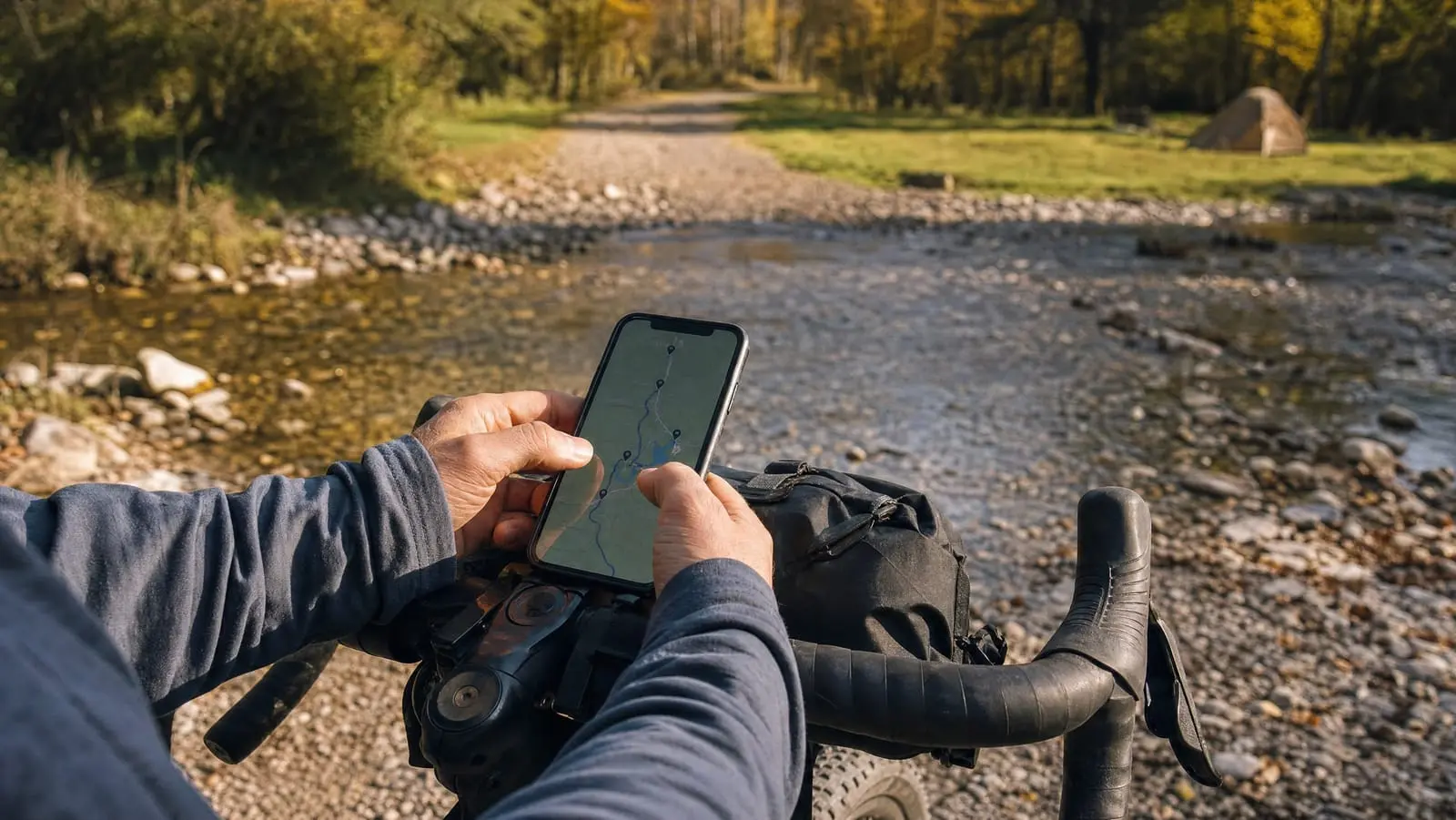
- Use technology appropriately: GPS devices with emergency features provide peace of mind that reduces background anxiety
Loneliness vs. Solitude
Not all alone-time feels the same. Solitude is chosen aloneness that feels nourishing. Loneliness is unwanted isolation that feels painful. The same objective situation—riding alone for hours—can shift between these states based on your mental frame.
Signs you're experiencing nourishing solitude:
- Time seems to flow easily
- Thoughts feel clear rather than ruminative
- You notice beauty in your surroundings
- Being alone feels like enough
Signs you're experiencing painful loneliness:
- Constant checking of phone for messages
- Obsessive thoughts about what others are doing
- Surroundings feel empty rather than peaceful
- Being alone feels like lacking something
Shifting from loneliness to solitude:
-
Acknowledge the loneliness: Resisting makes it worse. "I'm feeling lonely right now" is more helpful than "I shouldn't feel this way"
-
Connect intentionally: A short phone call or text to someone who cares can reset your emotional state. Plan these ahead of time.
-
Engage your environment: Loneliness often pairs with environmental disconnection. Stop, look around, notice five specific things. Ground yourself in place.
-
Find the purpose: Remind yourself why you chose solo travel. What are you gaining that wouldn't exist with companions?
Decision Fatigue and Cognitive Load
Every decision depletes a finite daily resource. Route choices, gear adjustments, when to eat, where to camp, how to respond to unexpected problems—by day five of a multi-day trip, even simple choices can feel overwhelming.
The Bikepacker's Decision Burden
Conservative estimates suggest bikepackers make hundreds of decisions daily that car travelers don't face:
- Navigation: Which fork to take, when to check the map, whether you're on route
- Pace: When to push, when to rest, how hard to climb
- Nutrition: When to eat, what to eat, how much water to filter
- Gear: What to wear, when to adjust, how to respond to conditions
- Safety: When to stop, where to camp, how to assess risks
Each decision, even small ones, draws from the same mental energy pool used for major choices. This explains why veteran bikepackers can make catastrophically bad decisions on day six that they would never make on day one.
Reducing Decision Load
Before the trip:
- Pre-decide what you can: Pack the same food routine, use standardized gear setups, create default responses to common situations
- Create decision rules: "If [condition], then [action]" rules eliminate deliberation. Example: "If there's a water source and my bottles are below half, I fill up"
- Choose routes that match energy: Save complex navigation for early trip days; save long miles on simple roads for when you're mentally depleted
During the trip:
- Batch decisions: Make navigation choices for the next two hours at once, rather than re-deciding at every intersection
- Protect mornings: Schedule important decisions for when you're freshest; save autopilot tasks for afternoon fatigue
- Establish routines: Same morning sequence, same camp setup process, same evening wind-down. Routines reduce decision points.
When depleted:
- Recognize the signs: Difficulty making simple choices, procrastination, irritability, and mental fog all indicate decision fatigue
- Pause major decisions: If possible, don't make route changes or trip-altering choices when exhausted
- Simplify radically: When overwhelmed, narrow focus to just the next action. Not the whole day—just the next mile.
The Paradox of Choice
Having too many options creates paralysis. Route planning platforms now show unlimited variations, and gear research reveals endless alternatives. This abundance increases anxiety rather than reducing it.
Practical limits:
- Research 3 route options maximum, then choose
- Stop gear comparisons after evaluating 5 options
- Don't redesign your trip mid-route unless safety requires it
- Accept "good enough" decisions rather than searching for optimal
Experienced bikepackers often seem decisive not because they have better judgment but because they've learned that quick, imperfect decisions executed confidently outperform slow, optimal decisions made with hesitation.
When Quitting Is Wisdom
One of the most important mental skills is knowing when to stop. Our culture celebrates pushing through at all costs, but experienced bikepackers understand that sometimes the bravest choice is ending the ride.
Reframing Quit
"It's essential to challenge the mindset that quitting is a sign of failure or weakness because there are many valid reasons to step away from a goal—whether due to physical health, mental well-being, or uncontrollable circumstances. Success shouldn't be defined solely by crossing the finish line but by being able to recognize your limits, having meaningful experiences, and prioritizing your welfare."
The best mental framework: Distinguish between stopping and quitting. Stopping is a strategic decision made from a position of awareness. Quitting is an emotional escape made to avoid discomfort. The external action may look identical, but the internal quality differs completely.
The Pause Option
A friend offered this perspective that transformed one rider's relationship with difficulty: "You know, it's not always go or give up. You can also pause, take shelter, let the worst of it pass, look after yourself, and move forward when the time is right."
Before deciding to end your trip, explore the middle options:
- Take a zero day: Stay in one place doing nothing bike-related
- Shorten the route: Complete a modified version rather than abandoning entirely
- Adjust expectations: Change goals from "finish the whole route" to "ride until it's not fun anymore"
- Get resupply: Sometimes what you need is a motel bed and a real meal
- Change modes: Skip a difficult section by alternate transport, continue afterward
Warning Signs vs. Normal Difficulty
Normal difficulty (push through with support strategies):
- Temporary physical discomfort that responds to rest
- Fear without objective danger
- Boredom or frustration that passes
- Loneliness that improves with connection
- Low motivation that reverses with food and sleep
Warning signs (seriously consider stopping):
- Persistent pain that worsens with activity
- Intrusive thoughts about self-harm or hopelessness
- Inability to make basic safety decisions
- Complete loss of positive emotion for multiple days
- Injury or illness that could become serious
Red flags (stop now):
- Signs of serious physical injury or illness
- Active suicidal thoughts
- Symptoms of dangerous exhaustion (hallucinations, confusion)
- Objective danger you cannot safely manage
- Gut instinct that something is seriously wrong
When in doubt, err toward caution. No bikepacking goal is worth permanent damage to your body or mind. The trails will be there when you're ready to return.
Mindfulness and Flow States
Some of the most profound bikepacking experiences happen when thinking stops and pure experience takes over. These flow states—where you're fully absorbed in the present moment without self-consciousness—are both mentally restorative and intrinsically rewarding.
Cycling as Moving Meditation
"You may actually be able to get most of the benefits of meditation, specifically mindfulness meditation, while you're pedaling. Riding a bike might actually be better than yoga as a medium for practicing meditation."
The rhythmic nature of cycling creates natural conditions for meditative awareness:
- Continuous sensory engagement (balance, steering, environment)
- Repetitive physical movement (pedaling cadence)
- Attention demands that crowd out rumination
- Changing scenery that maintains interest
Unlike seated meditation, where the mind constantly wanders to distraction, cycling provides an anchor—the demands of riding—that holds attention in the present.
Practical Mindfulness on the Bike
Breath awareness: Synchronize your breathing with your pedaling. Notice how your breath changes with effort level. Use breath as an anchor when thoughts spiral.
Sensory grounding: Periodically sweep through your senses: What do you see? Hear? Feel on your skin? Smell? This pulls attention from abstract worry to concrete experience.
Body scanning: Move attention through your body while riding: feet, legs, core, hands, neck, face. Notice tension without trying to change it. Often, awareness alone releases holding patterns.
Letting thoughts pass: When worries or plans arise, notice them as thoughts rather than truths. Imagine them floating past like scenery. Return attention to the physical experience of riding.
Engineering Flow States
Flow happens when the challenge of an activity perfectly matches your skill level—not too easy (boredom) or too hard (anxiety). Bikepacking naturally creates flow conditions, but you can optimize for them:
Match difficulty to energy:
- Choose technical trails when you're fresh and alert
- Save mellow roads for low-energy periods
Remove distractions:
- Phone in bag, not in sight
- No planned stops for arbitrary miles
Set clear proximal goals:
- "Make it to that hill" rather than "finish the trip"
- Immediate challenges create immediate engagement
Embrace novelty:
- New routes engage attention more than familiar ones
- Even small variations (different food, new music) provide freshness
Building Your Support System
Even the most dedicated solo bikepacker needs human connection. The riders who complete challenging expeditions aren't those who need people least—they're those who most effectively use human support despite physical isolation.
Pre-Trip Support Structures
Identify your people:
- Who will you contact if things go wrong?
- Who understands what you're attempting well enough to provide relevant encouragement?
- Who should know your route and timeline?
Establish check-in protocols:
- When and how will you communicate?
- What should people do if they don't hear from you?
- What counts as "things are fine" vs. "come get me"?
Create a cheer squad:
- Share your route with people who will track your progress
- Accept that their enthusiasm, even if uninformed, provides real support
On-Trail Connection
Technology enables connection that wasn't possible a decade ago. Use it strategically:
Planned check-ins: "The social interaction available through a phone can be extremely important for your emotional state, especially when you don't see other riders for a couple of days. Try not to lose time on social media, but checking it occasionally and making a short post can help you feel more connected to the world."
Emergency communication: Devices like the Garmin inReach Mini provide both emergency SOS functionality and the ability to send messages from anywhere. The psychological benefit of knowing you can reach help often exceeds the practical utility.
In-person encounters: Be open to connection with strangers on trail. Other bikepackers, locals, trail users—brief interactions provide surprising emotional sustenance. Solo doesn't mean closed to connection.
Post-Trip Integration
The mental challenges of bikepacking don't end at the finish line. Many riders experience a difficult reentry period:
- The "now what" void: The goal that structured your days is gone
- Re-integration friction: Normal life feels small after big experiences
- Processing difficult moments: Experiences that were survived may need to be understood
Plan for this transition:
- Schedule downtime before resuming full responsibilities
- Talk with people who understand what you did (not just "that sounds nice")
- Journal about the experience while memories are fresh
- Allow yourself to feel whatever arises—flatness, grief, elation
Practical Mental Strategies Quick Reference
When you're deep in a hard moment and can't think clearly, these simple strategies help:
The 5-4-3-2-1 Grounding Technique
When anxiety spikes, identify:
- 5 things you can see
- 4 things you can touch
- 3 things you can hear
- 2 things you can smell
- 1 thing you can taste
This interrupts spiraling by anchoring attention in physical reality.
The HALT Check
Before making any significant decision, ask if you're:
- Hungry?
- Angry?
- Lonely?
- Tired?
Any "yes" means postpone the decision if possible, or at least factor the state into your judgment.
The 10-10-10 Framework
For decisions you're uncertain about, ask:
- How will I feel about this choice in 10 minutes?
- How will I feel about it in 10 days?
- How will I feel about it in 10 months?
This creates perspective that short-term discomfort often distorts.
The Just-One-More Strategy
When you want to quit, commit to just one more:
- One more mile
- One more hill
- One more hour
Then reassess. Often, the act of continuing changes the feeling that prompted wanting to stop.
The Best-Case Reframe
When catastrophizing, your brain presents only disaster scenarios. Force it to generate alternatives:
- What's the worst that could happen? (Your brain does this automatically)
- What's the best that could happen?
- What's most likely to happen?
Usually, reality lands closer to "most likely" than "worst."
Your Mental Resilience Journey
Mental toughness isn't a fixed trait—it's a skill that develops through practice. Every challenging ride adds to your psychological foundation. Every fear faced and survived reduces its future power. Every moment of choosing to continue builds the habit of resilience.
Start where you are:
- If you've never ridden solo, start with a short overnight trip
- If night anxiety stops you, camp in your backyard until it doesn't
- If decision-making overwhelms, simplify your next route dramatically
- If you struggle with discomfort, practice small exposures regularly
The mental side of bikepacking is inseparable from the physical, the logistical, and the experiential. You don't need to master your mind before you can enjoy riding—you master your mind through riding.
And here's the secret the most resilient bikepackers know: the hard moments become the best stories. The nights you were scared, the days you wanted to quit, the challenges that seemed insurmountable—these become the experiences you value most, the ones that proved you were more capable than you believed.
The trails are waiting. Your mind is ready. Get out and ride.
Related Guides
Build your mental foundation with these supporting resources:
Mindset & Psychology:
- Solo Bikepacking: How to Ride Alone with Confidence
- Managing Fear and Anxiety on Bikepacking Trips
- Dealing with Loneliness on Long-Distance Rides
- Pushing Through or Quitting: When to Stop Your Ride
- Decision Fatigue: Protecting Your Mind on Multi-Day Trips
- Building Mental Toughness Before Your First Expedition
- Night Riding Psychology: Conquering Fear of the Dark
- Mindfulness and Meditation Practices for Cyclists
- Staying Motivated When Every Mile Hurts
- The Mental Side of Bikepacking Races
Physical Foundation:
- Complete Bikepacking Comfort Guide
- Building Saddle Time and Conditioning
- Recovery Strategies Between Riding Days
Getting Started:
This article contains affiliate links. We may earn a commission if you make a purchase through our links, at no extra cost to you.