Emergency Field Repairs for Bikepacking: Creative Fixes When Proper Tools Aren't Available
20+ years testing gear in Colorado backcountry
When Standard Repairs Fail
Sometimes the proper fix isn't possible. Your derailleur is destroyed, your rack is broken, or your spoke is irreparably bent. In these moments, creative improvisation gets you to safety.
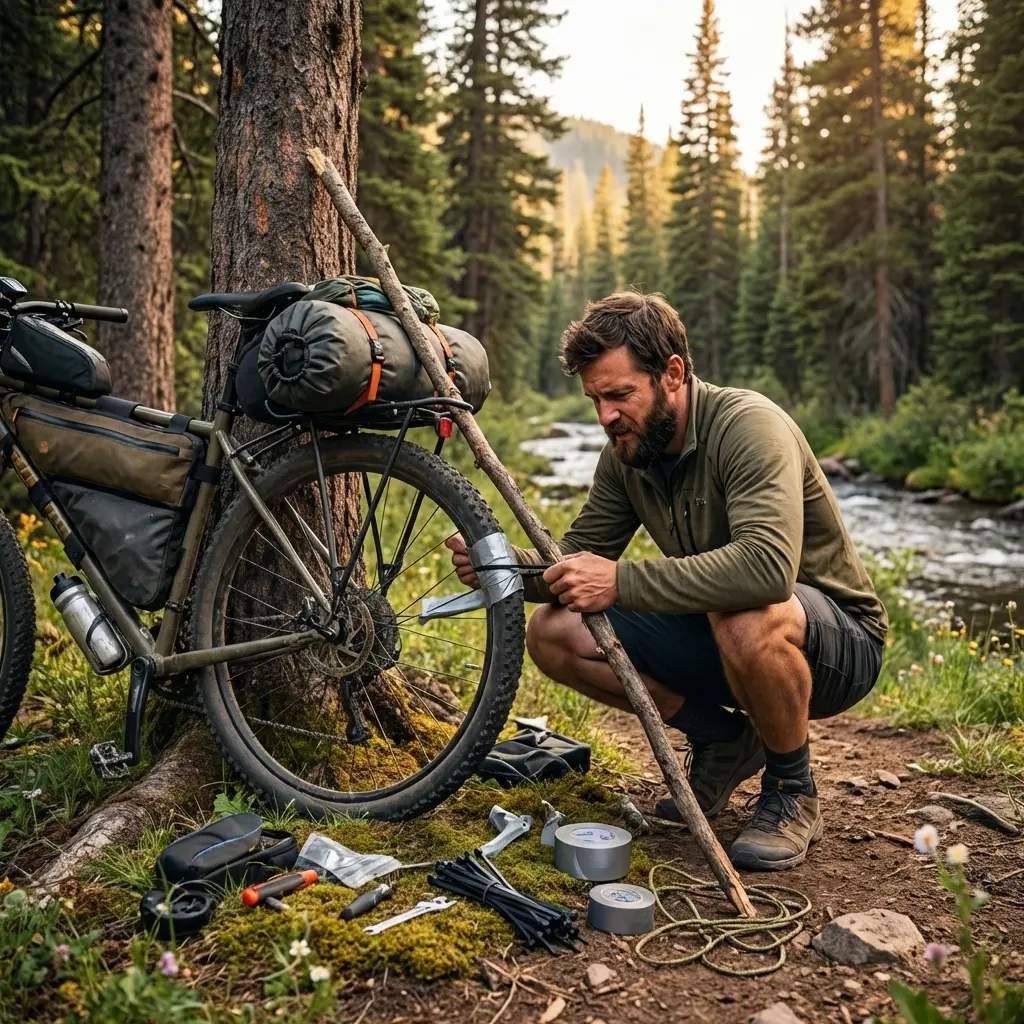
Proper maintenance and quality tools solve most problems. But bikepacking takes you far from bike shops, and some failures exceed what standard repairs can address. In these situations, creative improvisation—using zip ties, tape, wire, and ingenuity—becomes the difference between riding out and a very long walk.
This guide covers emergency fixes for situations beyond normal repair. These aren't elegant solutions. They're survival repairs—getting you functional enough to reach proper help.
For standard repairs, see our Complete Bikepacking Maintenance Guide. For what to carry, check our Building Your Tool Kit guide.
The Emergency Repair Mindset
Goals of Emergency Repair
1. Safety first
- A repair that creates a new hazard isn't a repair
- Prioritize brakes and structural integrity
- Know when a bike is unrideable
2. Get functional, not perfect
- You need to move, not win races
- Expect reduced performance
- Plan for the repair to be temporary
3. Reach proper help
- Navigate toward bike shops or transportation
- Consider bail-out options
- Don't push a sketchy repair further than necessary
The Walk-Out Decision
Sometimes the right answer is walking:
Consider walking if:
- Frame is cracked
- Fork is damaged
- Brakes are completely non-functional
- Wheel is severely bent/broken
- Multiple critical failures compound
Walking tips:
- Bike shoes walk poorly—plan accordingly
- Bike can be pushed/carried if it rolls
- May need to remove wheels for transport
- Have emergency contact plan
Essential Emergency Supplies
The Core Emergency Kit
These items solve most improvised repairs:
| Item | Weight | Primary Uses |
|---|---|---|
| Zip ties (large) | 20g | Structural repairs, securing loose parts |
| Zip ties (small) | 10g | Cable routing, light-duty fixes |
| Duct tape (2" x 36") | 25g | Everything: structural, sealing, padding |
| Steel wire | 15g | Strong structural fixes, cable replacement |
| Electrical tape | 10g | Grip wrap, cable protection, insulation |
| Multi-tool | 150g | The foundation of all repairs |
Total: ~230g for comprehensive emergency capability
How to Carry
Duct tape: Wrap around pump, lighter, or water bottle—no separate roll needed.
Zip ties: Rubber band around frame tube or in frame bag.
Wire: Wrap around chainstay or in small coil in bag.
Zip Tie Fixes
Zip ties are remarkably strong and versatile. Large heavy-duty ties can hold significant loads.
Structural Applications
Broken rack mount:
- Position rack at correct angle
- Loop large zip ties through frame eyelets/tubes
- Pull tight, creating multiple attachment points
- Add ties until solid
- Check tightness periodically
Broken bottle cage:
- Run zip ties through frame bosses
- Wrap around cage and through boss
- Tighten securely
- May need tape padding where cage contacts bottle
Loose fender:
- Zip tie to stay or frame
- Use multiple ties for stability
- Position to avoid wheel contact
Component Securing
Loose derailleur:
- If hanger is damaged, may need to immobilize derailleur
- Zip tie derailleur body to chainstay
- This locks you in single gear (see singlespeed conversion below)
Brake cable failure (mechanical):
- If inner cable breaks at lever, can't easily fix
- Zip tie brake in partially applied position for some braking
- Use other brake as primary
- Extreme emergency only
Saddle rail failure:
- Zip ties through rail loops
- Wrap around seatpost
- Creates sloppy but functional connection
- Add tape padding for comfort
Cable Management
Broken cable housing:
- Splice with electrical tape for short sections
- Zip tie exposed cable to frame
- Increases friction but maintains function
Loose cable:
- Zip tie to frame tubes
- Prevents snagging
- Maintains routing
Duct Tape Solutions
Gorilla Tape or quality duct tape handles repairs that require flexibility and adhesion.
Tire and Wheel
Sidewall cut (internal boot):
- Clean inside of tire
- Apply tape extending 1" beyond cut in all directions
- Burnish firmly
- Reinstall tube
- Multiple layers for larger cuts
Tube protection:
- Wrap tape around rim tape repairs
- Adds puncture protection
- Temporary until proper tape available
Frame and Components
Cracked frame (temporary):
- Clean area thoroughly
- Wrap multiple tight layers around crack
- Extend well beyond crack
- This is a get-home fix only
Handlebar grip replacement:
- Wrap tape around bar as grip
- Double layer for padding
- Functional if uncomfortable
Broken cleat:
- Tape shoe to pedal for emergency pedaling
- Extremely awkward but works for flat pedals
- Can't unclip—be careful
Miscellaneous
Torn bag:
- Tape from inside and outside
- Creates waterproof seal
- Maintains bag function
Lost bolt:
- Tape the component in place
- Not structural but prevents loss
- Replace bolt ASAP
Wire Fixes
Steel wire provides strength that tape and zip ties can't match.
When Wire Is Needed
- High-stress structural connections
- Cable replacement
- Metal-to-metal bridging
Techniques
Safety wire wrap:
- Thread wire through both attachment points
- Twist ends together
- Continue twisting until tight
- Fold sharp ends under
Cable replacement (brake or shift):
- Remove broken cable
- Thread wire through same path
- Secure at anchor bolt
- Tension with pliers
- Very rough shifting/braking but functional
- For proper cable replacement, see our Cable Replacement Guide
Broken spoke temporary:
- Wire around hub flange
- Tension to neighboring spokes
- Not as good as real spoke but adds structure
- For proper spoke repair techniques, see our Wheel Truing Guide
The Singlespeed Conversion
When your derailleur is destroyed or shifting is impossible, converting to singlespeed keeps you moving. For standard derailleur adjustments before reaching this point, see our Derailleur Adjustment Guide.
When to Convert
- Derailleur snapped off
- Derailleur hanger destroyed
- Shift cable broken with no spare
- Multiple cassette cogs damaged
The Process
1. Shorten chain:
- Remove derailleur
- Size chain for middle chainring to middle cog
- Chain should be taut but not binding
2. Choose your gear:
- Middle cog usually best compromise
- Consider remaining terrain
- Hills need easier gear; flats allow harder
3. Maintain chain tension:
- Horizontal dropouts: slide wheel back
- Vertical dropouts: chain may be loose
- Zip tie tensioner: loop through chain path, anchor to frame
4. Secure chain on cog:
- May fall off if too loose
- Use dropout adjustment or improvised tensioner
- Ride smoothly—sudden power can drop chain
The Zip Tie Tensioner
If chain is too long after derailleur removal:
- Create a loop of large zip ties
- Thread chain through loop
- Anchor loop to chainstay or seatstay
- Tighten to create chain tension
- Not pretty, but creates spring tension
Riding Singlespeed
- Start pedaling before heavy load
- Spin legs faster on climbs
- Coast on descents
- Avoid sudden power spikes
- Listen for chain tension issues
Other Emergency Scenarios
Broken Crank Arm
If crank falls off (bolt backed out):
- Find the bolt if possible
- Reinstall and tighten thoroughly
- Apply threadlocker or even superglue
- Monitor closely
If crank is cracked:
- Usually unrideable
- May be able to ride one-legged to help
- Consider walking
Headset Failure
For proper headset adjustment techniques before reaching emergency status, see our Bearing Maintenance Guide.
If headset is loose and won't adjust:
- Shim with tape or card stock
- Tighten stem bolts firmly
- Steering will be vague but controllable
If bearings are destroyed:
- Dangerous—affects steering
- Ride very slowly if at all
- Walking preferred
Pedal Issues
Broken pedal:
- Remove broken pedal
- Ride one-legged (opposite side)
- Surprisingly possible for short distances
Seized pedal:
- May need to leave it
- If stuck in good position, ride normally
- Don't remove—reinstallation may be impossible
Brake Failure
One brake failed:
- Rely on remaining brake
- Reduce speed dramatically
- Allow much more stopping distance
- Use foot dragging as backup if needed
Both brakes weak:
- Find lowest-resistance route
- Foot dragging for additional stopping
- Walk steep descents
- Extreme caution required
Featured Products
Gorilla Tape
Not all duct tape is equal. Gorilla Tape's double-thick adhesive and reinforced backing holds where cheaper tapes fail. The adhesive sticks to dirty surfaces, doesn't leave residue when removed, and maintains hold in wet conditions. Wrap a 2-foot strip around your pump—weighs almost nothing and can save your trip. We've booted sidewalls, repaired bags, and improvised countless fixes with Gorilla Tape. Accept no substitutes.
- Double-thick adhesive
- Sticks to dirty surfaces
- Holds in wet conditions
- Reinforced backing
- Essential emergency supply
Heavy Duty Zip Ties
These 12-inch heavy-duty ties hold 120 pounds of tensile strength—enough for serious structural repairs. UV-resistant for outdoor durability and wide enough to distribute load without cutting through soft materials. Carry a dozen; they weigh nothing and create repair options that other methods can't match. The locking mechanism holds under vibration. We've seen these hold racks, derailleurs, and saddles in place for hundreds of miles.
- 120 lb tensile strength
- UV-resistant
- 12-inch length
- Wide strap distributes load
- Self-locking mechanism
Safety Wire
Stainless steel safety wire provides repair strength that zip ties and tape can't match. The 0.032-inch diameter is thin enough to work with but strong enough for structural fixes. Traditional use is preventing bolt loosening, but bikepackers use it for cable replacement, spoke repair, and creating metal-to-metal connections. A small coil weighs almost nothing and sits in your repair kit indefinitely.
- Stainless steel—no corrosion
- Strong enough for structure
- Thin enough to work with
- Multiple repair applications
- Lasts indefinitely
Gear Aid Tenacious Tape
For bag repairs and fabric emergencies, Tenacious Tape outperforms duct tape. The clear patches are nearly invisible on gear, the fabric backing flexes without cracking, and the adhesive stays put through washing and weather. Keep a few patches in your repair kit for tent, bag, and clothing emergencies. The pre-cut shapes are convenient; the roll provides more material for larger repairs.
- Designed for outdoor fabrics
- Flexible—doesn't crack
- Waterproof seal
- Clear option nearly invisible
- Survives washing
Emergency Repair Kit Bundle
If you want a pre-packaged solution, this kit includes zip ties, wire, tape, and basic tools in a compact package. Not the highest quality components, but adequate for emergency use and convenient for new bikepackers who want baseline capability without sourcing individual items. Upgrade individual components as you learn what you actually use.
- Pre-packaged convenience
- Basic components included
- Compact storage
- Good starting point
- Upgrade components over time
Emergency Repair Principles
Before Attempting Repair
- Assess the situation - What's broken? What resources do you have?
- Consider alternatives - Is there an easier solution?
- Plan your approach - How will you execute? What could go wrong?
- Think about consequences - Will this create new problems?
During Repair
- Work carefully - Rushing creates new damage
- Test incrementally - Check stability before full load
- Document mentally - Remember what you did for later proper repair
After Repair
- Ride gently at first - Test before committing
- Monitor continuously - Watch/listen for failure signs
- Plan next steps - Where can you get proper repair?
FAQ
Should I practice emergency repairs at home?
Yes. Try removing your derailleur and riding singlespeed. Practice zip tie structural repairs on non-critical parts. Familiarity at home builds confidence on trail.
How many zip ties should I carry?
A dozen large (12-inch) ties and a dozen small (6-inch) ties cover most scenarios. They weigh almost nothing.
Is duct tape really necessary if I have zip ties?
Yes. Tape handles flexible repairs, sealing, and applications where zip ties won't work (tire boots, grip wrapping, bag patching). They're complementary, not redundant.
What's the most common emergency repair?
Probably tire boots for sidewall cuts, followed by improvised cable routing, followed by rack/bag attachment repairs.
Can emergency repairs damage my bike?
Some can. Wire wrapped on frame tubes can scratch paint. Tape adhesive may leave residue. But these are acceptable trade-offs when the alternative is walking.
Related Guides
- Complete Bikepacking Maintenance Guide - Standard maintenance
- Building Your Tool Kit - What to carry
- Emergency Gear Guide - Beyond mechanical issues
- Multi-Tool Guide - Foundation tools
- Wheel Truing Guide - Proper spoke repair techniques
- Disc Brake Maintenance - Standard brake repairs
Emergency repairs are last resorts. Proper maintenance prevents most problems. But when the unexpected happens—and it will—knowing these techniques transforms potential disasters into stories you tell later.
Carry the supplies. Know the techniques. Improvise when necessary.
The trail rewards resourcefulness.