Derailleur Adjustment and Repair for Bikepacking: Master Your Shifting
20+ years testing gear in Colorado backcountry
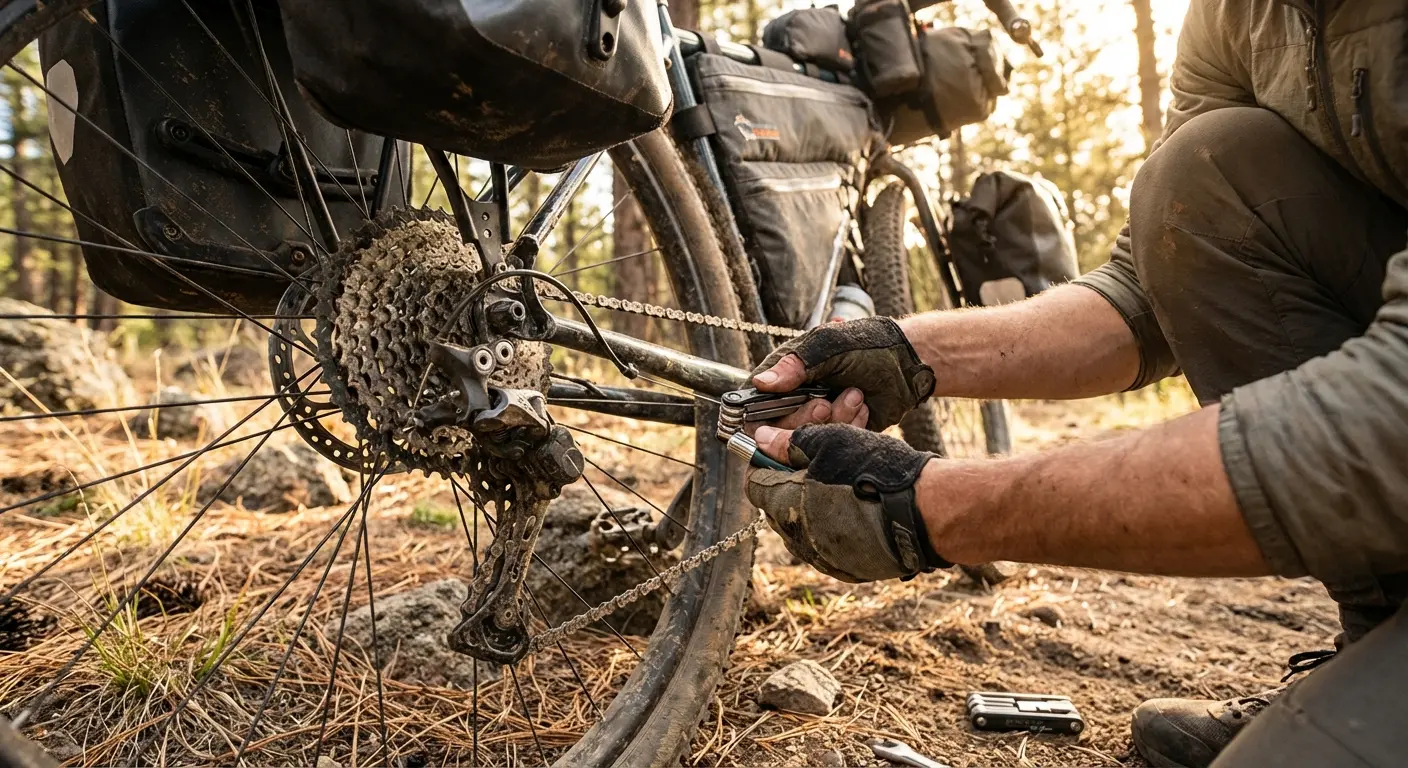
When Shifting Goes Wrong
Poor shifting on a loaded bike grinding up a steep climb isn't just frustrating—it's exhausting. Every missed shift wastes energy. Understanding derailleur adjustment means riding efficiently, not fighting your bike.
Your derailleur is a precision instrument that positions your chain across different-sized cogs with millimeter accuracy. When it works, you don't think about it. When it doesn't, every shift reminds you something's wrong.
The good news: most shifting problems have simple causes and simple fixes. Cable tension, limit screws, and hanger alignment account for 95% of shifting issues. Master these adjustments and you'll fix most problems on trail without special tools.
For the complete maintenance picture, see our Complete Bikepacking Maintenance Guide. For related repairs, check our Cable Replacement Guide.
How Derailleurs Work
Before adjusting, understand what you're adjusting.
Rear Derailleur Basics
Cable tension:
- Pulls the derailleur inward (toward larger cogs)
- Spring pushes outward (toward smaller cogs)
- Balance determines chain position
Limit screws:
- H (High) screw limits outward travel (prevents chain overshooting small cog)
- L (Low) screw limits inward travel (prevents chain going into spokes)
- Don't affect middle gears—only endpoints
B-tension (body angle):
- Adjusts derailleur cage distance from cassette
- Affects shifting quality, especially in largest cogs
- Usually set once and forgotten
Indexing:
- The click-stops in your shifter
- Must align with cog positions
- Controlled by cable tension
Front Derailleur Basics
Less common on modern bikepacking bikes (1x drivetrains dominate), but similar principles:
- Cable tension moves cage inward
- Spring pushes cage outward
- Limit screws prevent chain from falling off chainrings
- Cage height and angle affect shifting quality
Cable Tension Adjustment
90% of shifting problems are cable tension issues.
Symptoms of Wrong Tension
Too little tension:
- Chain hesitates shifting to larger cogs
- Multiple clicks needed for upshifts
- Chain falls off the smallest cog under load
Too much tension:
- Chain overshifts, jumping past intended cog
- Chain hesitates shifting to smaller cogs
- Chain rubs in certain gear combinations
Making Adjustments
Location of barrel adjusters:
- Rear derailleur body
- Shifter (often inline on cable)
- Cable stops on frame
To increase tension (shift to larger cogs easier):
- Turn barrel adjuster counterclockwise (when viewed from behind)
- This effectively lengthens the cable housing, increasing cable tension
To decrease tension (shift to smaller cogs easier):
- Turn barrel adjuster clockwise
- This shortens the cable housing, decreasing tension
The Adjustment Process
- Shift to smallest cog (rear) or smallest ring (front)
- Note how the chain responds to one shift click
- Does it move immediately to the next cog?
- Does it hesitate or require multiple clicks?
- Does it overshoot to the second cog?
- Adjust barrel by ¼ turn based on symptoms
- Repeat until shifts are crisp
Testing Your Adjustment
After adjusting:
- Shift through full range slowly
- Shift through full range quickly
- Shift under mild pedaling load
- Check both directions (up and down cassette)
- Any hesitation means further adjustment needed
Limit Screw Adjustment
Limit screws are safety devices that prevent catastrophic chain placement.
H Limit (High Gear)
Controls outward travel—prevents chain from overshooting the smallest cog and landing on the dropout.
Checking H limit:
- Shift to smallest cog
- Look from behind: derailleur pulley should align directly under smallest cog
- If pulley is too far outward, chain can fall off
- If pulley is too far inward, shifting to smallest cog may be sluggish
Adjusting H limit:
- Clockwise = moves derailleur inward (restricts outward travel)
- Counterclockwise = allows more outward movement
- Adjust so pulley sits directly under smallest cog
L Limit (Low Gear)
Controls inward travel—prevents chain from overshooting the largest cog and hitting the spokes.
Checking L limit:
- Shift to largest cog
- Look from behind: pulley should align under largest cog
- Try pushing derailleur inward by hand—it should not move past the largest cog
- If it moves too far, chain can hit spokes
Adjusting L limit:
- Clockwise = restricts inward travel (more spoke protection)
- Counterclockwise = allows more inward movement
- Err on the side of caution—slightly restrict rather than allow
When Limits Need Adjustment
After:
- Replacing cable (tension changes may reveal incorrect limits)
- Bending derailleur hanger (geometry changed)
- Installing new cassette (especially different size range)
- New derailleur installation
Symptoms:
- Chain falls off smallest cog = H limit too loose
- Chain won't reach smallest cog = H limit too tight
- Chain hits spokes or shifts past largest cog = L limit too loose
- Chain won't reach largest cog = L limit too tight
Indexing and Fine-Tuning
With cable tension and limits correct, dial in the indexing.
The Indexing Test
- Shift to middle of cassette
- Make one click on shifter
- Chain should move precisely one cog
- No hesitation, no overshoot
- Both directions should feel the same
Troubleshooting Indexing
Slow upshifts (to larger cogs):
- Increase cable tension (counterclockwise on barrel)
- Check for cable friction (housing damage, contamination)
Slow downshifts (to smaller cogs):
- Decrease cable tension (clockwise on barrel)
- Check for derailleur spring weakness
Works fine cold, gets worse when hot:
- Cable housing may be contaminated
- Consider replacement
Works in stand, fails under load:
- Often indicates cable stretch or housing compression
- May need cable/housing replacement
Bent Derailleur Hanger
The derailleur hanger is designed to bend in a crash—protecting your frame. But a bent hanger ruins shifting.
Signs of Bent Hanger
- Shifting works well in some gears, poorly in others
- Chain skip in certain cogs only
- Derailleur doesn't hang straight (viewed from behind)
- Gap between cassette and pulley varies as you shift
Checking Hanger Alignment
Visual check:
- Look at bike from directly behind
- Derailleur cage should hang vertically
- Compare to another bike if unsure
- Even small bends are visible to a trained eye
The measurement method:
- Remove rear wheel
- Use a long ruler or straight stick
- Hold against derailleur mount and hanger
- Check for gaps indicating bend
Trail Fixes
Gentle straightening:
- Shift chain to smallest cog
- Remove wheel for access
- Place adjustable wrench on hanger body (not derailleur)
- Apply gentle, controlled pressure opposite the bend direction
- Check alignment
- Work in small increments
Alternative: adjustable wrench on derailleur:
- For minor bends only
- Grip derailleur cage with adjustable wrench
- Use derailleur as lever to bend hanger
- Risk: can stress derailleur itself
Limitations:
- Aluminum hangers work-harden—repeated bending weakens them
- Severely bent hangers may break
- Trail straightening is temporary—replace at next opportunity
Carrying a Spare Hanger
Why carry one:
- Hangers are frame-specific
- They're designed to be sacrificial
- They're small and light
- Impossible to fabricate on trail
Finding your hanger:
- Check manufacturer website
- Many bikes use standard aftermarket hangers (Wheels Manufacturing)
- Order exact replacement before remote trips
Featured Products
Wheels Manufacturing Derailleur Hanger
Wheels Manufacturing makes replacement hangers for virtually every bike made in the last 20 years. Their catalog is extensive and their quality matches or exceeds OEM parts. Find your bike's model, order the correct part number, and carry it on every trip. At typically under $30 and weighing just a few grams, there's no excuse not to have this critical spare. We've seen trips saved by a spare hanger; we've seen trips ended without one. Get one before you need it.
- Covers virtually all bike models
- Matches or exceeds OEM quality
- Light and compact
- Essential for remote rides
- Check their catalog for exact model
Park Tool DAG-2.2 Derailleur Alignment Gauge
For precise hanger alignment, nothing beats the DAG-2.2. The tool mounts to the hanger and provides multiple measurement points to identify exactly how and how much the hanger is bent. Then it serves as the straightening tool for precise correction. This is what professional shops use. For home mechanics who service multiple bikes, it pays for itself quickly. Too specialized for trail carry, but essential for proper repair at home. Your shifting will never be better than your hanger alignment.
- Professional-grade accuracy
- Measure and straighten with one tool
- Works on all derailleur hangers
- Essential home shop tool
- What bike shops use
Jagwire Pro Shift Cable Kit
When cables stretch, fray, or housing compresses, shifting suffers no matter how well your derailleur is adjusted. The Jagwire Pro kit includes pre-stretched Slick Stainless cables, sealed cable housing, and all necessary end caps and ferrules for a complete replacement. The sealed housing resists contamination far better than open coil housing. For bikepackers doing pre-trip preparation, fresh cables eliminate one more potential failure point. Includes both shift and brake cables.
- Pre-stretched cables
- Sealed housing
- All hardware included
- Professional quality
- Complete replacement kit
Park Tool CN-10 Cable and Housing Cutter
Proper cable cuts require proper tools. The CN-10 makes clean, square cuts through both cable and housing without crushing the housing interior. Crushed housing creates friction that ruins shifting feel. The built-in crimper handles cable end caps and ferrules. If you're replacing cables yourself, this tool is non-negotiable. Cheap side-cutters work once; the CN-10 works thousands of times. Every home shop needs one.
- Clean cuts without crushing
- Built-in crimper
- Works on cable and housing
- Professional quality
- Essential for cable work
Shimano Shift Cable
Shimano's basic shift cables work with any derailleur system and cost very little. Keep a spare in your repair kit—shift cables can fray at the anchor bolt or break at the shifter end, and when they do, you can't shift. The standard 1.2mm diameter fits all modern shift systems. Installation requires basic cable cutting tools, but on trail, you can make it work with a multi-tool. Cheap insurance for remote rides.
- Universal compatibility
- Inexpensive backup
- Light and compact
- Easy installation
- Essential repair kit item
Common Shifting Problems and Solutions
| Problem | Likely Cause | Solution |
|---|---|---|
| Won't shift to largest cog | Low cable tension, L limit too tight | Increase tension, check L limit |
| Won't shift to smallest cog | High cable tension, H limit too tight | Decrease tension, check H limit |
| Hesitates mid-cassette | Cable tension wrong, cable friction | Adjust tension, inspect cable/housing |
| Skips under power | Worn chain/cassette, bent hanger | Check wear, check hanger alignment |
| Noisy in all gears | Poor indexing, B-tension off | Full adjustment, check B-tension |
| Works fine standing, fails riding | Cable stretch, housing compression | Replace cable and housing |
| Shifts on its own | Cable tension too high, friction | Decrease tension, check for binding |
Adjustment Checklist
Before every multi-day trip:
- Full shift test through all gears
- Check cable for fraying at anchor and shifter
- Verify limit screws prevent over-shift
- Inspect derailleur hanger for bend
- Check barrel adjuster position (mid-range allows trail adjustment)
- Verify derailleur bolts tight
- Test under load (brief climb or sprint)
FAQ
Why does my shifting get worse as the ride goes on?
Common causes: cable stretch (especially new cables), housing contamination, or cable friction building as cable gets dirty. Fresh cables and sealed housing help.
Should I adjust cable tension or limit screws first?
Limit screws first. They establish the range of motion. Then cable tension dials in the indexing. Adjusting in the wrong order creates confusion.
My derailleur was working fine and suddenly stopped. What happened?
Sudden changes suggest cable breakage, loose derailleur bolt, or impact damage to hanger. Check the obvious before doing fine adjustments.
How often should I replace shift cables?
Preventively, annually or every 3,000-5,000 miles. Reactively, when you notice fraying, stiff shifting that doesn't respond to adjustment, or visible corrosion.
Can electronic shifting have derailleur problems?
Different problems—no cable tension issues, but battery, motor, and firmware can fail. Mechanical backup isn't possible. Keep firmware updated and batteries charged.
What if I can't get it right on trail?
Sometimes a full adjustment requires a shop. Get it close enough to ride, avoid the gears that don't work, and get proper service when possible. If your derailleur is completely destroyed, our Emergency Field Repairs Guide covers singlespeed conversion and other creative fixes.
Related Guides
- Complete Bikepacking Maintenance Guide - Full maintenance overview
- Chain Maintenance Guide - Drivetrain partner to shifting
- Cable Replacement Guide - When cables are the problem
- Multi-Tool Guide - Tools for adjustments
Smooth shifting makes riding feel effortless. Poor shifting makes every pedal stroke a reminder that something's wrong. The adjustments aren't complicated—tension, limits, hanger alignment—and mastering them transforms your riding experience.
Carry a spare hanger. Know your adjustments. Keep your drivetrain shifting sweetly.
The trail rewards preparation.