Wheel Truing and Spoke Repair for Bikepacking: Trail Fixes Without a Stand
20+ years testing gear in Colorado backcountry
When Wheels Go Wrong
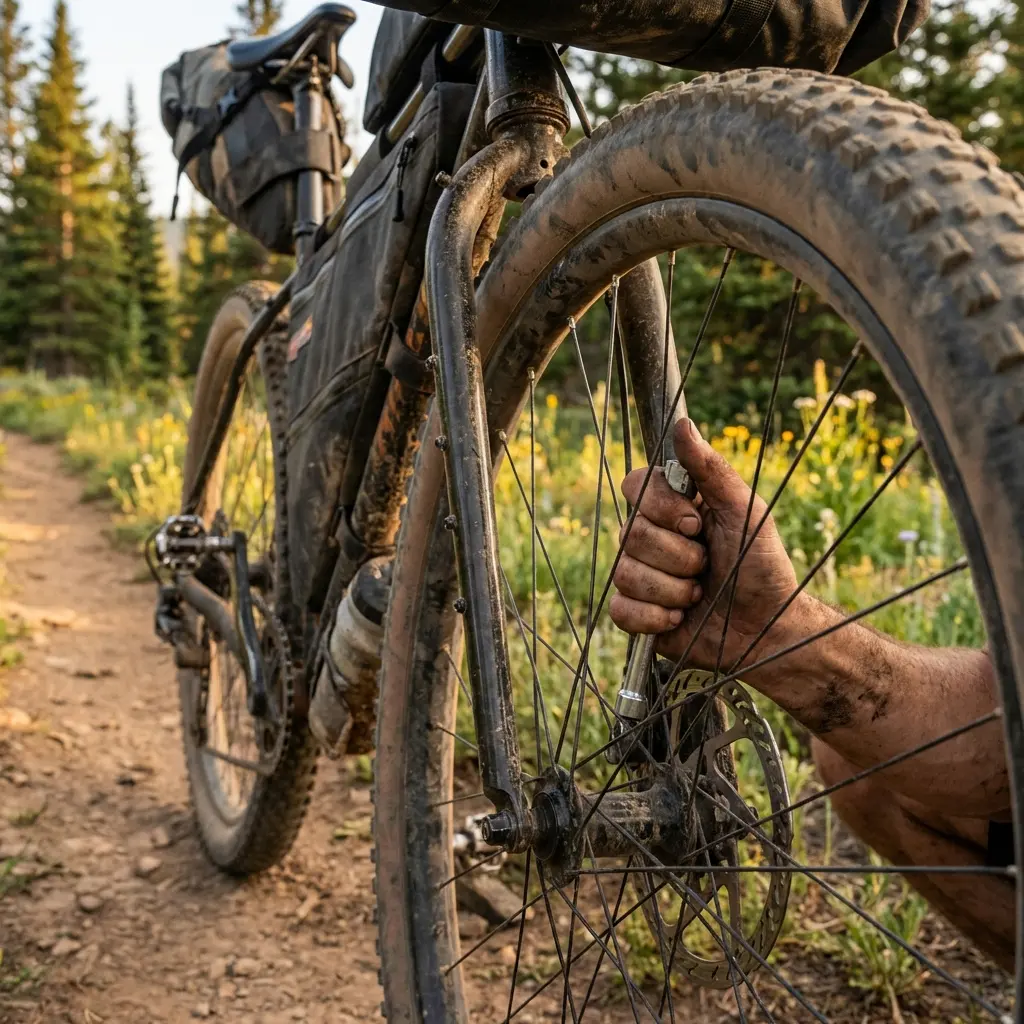
A significantly out-of-true wheel doesn't just rub your brakes—it can make your bike unrideable. Knowing how to true a wheel without a stand transforms a trip-ending problem into a minor inconvenience.
Potholes, rocks, loaded bikes, and hard riding stress wheels constantly. Spokes loosen, tension becomes uneven, and wobbles develop. On a remote trail, that wobble rubbing your brake pad might be the difference between riding out and walking out.
You don't need a professional truing stand to make a wheel rideable. The techniques in this guide will get you rolling again—not perfectly true, but functional enough to reach proper repair facilities.
For the complete maintenance picture, see our Complete Bikepacking Maintenance Guide. For related repairs, check our Multi-Tool Guide.
Understanding Wheel True
What True Means
A true wheel has two qualities:
Lateral true (side-to-side):
- The rim stays centered between the brake pads
- No wobble left or right when spinning
Radial true (round):
- The rim maintains consistent distance from the hub
- No high or low spots when spinning
Most trail problems are lateral—the wheel wobbles side to side. Radial issues are harder to fix and usually require shop tools.
Why Wheels Go Out of True
Spoke tension changes:
- Spokes loosen from vibration
- Uneven initial tensioning from factory
- Spoke nipples work loose
Impacts:
- Hitting rocks or potholes
- Hard landings on drops
- Crashes
Spoke damage:
- Broken spokes immediately affect true
- Bent spokes pull unevenly
Normal wear:
- Spoke threads wear slowly
- Nipples become harder to turn
Trail Truing Without a Stand
You won't have a truing stand on trail. Here's how to true using what you have.
The Brake Pad Method
Your brake pads are built-in reference points:
Setup:
- Flip bike upside down (or lift wheel off ground)
- Spin wheel slowly
- Watch the gap between rim and brake pad
- Note where rim moves toward pad (tight spot) and away (loose spot)
Identification:
- Mark tight spots with tape, chalk, or memorize position
- Each wobble has a peak—identify the center of the problem
The Fix:
- Locate spokes at the center of the tight spot
- Spokes on the OPPOSITE side of the wobble need tightening
- Spokes on the SAME side of the wobble may need loosening
- Turn nipples in ¼-turn increments
- Spin and check
- Repeat until wobble is minimized
The Zip Tie Method
Create a reference point with a zip tie:
- Attach zip tie to fork or chainstay
- Point the zip tie tail toward the rim sidewall
- Trim until it nearly touches the rim
- Spin wheel—zip tie shows where rim moves in/out
- Adjust spokes as above
This method works well when brake pads aren't close enough to the rim or when brakes are removed.
Working in Increments
The process:
- Make one ¼-turn adjustment
- Spin wheel and assess
- If improvement, continue in same direction
- If worse, reverse the adjustment
- Move to adjacent spokes if wobble persists
- Aim for functional, not perfect
How True Is True Enough?
For trail purposes:
- Rim shouldn't rub brake pads constantly
- Wheel should spin freely
- No noticeable handling issues
Save perfection for home or shop:
- 1-2mm wobble is acceptable for riding out
- Brake pad adjustment can compensate for minor wobble
- Priority is keeping wheel functional
Broken Spoke Repair
A broken spoke creates immediate problems. The wheel loses tension symmetry and goes out of true, sometimes dramatically.
When a Spoke Breaks
Immediate actions:
- Stop riding—continuing can damage rim
- Assess the break location
- Secure the broken spoke
- Evaluate ridability
Temporary Solutions
Tape or wrap the broken spoke:
- Wrap around a neighboring spoke
- Prevents snagging on derailleur or frame
- Keeps spoke from rattling
Tension compensation:
- Slightly loosen the two spokes directly opposite the break
- This reduces their pull in the opposite direction
- Loosen the spokes adjacent to the break slightly as well
- Re-true the wheel as above
- Wheel won't be perfect but can be rideable
Reduce spoke count impact:
- On a 32-spoke wheel, losing one spoke means 3% less structure
- The wheel will be weaker—avoid big impacts
- Ride to next repair opportunity
Trailside Spoke Replacement
If you carry spare spokes, you can replace the broken one:
What you need:
- Correct length spoke (drive-side and non-drive-side may differ)
- Spoke wrench fitting your nipples
- Possibly a cassette removal tool (for drive-side rear spokes)
Drive-side complications: Drive-side rear spokes are blocked by the cassette. Full replacement often requires cassette removal—difficult on trail without proper tools.
Non-drive side and front wheel:
- Remove tire and tube/tape (for easier nipple access)
- Thread new spoke through hub flange
- Weave through crossing spokes (match the pattern)
- Thread nipple onto spoke
- Tension to match neighboring spokes
- True the wheel
Reality check: Trailside spoke replacement is challenging. Many bikepackers ride out on compromised wheels and replace spokes at the next bike shop.
Carrying Spare Spokes
Options:
- Tape spokes to chainstay or seatstay
- Carry folding/emergency spokes (FiberFix)
- Use spoke holder in frame bag
Know your spoke length:
- Front and rear may differ
- Drive-side and non-drive-side rear spokes often differ
- Measure or look up before your trip
Hub Checks and Maintenance
While working on wheels, check your hubs too. Hub bearings are often overlooked—for detailed bearing inspection and adjustment, see our Bearing Maintenance Guide.
Checking for Play
Test method:
- Hold frame (or fork for front wheel)
- Grip rim at 3 o'clock and 9 o'clock
- Push and pull laterally (toward and away from bike)
- Feel for clicking or movement
What it means:
- Slight movement = bearings may need adjustment
- Clicking = definite looseness, needs attention
- Grinding = bearings worn, needs service
Checking for Roughness
Test method:
- Remove wheel from bike
- Hold axle and spin wheel
- Feel for grinding, notchiness, or resistance
What it means:
- Smooth spinning = healthy bearings
- Grinding = contamination or wear
- Notchy feeling = bearing damage
Trail Limitations
Hub bearing adjustment requires specific tools for most modern hubs. On trail:
- Note the problem for later
- Loose bearings can often still be ridden carefully
- Severely damaged bearings may fail—prioritize reaching a shop
- Avoid water crossings if hub is compromised (prevents further contamination)
Spoke Tension Basics
Understanding spoke tension helps diagnose wheel problems.
Checking Tension
The pluck test:
- Pluck spokes like guitar strings
- Higher pitch = higher tension
- Lower pitch = lower tension
- All spokes on one side should sound similar
What tension tells you:
- Consistent tension = healthy wheel
- One low-pitched spoke = needs tightening
- Random variations = wheel may need full retensioning
Tension Patterns
Normal patterns:
- Drive-side rear spokes are tighter than non-drive-side (dish offset)
- Front wheel should be more even
- Radially laced spokes may have different tension than crossed spokes
Problem patterns:
- One spoke noticeably loose while neighbors are tight
- Section of loose spokes = possible rim damage
- All spokes loose = wheel needs full rebuild/tensioning
Featured Products
Park Tool SW-2 Spoke Wrench
The industry-standard spoke wrench for most wheels. The SW-2 fits 3.45mm nipples—the most common size on modern bikes. High-quality stamped steel provides positive grip without rounding nipples. The compact size disappears in any repair kit, yet provides enough leverage for proper adjustments. We've carried the same SW-2 for years. If you only carry one spoke wrench, this is probably the size you need. Check your wheels first to confirm nipple size.
- Fits most modern wheels
- Steel construction
- Won't round nipples
- Compact for repair kit
- Industry standard tool
Park Tool SW-7.2 Triple Spoke Wrench
When you're not sure which nipple size you have—or you're working on multiple bikes—the SW-7.2 covers three common sizes in one tool. The triple-sided design provides access to 0.127, 0.130, and 0.136 inch nipples. Larger than single spoke wrenches but still pocketable. For bikepackers who service their own bikes and want one tool that handles anything, this eliminates guesswork. We keep this on the home workbench and pack the specific size for trips.
- Three sizes in one tool
- Covers most nipple types
- Durable construction
- Works on multiple bikes
- Good workbench tool
FiberFix Emergency Spoke
When a spoke breaks far from a bike shop, FiberFix gets you home. The Kevlar emergency spoke threads through your hub flange and provides tension without requiring cassette removal or matching spoke length. Installation takes minutes versus potentially hours for a true spoke replacement. It's not a permanent fix—the Kevlar fiber stretches slightly and has limited fatigue life—but for emergency use, it works remarkably well. Keep one in your repair kit for peace of mind on remote routes.
- Emergency spoke replacement
- No cassette removal needed
- One size fits most
- Installs in minutes
- Kevlar construction
DT Swiss ProLine Spokes
If you carry spare conventional spokes, DT Swiss is the industry standard for reliability. The double-butted design provides strength at the heads and elbows while reducing weight in the middle. Available in lengths from 250mm to 310mm—measure your current spokes or check with your wheel manufacturer. For expedition bikepackers, carrying 2-4 spokes of the correct length provides the best repair capability. The straight gauge version works well and costs less if you're not concerned about weight savings.
- Industry-standard quality
- Double-butted for strength
- Wide length range
- Proven durability
- Used by wheel builders worldwide
DT Swiss Spoke Nipples (Brass)
Nipples can be damaged during wheel work or become corroded and seize. Carrying a few spare nipples weighs almost nothing and can save a wheel. Brass nipples are heavier than aluminum but more durable and easier to work with—especially on trail where conditions aren't ideal. They resist rounding better than aluminum and handle higher torque. Match the size to your wheel's nipples (usually 14-15mm length, 3.45mm external width). Four spares in a small baggie add negligible weight.
- More durable than aluminum
- Resist rounding better
- Handle higher torque
- Negligible weight to carry spares
- Match to your wheel size
Wheel Maintenance Schedule
| Interval | Action |
|---|---|
| Every ride | Listen for rubbing, check for obvious wobble |
| Monthly | Quick tension check (pluck test) |
| Before multi-day trips | Full inspection, check hub play, tension check |
| After hard riding | Check for new wobbles, listen for spoke noise |
| Annually | Professional tension check, hub service |
FAQ
How do I know which spoke size I need?
Measure an existing spoke from under the head to the thread end, or check your wheel manufacturer's specifications. Front, rear drive-side, and rear non-drive-side often require different lengths.
Can I true wheels with my multi-tool's spoke wrench?
Yes, though multi-tool spoke wrenches are often less precise than dedicated tools. They work for emergency truing but check that the wrench actually fits your nipples snugly—poor fit rounds nipples.
My wheel is rubbing even though it looks true. Why?
The caliper may be misaligned rather than the wheel being untrue. Try the caliper-centering technique from our disc brake guide before adjusting spokes.
How much wheel wobble is too much?
On trail, anything that doesn't cause constant brake rubbing is rideable. For reference, most well-maintained wheels are true to within 0.5mm. Up to 2-3mm wobble is functional for riding out.
Should I replace one broken spoke or rebuild the wheel?
One broken spoke on an otherwise healthy wheel: replace it. Multiple broken spokes or repeated breakage: the wheel likely needs full rebuild or replacement.
Why do my spokes keep loosening?
Possible causes: insufficient initial tension, nipples not locked (no threadlocker), riding conditions (repeated impacts), or wheel reaching end of life. Persistent loosening suggests the wheel needs professional attention.
Related Guides
- Complete Bikepacking Maintenance Guide - Full maintenance overview
- Multi-Tool Guide - Essential tools
- Building Your Tool Kit - What to carry
- Emergency Gear Guide - Emergency preparedness
- Emergency Field Repairs - Creative fixes when standard repairs fail
Wheel truing is part art, part science. The good news: you don't need to be an artist to get your wheel rideable on trail. A spoke wrench, patience, and the techniques above will handle most problems.
Carry the right tools, understand the basics, and wheel wobbles become minor setbacks rather than trip-ending disasters.
Keep rolling.