Bear Canisters vs Bear Bags: Food Storage for Bikepacking
20+ years testing gear in Colorado backcountry
This article contains affiliate links. We may earn a commission if you make a purchase through our links, at no extra cost to you.
Protecting Your Food Protects Bears
In bear country, proper food storage isn't just about saving your provisions—it's about keeping bears wild. A bear that accesses human food becomes a problem bear. Problem bears often become dead bears.
For bikepackers, food storage presents unique challenges. Unlike backpackers, we have bulky, irregularly-shaped bike bags that don't accommodate canisters well. Yet we travel through the same bear habitat with the same obligations.
This guide compares the three main food storage options—bear canisters, bear bags (hanging), and Ursacks—to help you choose the right system for your route and riding style.
For complete food planning, see our Complete Bikepacking Food Guide. For meal planning strategies, check Bikepacking Meal Planning. To maximize what fits in your container, focus on calorie-dense foods.
Understanding Bear Country Requirements
Where You Need Bear-Resistant Storage
Required by regulation:
- Many national parks (Yosemite, Denali, parts of Yellowstone)
- Designated wilderness areas with active bear management
- Specific trails and zones with regulations
Strongly recommended:
- Anywhere with known bear activity
- Grizzly country (even without regulations)
- Areas with recent bear incidents
Types of Bears, Different Risks
Black bears:
- Found across North America
- Generally avoid humans but pursue food aggressively
- Can climb trees (affects hanging strategy)
- Most bear country involves black bears
Grizzly bears:
- Northern Rockies, Alaska, Western Canada
- More aggressive, more dangerous
- Cannot climb trees as well
- Require more robust food storage
Know your area: Research the specific regulations and bear activity for your route before departure.
The Three Options
Bear Canisters
Hard-sided, bear-resistant containers that bears cannot open or break.
How they work: Rigid plastic or composite construction with specialized locking mechanisms that defeat bear manipulation. Approved models have been tested against actual bears.
Pros:
- Most effective protection
- Required in many areas (only legal option)
- No tree needed (work above treeline)
- Doubles as camp seat/table
Cons:
- Heavy (2-3 lbs empty)
- Bulky and awkwardly shaped
- Expensive ($60-100+)
- Difficult to pack on a bike
Best for: Areas where required, grizzly country, above-treeline camping.
Bear Bags (Hanging)
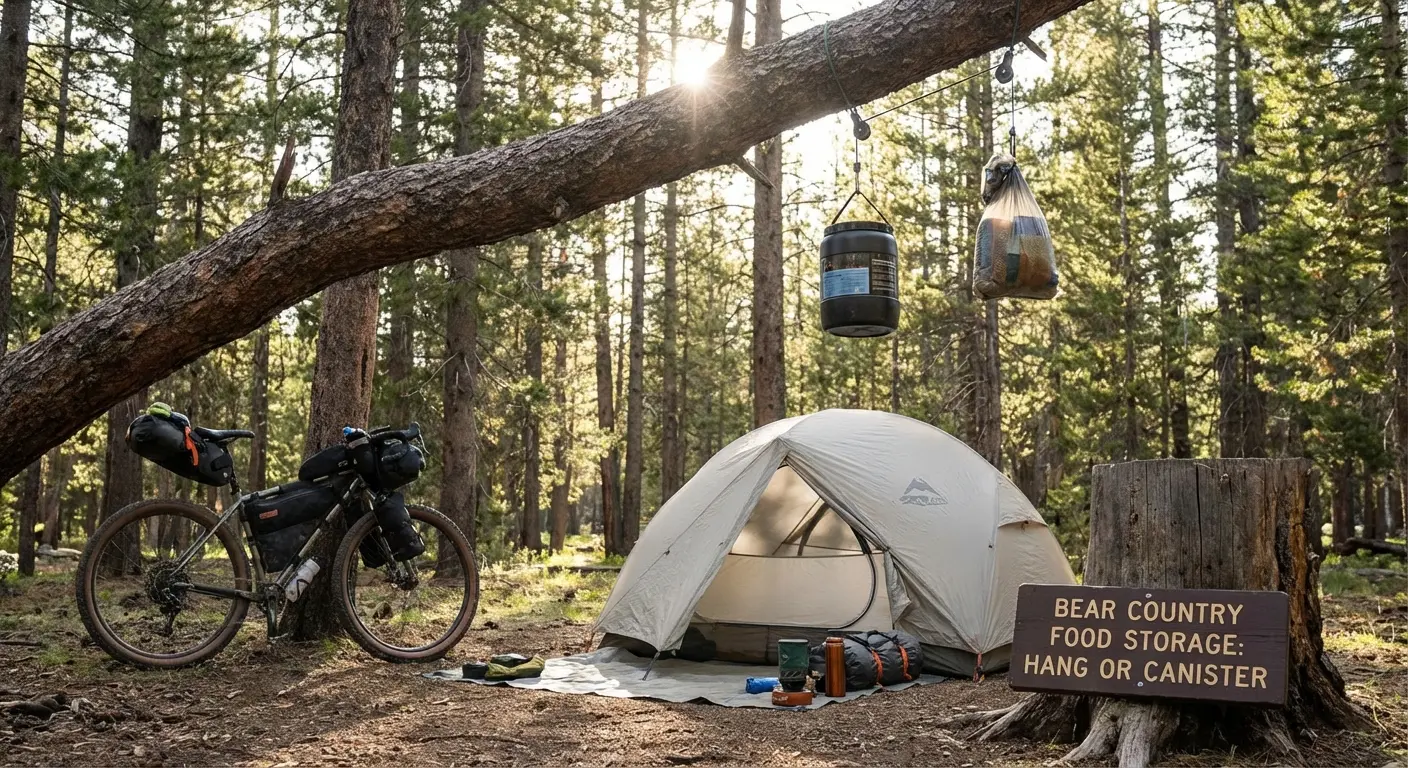
Traditional method: hang food from a tree branch where bears cannot reach.
How it works: Suspend food bag from a tree branch at least 10-12 feet high and 4-6 feet from the trunk. Bears can't climb thin branches or reach the bag.
Pros:
- Lightweight (just the bag and rope)
- Packs easily on a bike
- Inexpensive
- Works with any food container
Cons:
- Requires suitable trees
- Technique matters—poor hangs fail
- Time-consuming (15-30 minutes)
- Not allowed in some areas
- Doesn't work above treeline
Best for: Forested areas without canister requirements, experienced wilderness travelers.
Ursacks
Bear-resistant fabric bags made from bulletproof material.
How they work: Spectra/Kevlar fabric that bears cannot tear. Must be tied to a tree to prevent bears from carrying them off. Some models are also IGBC-certified.
Pros:
- Lighter than canisters (7-8 oz)
- Packs flat—better for bike bags
- Acceptable in many (not all) canister-required areas
- More affordable than canisters
Cons:
- Must be tied to a tree
- Bears can crush contents
- Not accepted everywhere
- Contents may be punctured through fabric
Best for: Weight-conscious bikepackers in areas that accept Ursacks.
Featured Products
BearVault BV500
The BV500 is the most popular bear canister for good reason: it balances capacity, weight, and packability better than competitors. At 7.2L capacity, it holds about 6-7 days of food for most hikers (less for hungry bikepackers). The 2 lb 9 oz weight is reasonable for the protection provided. The wide opening makes packing and accessing food easier than narrow-mouth designs. Clear plastic lets you see contents. The screw-top lid requires a coin or tool to open—defeating bears while remaining manageable for humans. IGBC certified and approved in all canister-required areas. If you need a canister, start here.
- 7.2L capacity (6-7 days food)
- 2 lb 9 oz weight
- Wide-mouth opening
- IGBC certified everywhere
- Clear visibility of contents
Ursack Major XL
For bikepackers, the Ursack Major XL offers the best compromise between protection and packability. At 10.65L, it holds more than most canisters while weighing just 8.8 oz—less than a quarter the weight. The Spectra fabric is bear-resistant (IGBC certified), though bears can crush contents—use aluminum liner if protecting fragile items. The bag packs flat into any bikepacking bag, unlike rigid canisters. Must be tied to a tree to prevent bears from carrying it off. Accepted in most—but not all—canister-required areas. Check regulations for your specific route. For bikepacking where weight and packability matter, this is the move.
- 10.65L capacity—more than canisters
- Only 8.8 oz weight
- Packs flat for bike bags
- IGBC certified
- Spectra fiber construction
Loksak OPSAK
Whatever container you use, the OPSAK odor-proof bags add crucial scent control. Bears find food by smell from miles away—eliminating odor reduces detection. These bags are laboratory-certified odor-proof (not just odor-resistant like regular dry bags). Use inside your bear canister, Ursack, or hanging bag for maximum protection. Also useful for separating scented items (toiletries, sunscreen) from food. Available in various sizes. At just a few ounces, there's no reason not to add this layer of protection. Note: Odor-proof bags are NOT bear-resistant—they must go inside proper storage.
- Laboratory-certified odor-proof
- Use inside any bear container
- Multiple size options
- Lightweight addition
- Reduces bear detection
Sea to Summit Ultra-Sil Stuff Sack (for hanging)
For traditional bear hangs, you need a durable stuff sack and quality rope. Sea to Summit's Ultra-Sil stuff sacks are the standard: ultralight silnylon construction at just 0.9 oz for the 13L size, water-resistant, and durable enough for repeated hanging. The drawstring closure secures the rope easily. Pair with 50+ feet of paracord or bear hang line. This method requires proper technique—learn the PCT method or counterbalance method before relying on it. In areas without canister requirements and with suitable trees, hanging remains a viable lightweight option. Just do it correctly.
- Just 0.9 oz (13L size)
- Durable silnylon construction
- Water-resistant
- Perfect for hanging setups
- Multiple size options
Comparison Table
| Factor | Canister | Ursack | Bear Bag (Hang) |
|---|---|---|---|
| Weight | 2-3 lbs | 7-9 oz | 2-4 oz |
| Volume | 7-12L | 10-15L | Unlimited |
| Packability | Poor for bikes | Excellent | Excellent |
| Effectiveness | Highest | High | Moderate |
| Accepted everywhere | Yes | Most areas | No (banned some places) |
| Requires tree | No | Yes | Yes |
| Cost | $60-100+ | $80-120 | $15-30 |
| Skill required | Minimal | Minimal | Moderate |
| Above treeline | Works | Problematic | Doesn't work |
Choosing the Right System
Choose a Bear Canister If:
- Regulations require it (no choice)
- Camping above treeline
- In grizzly country (maximum protection)
- You want foolproof protection
- You can solve the packing challenge
Choose an Ursack If:
- Weight and packability are priorities
- Your route accepts Ursacks (verify!)
- Trees are available for tying off
- You'll use an odor-proof liner
- You don't need to protect crushable items
Choose Bear Hanging If:
- No canister requirement in your area
- Black bear country only
- Plenty of suitable trees on route
- You have proper technique
- Budget is a concern
Packing Bear Canisters on a Bike
The biggest challenge for bikepacking: canisters are round and bulky.
Options That Work
- Some larger handlebar bags accommodate smaller canisters
- Pack canister horizontal, pad with clothes
- Center of gravity is high but manageable
Rear rack + dry bag:
- If using a rear rack, strap canister on top
- Secure firmly—vibration is significant
- Works but adds weight and complexity
Trailer:
- For long expeditions, a trailer solves packing issues
- Not practical for most bikepacking
External attachment:
- Some riders strap canisters to frame with voile straps
- Affects handling; test before committing
What Doesn't Work
- Most frame bags (wrong shape)
- Seat packs (cylinder doesn't fit)
- Fork cages (too small for most canisters)
The Bikepacker's Canister
If you must use a canister, the Bear Boxer Contender is designed for bikes:
- Rectangular shape fits frame bags
- Lower capacity (375 cubic inches)
- Significantly easier to pack
Proper Bear Hang Technique
If using the hanging method, technique determines success.
The PCT Method (Recommended)
- Find a branch 15-20 feet high, extending 10+ feet from trunk
- Tie a rock or weight to rope end
- Throw over branch, 4-6 feet from trunk
- Tie food bag to rope
- Tie a loop in the rope at head height
- Raise bag to branch level
- Insert a stick through the loop
- Release—bag drops, stick catches at branch
- Bag hangs 12+ feet high, 4+ feet from trunk
Minimum Standards
- 12 feet above ground
- 4-6 feet from tree trunk
- 4 feet below branch (so bears can't reach from above)
- Branch too thin to support a bear
Common Mistakes
Too low: Bears can jump 8+ feet. Hang higher. Too close to trunk: Bears climb and reach. Branch too thick: Bears can walk out on it. Weak knots: Bag falls overnight. Insufficient distance from tent: Camp at least 200 feet away from hang.
Beyond Food: What to Store
Bear-resistant storage applies to anything with scent:
Must store:
- All food (including wrappers and crumbs)
- Toiletries (toothpaste, deodorant, sunscreen)
- Lip balm and chapstick
- Medicines
- Garbage and food waste
Consider storing:
- Cookware (if food residue)
- Stove (fuel residue)
- Clothes worn while cooking
Keep with you:
- Clean clothes
- Sleeping bag
- Tent
Camp Layout
        Wind Direction →

[Food Storage] ←—— 200+ feet ——→ [Tent]
     ↑                              ↑
     |                              |
[Cooking Area] ←— 200 feet ——————→ |
Store food, cook, and sleep in a triangle at least 200 feet apart when possible.
Area-Specific Regulations
Always Verify Current Rules
Regulations change. Always check current requirements for your specific route.
Common Canister-Required Areas
National Parks (US):
- Yosemite (required)
- Denali (required)
- North Cascades (some areas)
- Yellowstone (some areas)
- Glacier (recommended/required zones)
Wilderness Areas:
- Many in California (Eastern Sierra)
- Select areas in Wyoming, Montana
Check: Each area maintains current requirements online. Some accept Ursacks; some require hard-sided canisters only.
Where Hanging Is Prohibited
Some areas have banned hanging due to:
- Bear habituation to hang sites
- Insufficient suitable trees
- Repeated hang failures
In these areas, canisters are the only legal option.
Common Mistakes
Mistake 1: Ignoring Regulations
"I'll just hang my food"—in a canister-required area, this is illegal and irresponsible.
Fix: Research regulations for your specific route before departure.
Mistake 2: Poor Hang Technique
Half-hearted hangs fail. Bears can reach improperly hung food.
Fix: Learn and practice proper technique before relying on it.
Mistake 3: Forgetting Scented Items
Your toothpaste smells as interesting to a bear as your dinner.
Fix: Store all scented items—not just food.
Mistake 4: Cooking Near Sleep Area
Sleeping where you cooked invites curious bears.
Fix: Maintain 200+ feet between cooking and sleeping.
Mistake 5: Leaving Food in Bike Bags
"Just for the night"—bikes are not bear-proof.
Fix: Never leave food in bike bags overnight in bear country.
FAQ
Are bear canisters actually necessary?
Where required, yes—it's the law. Where not required, they're the most effective option in grizzly country. In black bear areas, properly executed hangs or Ursacks work well.
Will an Ursack protect my food completely?
From being eaten, yes. From being crushed, no. Bears can chew and crush contents through the fabric. Use an aluminum liner (AllMitey insert) for delicate items.
Can bears open BearVaults?
No properly closed BearVault has been opened by a bear. Issues occur when lids aren't fully closed or canisters are cracked.
How do I know if an area requires canisters?
Check the land manager's website (National Park Service, Forest Service, BLM). Call ranger stations for current info. When in doubt, ask.
What about electric fences?
Lightweight electric fences (like Udap Bear Shock) are effective but expensive and add complexity. Used more for basecamp situations than bikepacking.
Is bear spray a substitute for proper food storage?
No. Bear spray is for encounters, not food protection. Always store food properly AND carry spray in bear country. See our emergency gear guide for essential safety items.
Quick Reference: Bear Storage Checklist
Before the trip:
- Research regulations for your route
- Obtain required canister or approved container
- Practice hang technique if using that method
- Pack odor-proof bags for scented items
At camp:
- Store food 200+ feet from sleep area
- Include all scented items (toiletries, garbage)
- Verify hang height/distance or canister closure
- Keep clean clothes separate from cooking clothes
Morning:
- Check that container wasn't disturbed
- Pack all food-related items (including crumbs)
- Leave no trace of food at campsite
For food recommendations, see our Complete Bikepacking Food Guide. For resupply strategy, check How to Resupply on Long Bikepacking Routes.
Store properly. Protect bears. Protect yourself.