Calorie-Dense Foods for Bikepacking: Maximize Nutrition, Minimize Weight
20+ years testing gear in Colorado backcountry
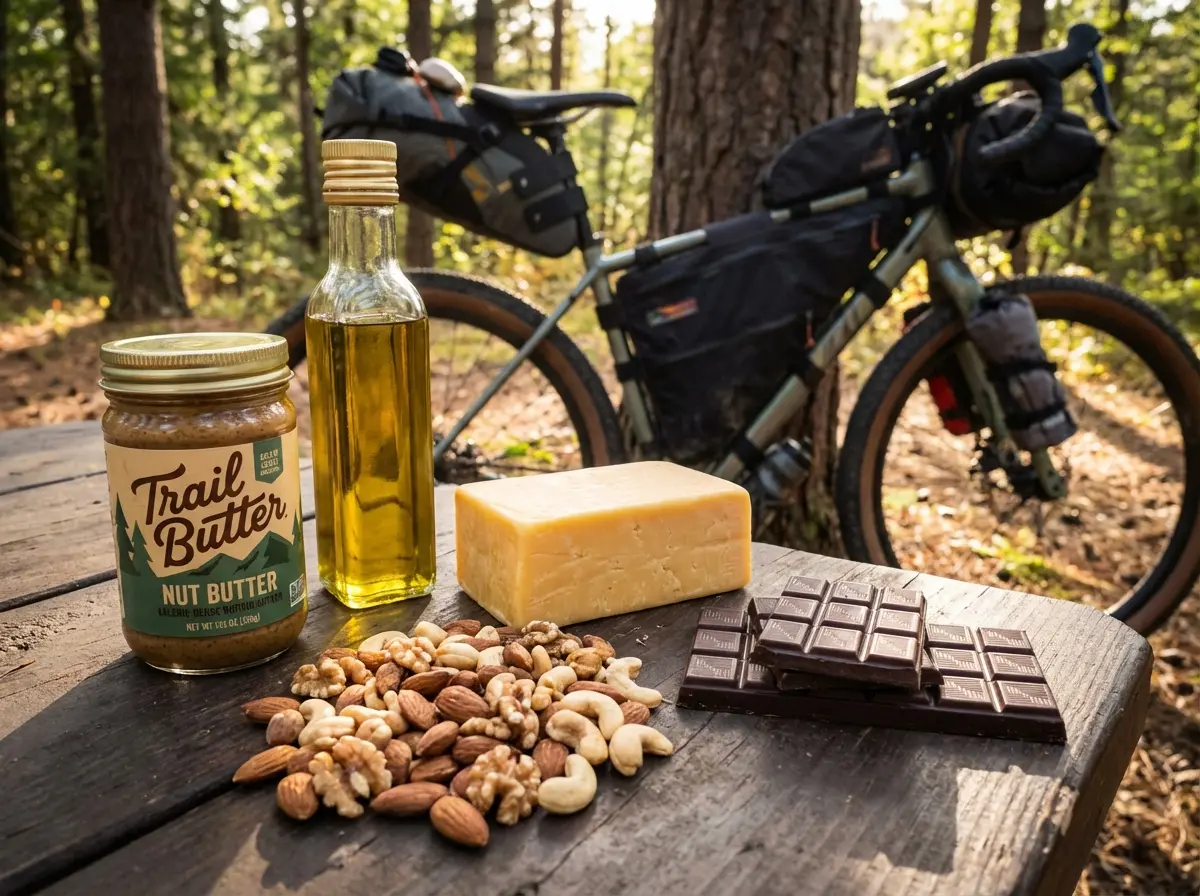
Every Ounce Earns Its Place
Weight is the enemy of climbing. Every extra ounce in your bags means more effort on every hill, more strain on every mile. Yet you need calories—lots of them—to keep pedaling day after day. The solution: calorie-dense foods that deliver maximum energy in minimum weight.
This isn't about eating less. It's about eating smarter. The difference between a 100-calorie-per-ounce food and a 180-calorie-per-ounce food means carrying 40% less weight for the same energy. Over a week-long trip, that adds up to pounds.
This guide breaks down the most calorie-efficient foods for bikepacking, explains the science behind calorie density, and helps you build a food strategy that fuels hard riding without weighing you down.
For complete nutrition planning, see our Complete Bikepacking Food Guide. For no-cook strategies using these foods, check No-Cook Bikepacking Food.
Understanding Calorie Density
The Math That Matters
Calorie density is simple: calories divided by weight. Foods range dramatically:
| Food Type | Calories/Ounce | Weight for 3,000 cal |
|---|---|---|
| Fresh vegetables | 5-15 | 12-37 lbs |
| Fresh fruit | 15-25 | 7-12 lbs |
| Bread | 75-85 | 2.2-2.5 lbs |
| Freeze-dried meals | 100-130 | 1.4-1.9 lbs |
| Trail mix | 140-160 | 1.2-1.3 lbs |
| Nuts | 160-180 | 1.0-1.2 lbs |
| Nut butter | 170-190 | 1.0-1.1 lbs |
| Olive oil | 250 | 0.75 lbs |
The difference is massive. Carrying fresh vegetables for a day's calories would require a trailer. Carrying nut butter? Fits in your jersey pocket.
Why Fat Wins for Weight Efficiency
Fat contains 9 calories per gram. Carbohydrates and protein contain 4 calories per gram. Pure math: fat-rich foods are more calorie-dense.
But you can't eat pure fat—and you shouldn't. Your body needs carbohydrates for high-intensity effort and protein for recovery. The optimal strategy combines calorie-dense fat sources with adequate carbs and protein.
The Practical Sweet Spot
For bikepacking, target foods with 130+ calories per ounce for the bulk of your provisions. Below that, you're carrying excess weight. Above 180 cal/oz, options become limited to pure fats and aren't practical as main foods.
The Calorie Density Champions
Tier 1: Maximum Density (180+ cal/oz)
These foods deliver the most calories per ounce—use them strategically.
Olive Oil: 250 cal/oz The ultimate calorie bomb. Add to any savory meal for instant calorie boost.
- Carry in small squeeze bottle or individual packets
- Drizzle on couscous, rice, ramen
- No protein or carbs—pure fat supplement
Coconut Oil: 250 cal/oz Similar to olive oil but solid at cool temperatures.
- Easier to transport in solid form
- Add to oatmeal, coffee (if you're into that)
- Subtle coconut flavor
Macadamia Nuts: 200 cal/oz The most calorie-dense common nut.
- Expensive but incredibly efficient
- Buttery flavor, easy to eat
- 2g protein, 21g fat per ounce
Pecans: 195 cal/oz Nearly as dense as macadamias, often cheaper.
- Great in trail mix
- 3g protein, 20g fat per ounce
Tier 2: Excellent Density (160-180 cal/oz)
The workhorses of calorie-efficient bikepacking food.
Peanut Butter: 170 cal/oz The bikepacking classic for good reason.
- Balanced macros (7g protein, 14g fat, 6g carbs per 2 tbsp)
- Versatile—spread, dip, or eat straight
- Available everywhere
- Individual packets eliminate mess
Almond Butter: 175 cal/oz Slightly more calorie-dense than peanut butter.
- Similar versatility
- Different flavor for variety
- Often costs more
Almonds: 165 cal/oz Best protein-to-calorie ratio among nuts.
- 6g protein per ounce
- Easy to portion and snack
- Combine with chocolate for trail mix
Cashews: 160 cal/oz Lower fat than other nuts but still efficient.
- Creamy texture
- 5g protein per ounce
- Slightly lower density but great taste
Walnuts: 185 cal/oz Excellent omega-3 content.
- 4g protein per ounce
- Can taste bitter to some
- Mix into trail blends
Dark Chocolate: 155-165 cal/oz The morale food that's actually efficient.
- Choose 70%+ cacao for density
- Melts in heat—plan accordingly
- Great reward after hard sections
Peanuts: 165 cal/oz Budget-friendly density.
- 7g protein per ounce—highest among nuts
- Honey-roasted adds carbs and flavor
- Affordable for bulk buying
Tier 3: Good Density (130-160 cal/oz)
Solid choices for variety and balanced nutrition.
Cheese (Hard): 110-120 cal/oz Lower density but provides protein and satisfying variety.
- Parmesan: 120 cal/oz, travels indefinitely
- Aged cheddar: 115 cal/oz, lasts 5-7 days
- Good fat and protein source
Salami/Pepperoni: 140 cal/oz Protein-rich option that travels well.
- 6-8g protein per ounce
- High sodium (helpful while sweating)
- Satisfying meaty variety
Dried Coconut: 185 cal/oz Surprisingly calorie-dense.
- Add to oatmeal or trail mix
- Fiber content adds bulk
- Tropical flavor variety
Crackers (Wheat): 130-140 cal/oz Vehicle for spreads and toppings.
- Choose dense varieties (Triscuits, Wheat Thins)
- Provide carbohydrate base
- Crush-prone—pack carefully
Tortillas: 140-150 cal/oz The wrap that makes meals.
- Durable, versatile
- Carbohydrate-focused
- Last 5-7 days
Tier 4: Moderate Density (100-130 cal/oz)
Use selectively—these add variety but carry weight penalty.
Energy Bars: 120-140 cal/oz Convenient but not the most efficient.
- Clif Bars: ~120 cal/oz
- RX Bars: ~130 cal/oz
- Bobo's Oat Bars: ~140 cal/oz
- See Best Energy Bars for comparisons
Dried Fruit: 80-95 cal/oz Sugar-rich quick energy, but lower density.
- Dates: 80 cal/oz
- Apricots: 85 cal/oz
- Raisins: 85 cal/oz
- Use sparingly for variety
Jerky: 80-115 cal/oz High protein but relatively low calories.
- 10-15g protein per ounce
- Good recovery food
- Not weight-efficient for pure calories
Freeze-Dried Meals: 100-130 cal/oz Convenient but not density champions.
- Peak Refuel: ~160 cal/oz (exception)
- Mountain House: ~100 cal/oz
- See Best Freeze-Dried Meals
Building a Calorie-Optimized Food Bag
The 150+ Strategy
For maximum weight efficiency, aim for an average of 150+ calories per ounce across your entire food bag.
Sample calculation for 3-day trip:
- Daily need: 3,500 calories
- Total needed: 10,500 calories
- At 150 cal/oz average: 70 oz (4.4 lbs)
- At 120 cal/oz average: 87.5 oz (5.5 lbs)
Savings: 1.1 pounds just from smarter food choices.
Balancing Density with Nutrition
Pure calorie density isn't everything. You need:
- Carbohydrates for high-intensity riding
- Protein for muscle recovery
- Some variety to prevent food fatigue
Practical approach:
- 40% from Tier 1-2 foods (highest density)
- 40% from Tier 3 foods (good density, variety)
- 20% from Tier 4 foods (convenience, carbs)
Sample High-Density Food List
For a 3-day trip (aiming for ~3,500 cal/day):
| Food | Amount | Calories | Weight (oz) |
|---|---|---|---|
| Peanut butter | 8 tbsp | 1,360 | 8 |
| Almonds | 4 oz | 660 | 4 |
| Dark chocolate | 4 oz | 640 | 4 |
| Olive oil | 4 tbsp | 500 | 2 |
| Tortillas (6) | 6 ea | 900 | 6 |
| Hard cheese | 4 oz | 460 | 4 |
| Salami | 4 oz | 560 | 4 |
| Clif Bars (6) | 6 ea | 1,560 | 14 |
| Instant oatmeal (4) | 4 pkt | 600 | 6 |
| Dried fruit | 4 oz | 340 | 4 |
| Trail mix | 6 oz | 960 | 6 |
| Crackers | 4 oz | 520 | 4 |
| Total | 9,060 | 66 oz (4.1 lbs) |
Average density: 137 cal/oz—solid efficiency while maintaining variety.
Calorie Boosting Strategies
The Olive Oil Upgrade
Add 1-2 tablespoons of olive oil to any savory meal:
- Ramen: +250-500 calories
- Couscous: +250-500 calories
- Instant mashed potatoes: +250-500 calories
Carry olive oil in small squeeze bottles or use individual restaurant packets.
Nut Butter Everything
Stir nut butter into:
- Oatmeal (breakfast calorie bomb)
- Ramen (surprisingly good—peanut butter ramen is a thing)
- Tortillas (the classic)
- Eaten straight from packet
Two tablespoons adds ~190 calories to any meal.
Fat-Fortified Trail Mix
Standard trail mix: ~140 cal/oz Optimized trail mix: ~170 cal/oz
High-density trail mix recipe:
- 2 cups macadamia or cashew nuts
- 1 cup dark chocolate chips
- 1/2 cup dried coconut
- 1/2 cup peanuts
Skip or minimize dried fruit—it's the least calorie-dense ingredient.
Cheese on Everything
Hard cheese adds ~115 cal/oz plus satisfying variety:
- Crumble parmesan on savory meals
- Add cheddar chunks to wraps
- Eat alone as protein-rich snack
The Chocolate Strategy
Dark chocolate (70%+) delivers ~160 cal/oz plus morale:
- Portion into daily allotments
- Protect from melting (insulated bag position)
- Save for post-climb rewards
Meal-by-Meal Density Optimization
Breakfast: Fortified Oatmeal
Standard instant oatmeal: ~110 cal/oz Fortified oatmeal: ~160 cal/oz
Power oatmeal recipe:
- 1 packet instant oatmeal (100 cal)
- 2 tbsp nut butter (190 cal)
- 1 tbsp dried coconut (40 cal)
- 1 tbsp chocolate chips (70 cal)
Total: 400 calories in ~3 oz = 133 cal/oz
Trail Snacks: Maximum Density
This is where efficiency matters most—you're carrying it all day.
Prioritize:
- Nut butter packets
- High-fat trail mix
- Cheese chunks
- Dark chocolate
Minimize:
- Fresh fruit (too heavy)
- Most granola bars (lower density)
- Dried fruit alone (better as mix ingredient)
Dinner: Calorie-Boosted Meals
Standard ramen: ~130 cal/oz Boosted ramen: ~175 cal/oz
Calorie ramen recipe:
- 1 ramen packet (380 cal)
- 2 tbsp peanut butter (190 cal)
- 1 tbsp olive oil (120 cal)
- Crushed peanuts (85 cal)
Total: 775 calories in ~5 oz = 155 cal/oz
When to Sacrifice Density
Calorie density isn't the only factor. Sometimes lower-density foods earn their weight:
For Performance Carbs
During hard efforts, you need fast-absorbing carbohydrates. Lower-density options may be worth it:
- Energy gels (100 cal/oz but fast absorption)
- Dried fruit (quick sugars)
- Sports drinks (mostly water weight but necessary)
For Protein Recovery
Pure protein sources are less calorie-dense but essential:
- Jerky provides protein that nuts can't fully replace
- Tuna packets deliver complete protein
- Worth carrying for multi-day recovery
For Morale
Sometimes you need comfort food regardless of efficiency:
- Fresh fruit from town resupply
- A heavier treat you love
- Restaurant meals (infinite weight, maximum morale)
For Hydration
Water-heavy foods can help in dry conditions:
- Fresh fruit from resupply
- Vegetables at town stops
- Not for carrying, but for eating when available
Common Mistakes
Mistake 1: Ignoring Carbs Entirely
Fat is calorie-dense, but you still need carbohydrates for high-intensity riding. Don't go all-fat; maintain carb intake for performance.
Mistake 2: Skipping Protein
Nuts provide some protein, but extended trips need more. Include tuna packets, jerky, or cheese despite lower density.
Mistake 3: Only Counting Calories
You need to actually eat your food. The most calorie-dense option you hate eating is worthless. Include variety.
Mistake 4: Not Testing Foods
Some calorie-dense foods (olive oil shots, etc.) don't agree with everyone's stomach. Test at home before depending on them for a trip.
Mistake 5: Forgetting Texture Variety
Eating only smooth, fatty foods gets old. Include crunchy, chewy, and solid options even if slightly less efficient.
FAQ
What's the single most calorie-dense food I can carry?
Pure olive oil or coconut oil at 250 calories per ounce. But you can't eat only oil—use it as a supplement to boost other foods.
How do I calculate my food bag's average calorie density?
Add up total calories of all foods, divide by total weight in ounces. Aim for 130+ cal/oz average.
Are freeze-dried meals calorie-dense enough?
Most average 100-130 cal/oz—decent but not optimal. Peak Refuel reaches ~160 cal/oz. Mix freeze-dried with denser supplemental foods.
Should I just carry nuts and nut butter?
You could survive on it, but you'd be miserable. Include variety for palatability and balanced nutrition.
Does eating calorie-dense food mean I can eat less volume?
Yes—that's partly the point. But listen to hunger signals. Feeling hungry despite adequate calories usually means you need more volume or variety.
What about calories per dollar?
Peanut butter and peanuts offer the best calorie-per-dollar ratio. Macadamia nuts are efficient by weight but expensive. Balance budget with weight goals.
Quick Reference: Calorie Density Chart
| Food | Cal/oz | Protein/oz | Best Use |
|---|---|---|---|
| Olive oil | 250 | 0g | Meal supplement |
| Coconut oil | 250 | 0g | Meal supplement |
| Macadamia nuts | 200 | 2g | Trail snacking |
| Pecans | 195 | 3g | Trail mix |
| Walnuts | 185 | 4g | Trail mix |
| Dried coconut | 185 | 2g | Oatmeal add-in |
| Almond butter | 175 | 6g | Spread/supplement |
| Peanut butter | 170 | 7g | Spread/supplement |
| Almonds | 165 | 6g | Snacking |
| Peanuts | 165 | 7g | Trail mix |
| Dark chocolate | 160 | 2g | Morale/snacking |
| Cashews | 160 | 5g | Snacking |
| Trail mix (optimized) | 160 | 5g | All-day snacking |
| Tortillas | 145 | 4g | Meal base |
| Salami | 140 | 6g | Protein source |
| Energy bars | 130 | 3-5g | Convenience |
| Hard cheese | 115 | 7g | Protein/variety |
| Jerky | 100 | 13g | Protein source |
| Dried fruit | 85 | 1g | Quick sugar |
For complete nutrition strategy, see our Complete Bikepacking Food Guide. For energy bar comparisons, check Best Energy Bars for Bikepacking.
Pack smart. Ride light. Fuel hard.