The Best Handlebar Packs for Bikepacking
20+ years testing gear in Colorado backcountry
Why Handlebar Placement Matters
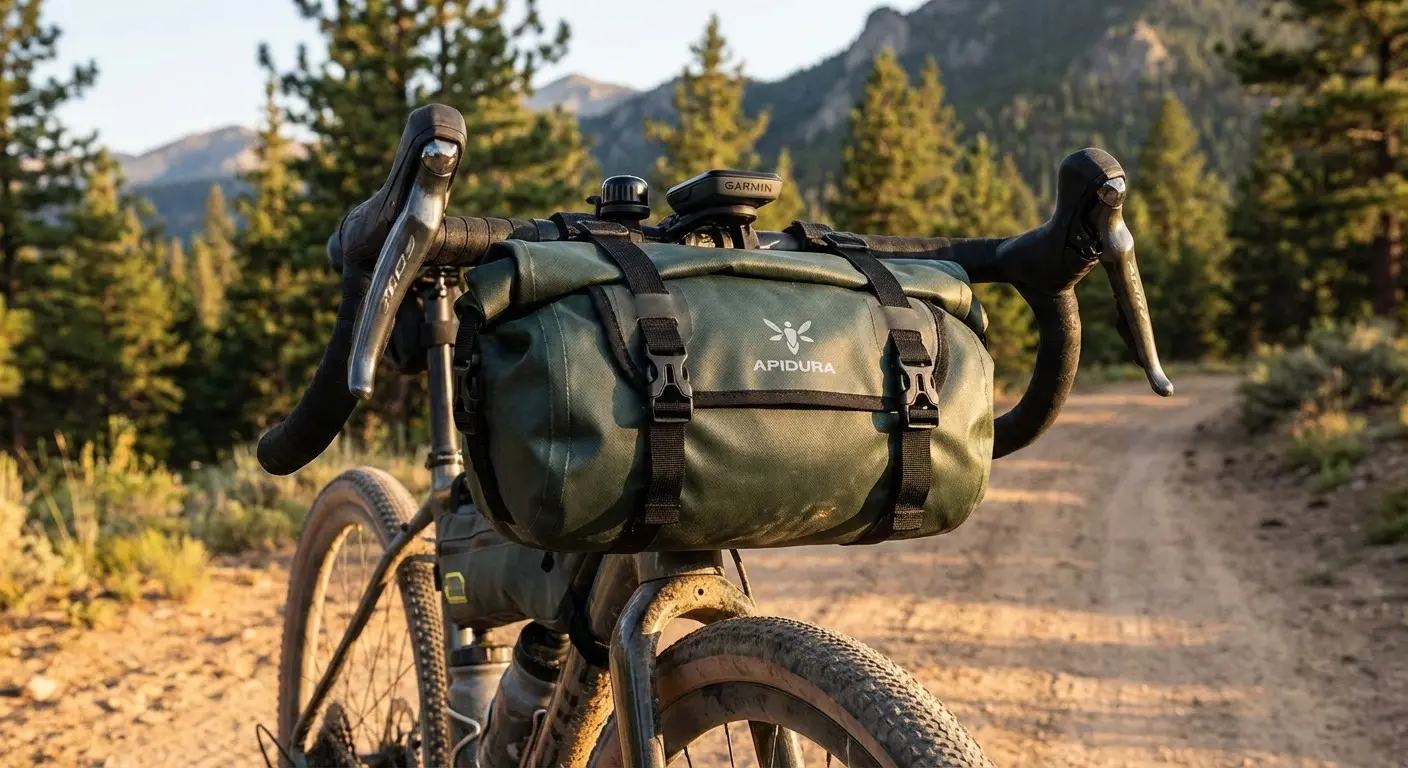
Handlebar bags sit at the most accessible position on your bike—perfect for items you need without stopping. Rain jacket when clouds roll in. Snacks for the next climb. Camera for that surprise vista.
But that prime real estate comes with a tradeoff: weight on your handlebars affects steering. Too much bulk slows your handling on technical terrain. A poorly mounted bag rotates or bounces, creating distracting movement in your peripheral vision.
The best handlebar bags balance capacity with stability. They mount rigidly to prevent rotation, pack enough gear for your needs without excess bulk, and keep contents dry when weather turns.
Here's what works in 2025.
For a complete overview of all bag types, see our Complete Bikepacking Bag & Storage Guide.
Handlebar Bag Basics
Harness Systems vs. Integrated Bags
Harness systems use a rigid frame that mounts to your handlebars, with a separate dry bag that clips into the harness. Pros: you can swap dry bags for different trips, and the harness stays put when you remove the bag at camp. Cons: more complex setup, slightly heavier.
Integrated bags mount directly to your bars using straps. Simpler design, often lighter, but removing the entire bag means re-strapping each time.
Sizing Considerations
- Small (3-6L): Quick-access items only—phone, snacks, rain jacket
- Medium (7-10L): Room for layers, food, and small shelter components
- Large (11-15L+): Tent, sleeping pad, or significant gear capacity
Most bikepackers find the 7-14L range offers the best balance. Smaller bags work for minimalist setups or as supplements to larger saddle bags. For beginners, see our complete gear guide for how handlebar bags fit into a full setup.
Drop Bars vs. Flat Bars
Drop handlebars present mounting challenges—the curved shape and brake/shift cables limit bag width. Look for bags specifically designed for drop bars, or choose narrower models.
Flat bars offer more mounting flexibility but less hand position variety during long days.
Featured Products
Ortlieb Handlebar-Pack (15L)
Ortlieb brings their legendary waterproof construction to handlebar bags—and it shows. The Handlebar-Pack uses the same welded seams and roll-top closure that made their panniers famous, rated IP64 for complete dust and splash protection. What sets it apart is the mounting system: spacers suspend the bag slightly from your bars, and a stiff internal structure plus head-tube strap eliminate the wobble that plagues cheaper bags. Dual side roll closures provide quick access, and the new air-release valve with pull string makes compression effortless. Heavy? Slightly. Worth it for reliability in any weather? Absolutely.
- IP64 waterproof rated
- Welded seam construction
- Spacer mounting system
- Dual side roll closures
- Air-release valve for compression
ROCKBROS Bikepacking Handlebar Bag (7-14L)
The ROCKBROS adjustable handlebar bag delivers genuine waterproofing at a fraction of premium prices. The 100% waterproof construction uses polyester with TPU coating and innovative seamless workmanship—no needle holes for water to penetrate. Capacity adjusts from 7L to 14L via roll-top compression, fitting everything from a minimal layer kit to a full tent and sleeping bag. Five fixed hooks plus compression straps keep the bag stable on rough terrain. For bikepackers who want real capability without the premium price tag, this is the bag to beat.
- 100% waterproof TPU construction
- Adjustable 7-14L capacity
- Seamless waterproof technology
- Five-point mounting system
- Compression straps for stability
Blackburn Outpost Elite Handlebar Roll
Blackburn nailed the harness concept. The rigid cradle mounts permanently to your bars, while a removable waterproof dry bag clips in and out in seconds. Need to grab your shelter at camp? Unclip and walk away—no re-strapping required. The scuba-style air bleed valve and welded seams keep contents bone-dry. The quick-release mount works with both 25.4mm and 31.8mm bars (not recommended for carbon). Where cheaper harness systems shift and rotate, the Outpost Elite stays locked in place over rough terrain.
- Rigid harness eliminates rotation
- Quick-release dry bag
- Scuba-style air bleed valve
- Welded waterproof seams
- Universal bar compatibility
ROCKBROS Handlebar Bag (6L)
Not every ride needs a massive handlebar bag. The ROCKBROS 6L handles daily essentials—phone, snacks, rain jacket, multitool—in a compact package that doesn't overwhelm your handlebars. The 600D nylon with TPU film provides solid water resistance (not fully waterproof, but handles light rain). Roll-down closure keeps moisture out while providing quick access. At this price point, it's worth keeping one in your gear closet for shorter rides that don't justify larger bags.
- Compact 6L capacity
- 600D nylon + TPU film
- Roll-down closure
- Budget-friendly price
- Good for day rides
Mounting Tips for Stability
Tighten straps properly. Loose straps cause rotation. Snug the bag against your bars until there's no play.
Use the head tube strap. Many handlebar bags include a strap that attaches to your frame's head tube. This single connection dramatically reduces bounce and rotation.
Pack strategically. Put heavier items toward the bottom and back of the bag, keeping weight closer to your stem. Light, bulky items (sleeping bag, clothing) work best in handlebar bags.
Check clearance. Ensure your bag doesn't contact brake cables or block your view of the front wheel. Test ride before committing to a multi-day trip.
The Quick-Access Test
Before your first real ride with a new handlebar bag, try this:
- Pack it fully with realistic gear
- Ride for 10 minutes on varied terrain
- Stop and time yourself:
- How long to grab your rain jacket? (Target: under 30 seconds)
- How long to get your snacks? (Target: under 15 seconds)
- How long to remove the entire bag? (Target: under 60 seconds)
If any of these take too long, adjust your packing. Items you need while riding should be at the top or in external pockets. Items you only need at camp can be buried.
The real test: Can you grab what you need with one hand while stopped but straddling your bike? If not, reorganize until you can.
What Goes in a Handlebar Bag?
The best handlebar bag items are those you need quick access to—or those that are bulky but light:
- Rain jacket / arm warmers / extra layer (grab without stopping)
- Snacks and food (eat on the go)
- Camera (quick shots)
- Tent / shelter (light, compressible)
- Sleeping pad (if you remove the valves)
- Puffy jacket (light, bulky, perfect for handlebar)
Avoid putting heavy items (tools, water, electronics) in handlebar bags—they belong in your frame bag where weight is centered and low. For more on optimal weight placement, see our weight distribution guide.
FAQ
Will a handlebar bag affect my steering?
Yes, but how much depends on weight and mounting. Light bags (under 2kg loaded) with rigid mounts have minimal impact. Heavy bags or loose mounts create noticeable handling changes, especially on technical terrain. Start light and adjust as you learn your tolerance.
Can I use a handlebar bag with drop handlebars?
Yes, but choose carefully. Wider bags interfere with drops and brake/shift cables. Look for bags specifically designed for drop bars, or opt for narrower models. The 9L Ortlieb works well with drops; the 15L fits flat bars better.
Waterproof vs. water-resistant—which do I need?
For fair-weather riders, water-resistant bags work fine. If you ride in genuine rain or expect wet conditions, invest in fully waterproof construction. A simple test: will you be upset if the contents get wet? If yes, go waterproof.
How do I prevent my bag from bouncing?
Use the head tube strap if your bag includes one. Tighten all mounting straps until there's zero play. Pack heavier items at the bottom and back. Consider bags with internal stiffeners or harness systems for maximum stability.
Can I still use my handlebar bag off the bike?
Most handlebar bags work as standalone stuff sacks or dry bags. Harness systems excel here—the dry bag unclips cleanly while the harness stays mounted. Strap-mount bags require full removal each time.
For other bag options to complete your setup, see our Best Saddle Bags and Best Frame Bags guides.