Fork Bags and Cargo Cages: Expanding Your Bikepacking Capacity
20+ years testing gear in Colorado backcountry
Unlock Your Fork's Carrying Potential
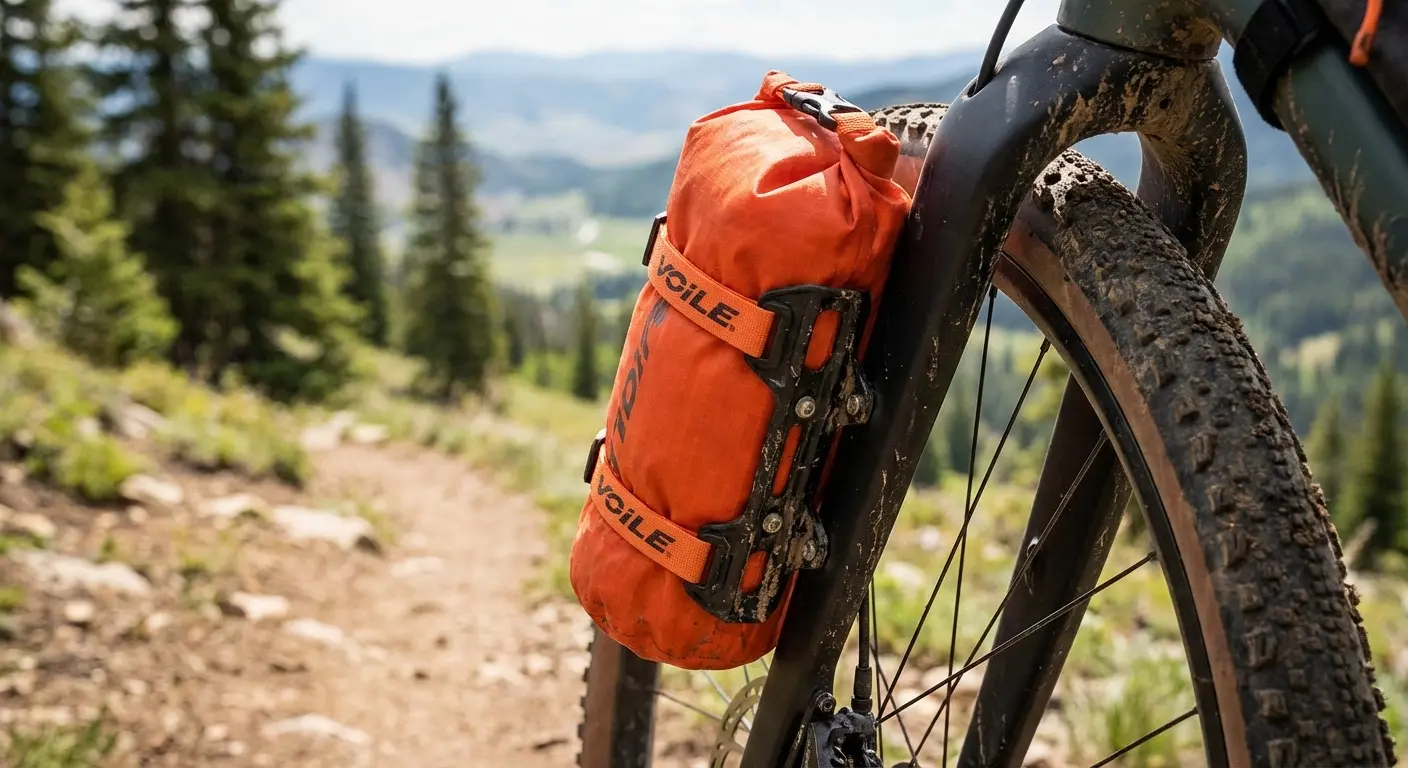
When your frame bag, saddle bag, and handlebar bag are full, your fork offers untapped capacity. Fork-mounted cargo is the secret to expedition-level carrying without panniers or racks—and it affects handling far less than you'd expect.
In 2010, Salsa invented the cargo cage category with the Anything Cage. Since then, fork-mounted storage has become standard for serious bikepackers. The approach is simple: bolt-on cages hold dry bags, water bottles, or specialized fork bags in the low, forward position where weight impacts handling least.
This guide covers cargo cage options, explains what works best where, and helps you decide between cages-plus-bags versus dedicated fork bags.
For complete bag system guidance, see our Bikepacking Bag & Storage Guide. Fork bags are just one piece of the puzzle—understanding how all your bags work together is essential for balanced, comfortable carrying.
Why Fork Storage Works
Low Weight Position
Weight on your fork sits low and forward—the least disruptive position for handling. Unlike a heavy handlebar bag that can make steering feel sluggish, fork-mounted cargo barely changes how your bike feels.
Accessible While Stopped
Fork bags are easy to access when you stop. No dismounting from your bike, no awkward reaching behind you. Pop off the dry bag, grab what you need, strap it back.
Additional Capacity Without Racks
For bikes without rack mounts (most gravel and mountain bikes), fork cages add 6-10+ liters of capacity per side. That's meaningful—enough for food, water, spare clothing, or sleeping pads.
Cargo Cage + Dry Bag Systems
The classic approach: bolt cargo cages to your fork's three-pack mounts, then strap dry bags or other gear to the cages.
How It Works
Cargo cages bolt to the three threaded inserts on adventure-ready forks (sometimes called "three-pack mounts"). Rubber or nylon straps secure dry bags, stuff sacks, or water bottles to the cage. The system is modular—any appropriately-sized bag works.
Advantages
- Versatility: Use any bag that fits, switch sizes based on trip needs
- Replaceable: Dry bags wear out or get damaged; replace just the bag
- Affordable: Budget dry bags cost little
- Proven: Thousands of bikepackers use this system without issues
Disadvantages
- Strap management: Rubber straps eventually degrade and need replacement
- Less aero: More exposed straps and potential for flapping
- Requires matching: Need to find bags that fit your specific cage
Featured Products
Salsa Anything Cage HD with Straps
The cage that started the category remains the benchmark. The Anything Cage HD uses three-bolt mounting for maximum security under heavy loads, and the glass-filled nylon construction handles years of abuse. The included rubber straps outperform competitors—thicker, more durable, and with better grip. At 4.6 inches wide, it accommodates larger dry bags than most alternatives. The 6.6 lb weight capacity handles legitimate cargo. If you're running cargo cages, start here—Salsa pioneered the concept and continues to refine it.
- Three-bolt secure mounting
- Glass-filled nylon durability
- 6.6 lb weight capacity
- High-quality rubber straps included
- 4.6 inch wide for larger bags
Blackburn Outpost Cargo Cage
The Outpost takes a different design approach—alloy tubing construction creates an open, lighter cage with sleeker aesthetics. The 11 lb weight limit exceeds most competitors, making it suitable for heavy loads like water in arid routes. The updated version includes holes for 64mm three-bolt mounting. The included straps are functional but not as refined as Salsa's—many riders upgrade the straps. For riders preferring the tubular look or needing maximum weight capacity, the Outpost delivers.
- 11 lb weight capacity
- Alloy tubing construction
- Updated 64mm mounting
- Sleek tubular design
- Lighter than nylon cages
Blackburn Outpost Elite Cargo Bag
If you want a purpose-built fork bag rather than cage-plus-dry-bag, the Outpost Elite provides an integrated solution. The rolltop 6.5L bag attaches directly to cargo cages (Blackburn's or competitors'), with stability and access designed specifically for fork mounting. Waterproof construction protects contents. The trade-off: you're locked into this specific bag rather than the flexibility of mixing dry bags. For riders who want a ready-to-go system without assembling components, it's a solid choice.
- 6.5L capacity
- Rolltop waterproof closure
- Designed for cargo cages
- Integrated mounting
- Ready-to-use system
Choosing Your System
Cargo Cage + Dry Bag
Best for:
- Riders who want flexibility to swap bag sizes
- Budget-conscious setups (basic dry bags are cheap)
- Those who already own dry bags
- Expedition riding where bag replacement may be needed
Recommended setup: Salsa Anything Cage + lightweight dry bag (3-5L per side)
Dedicated Fork Bags
Best for:
- Riders who want plug-and-play simplicity
- Those prioritizing waterproofing
- Cleaner aesthetic preference
- Quick on/off for camp access
Recommended setup: Blackburn Outpost Elite or similar integrated fork bag
Bottle Cages Only
Best for:
- Hot-weather riding with hydration priority
- Minimalist setups where frame cages are blocked
- Supplementing, not replacing, main carrying capacity
Recommended setup: Standard bottle cages on fork mounts (many work on three-pack bosses)
What to Pack in Fork Bags
Fork position works best for certain items:
Ideal for fork storage:
- Extra water (especially for arid routes)
- Snacks and food
- Sleeping pads (in stuff sacks)
- Spare clothing
- Camp shoes
- Tent poles (if your fork bag accommodates length)
Less ideal for fork storage:
- Heavy, dense items (better in frame bag)
- Frequently-accessed items (top tube bag is faster)
- Fragile electronics (more vibration exposure)
Weight Distribution
For best handling, keep fork loads balanced side-to-side. Uneven loading creates a steering pull toward the heavier side. When running a single fork bag, some riders position it on the non-drive side to offset drivetrain weight.
The Balance Test Before Every Ride
Before heading out with loaded fork bags, run this 60-second check:
- Visual balance: Stand behind the bike and look at both fork bags—are they roughly the same size and fullness?
- Lift test: Lift the front wheel by the handlebars—does it feel balanced or does one side dip?
- Hands-free test: Find a flat section and (safely) ride briefly with very light hand pressure—does the bike track straight or pull to one side?
- Clearance check: Turn the handlebars full lock each direction—do the bags contact the down tube or front wheel?
If anything fails, rebalance before your ride. A minor pull at slow speeds becomes exhausting over 50 miles.
Fork Compatibility
Three-Pack Mounts
Modern adventure, gravel, and touring bikes typically include three threaded inserts (M5 bosses) on each fork leg. These "three-pack" mounts space 64mm apart—the standard for cargo cages.
Check your fork before purchasing. Some forks have only two bosses or non-standard spacing.
Adding Mounts
If your fork lacks mounts, clamp-on solutions exist but are less secure than threaded bosses. Hose clamps or dedicated fork mount adapters add capability to unsupported forks. For more tips on adapting bikes without built-in mounts, see our guide on How to Convert Any Bike for Bikepacking.
Suspension Fork Considerations
Most suspension forks lack cargo cage mounts and have minimal clearance. Some hardtail bikepacking setups use rigid fork conversions specifically to gain fork mounting capability.
Mounting Tips
Proper Torque
Bolt cargo cages to spec torque—tight enough to prevent rotation, but not so tight you strip threads. Many cages include plastic washers that prevent frame/fork marring.
Strap Security
Rubber straps eventually degrade from UV exposure. Carry a spare strap or use voile straps as backup. Check strap security periodically during rides—vibration can loosen them.
Clearance Check
Before your trip, load your fork bags and check clearances:
- Wheel/tire clearance when turning
- Cable/hose clearance
- Brake caliper clearance
- Fender clearance if applicable
Test on rough terrain to ensure nothing shifts or contacts moving parts.
FAQ
How much weight can I put on my fork?
Most cargo cages support 5-11 lbs per cage. More importantly, your fork has its own limits—check manufacturer specs. Generally, 3-5 kg (6.5-11 lbs) per side is reasonable for most adventure forks.
Will fork bags affect handling?
Minimally. The low, forward position is surprisingly neutral for handling. Heavy loads (especially asymmetric ones) have more impact. Most riders notice little difference with reasonable loads.
Cargo cage or dedicated fork bag?
Cargo cage + dry bag for flexibility and budget efficiency. Dedicated fork bag for convenience and integrated design. Neither is objectively better—choose based on your priorities.
Can I use regular bottle cages on fork mounts?
Some standard bottle cages fit fork three-pack mounts. Others don't—spacing and mounting hole position vary. Check compatibility before purchasing.
Quick Recommendations
Best cargo cage: Salsa Anything Cage HD—the original and still the benchmark.
Best for heavy loads: Blackburn Outpost Cargo Cage—11 lb capacity for water-heavy routes.
Best complete system: Blackburn Outpost Elite Bag—ready-to-use fork bag for cages.
For complete bag system guidance, return to our Bikepacking Bag & Storage Guide. See also our Best Frame Bags and Best Saddle Bags guides for the full picture.
Expand your capacity. The fork has room.