Water Filtration Systems for Bikepacking
20+ years testing gear in Colorado backcountry
Safe Water, Anywhere
As the CDC's water treatment guidelines explain, proper filtration is essential for safe backcountry hydration. Water filtration provides freedom—instead of calculating water carries and planning around known sources, you can drink from natural water wherever you find it.
This guide covers the main filtration technologies, compares leading systems for bikepacking, and helps you choose the right approach for your riding style.
For complete hydration strategy, see our Packing List and Camp Gear Guide.
Filtration vs. Purification
Filters
Filters physically strain water through membranes with pores small enough to block pathogens. Most camping filters use 0.1-0.2 micron pores.
What filters remove:
- Protozoa (giardia, cryptosporidium) ✓
- Bacteria (E. coli, salmonella) ✓
- Sediment and particulates ✓
- Viruses ✗ (usually)
Best for: North America, Europe, and other areas where viral contamination is rare.
Purifiers
Purifiers add virus removal capability through UV light, chemicals, or finer filtration.
What purifiers remove:
- Everything filters remove ✓
- Viruses (norovirus, hepatitis A) ✓
Best for: International travel, areas with human fecal contamination, questionable water sources near agriculture or settlements.
Which Do You Need?
For most North American bikepacking, a filter is sufficient. Viral waterborne illness is rare in backcountry settings. If you're bikepacking internationally or using water sources near human activity, consider purification.
The Water Audit: Before Every Multi-Day Trip
Water strategy fails when you don't think it through. Run this audit before any trip longer than an overnight:
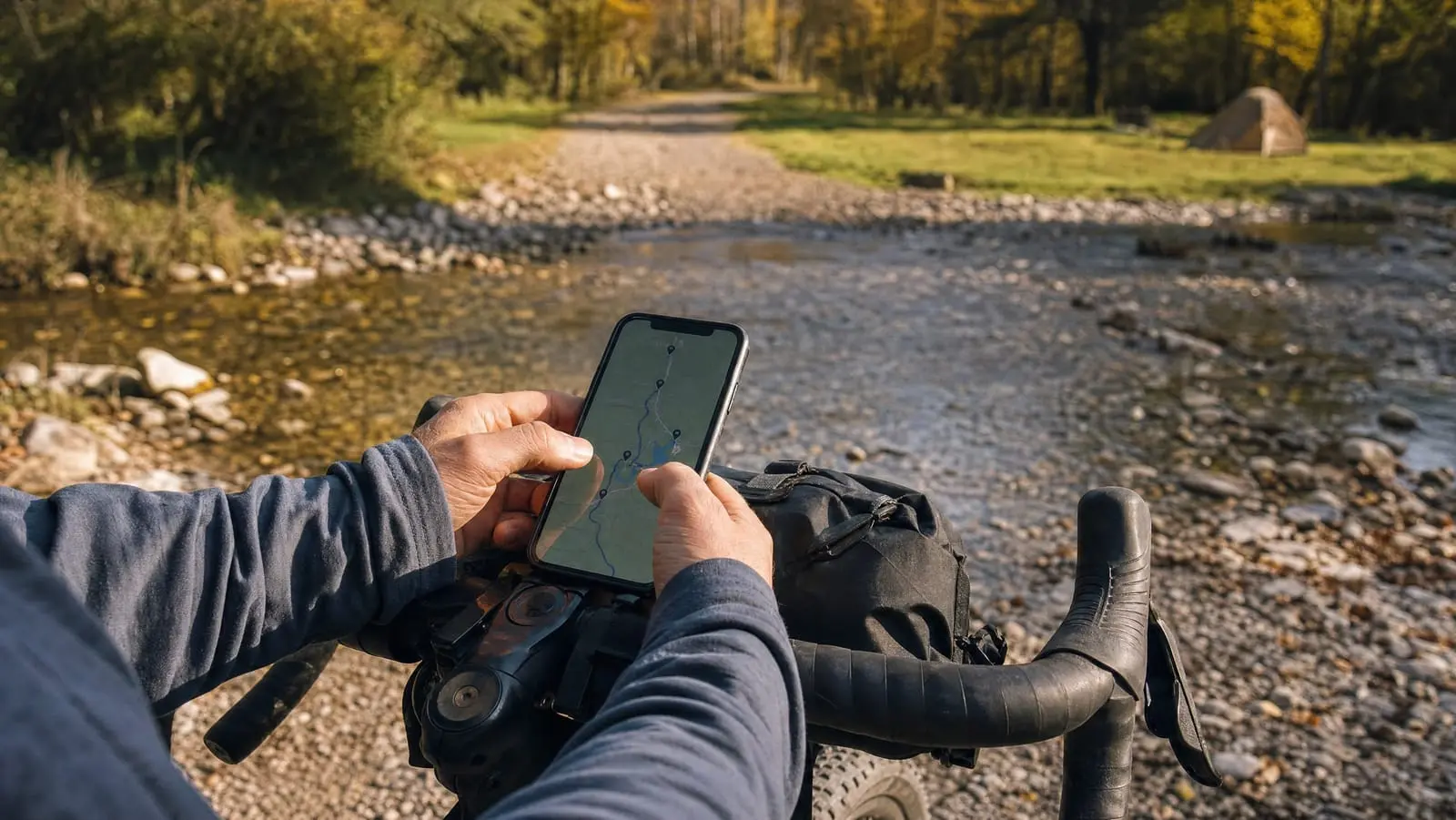
Route Analysis (10 minutes with map):
- Mark all water sources on your route (streams, springs, lakes, towns)
- Measure distances between sources—what's the longest dry stretch?
- Identify questionable sources (livestock nearby? mining? agriculture?)
- Note seasonal reliability (that creek on the map might be dry in August)
- Plan your carries based on longest gap + 50% safety margin
The Carry Math:
- Average consumption: 0.5-1L per hour of riding in moderate weather
- Hot weather multiplier: 1.5-2x normal consumption
- Your carrying capacity: Count bottles, bladders, and emergency containers
- Safety margin: Always carry enough to reach the NEXT source after your planned refill
Example Calculation:
- Longest dry stretch: 30 miles
- Estimated time: 4 hours
- Consumption rate: 0.75L/hour in moderate heat
- Needed: 3L minimum + 1L safety = 4L
- Your capacity: 2 bottles (1.5L) + frame bladder (2L) = 3.5L
- Problem identified: Need to add 0.5L capacity or filter at an intermediate source
What This Audit Reveals:
- Carry capacity gaps before they become emergencies
- Sections requiring early-morning starts (cooler = less water needed)
- Whether your route needs modification
- Where to push hard vs. where to rest
Filter Types for Bikepacking
Squeeze Filters
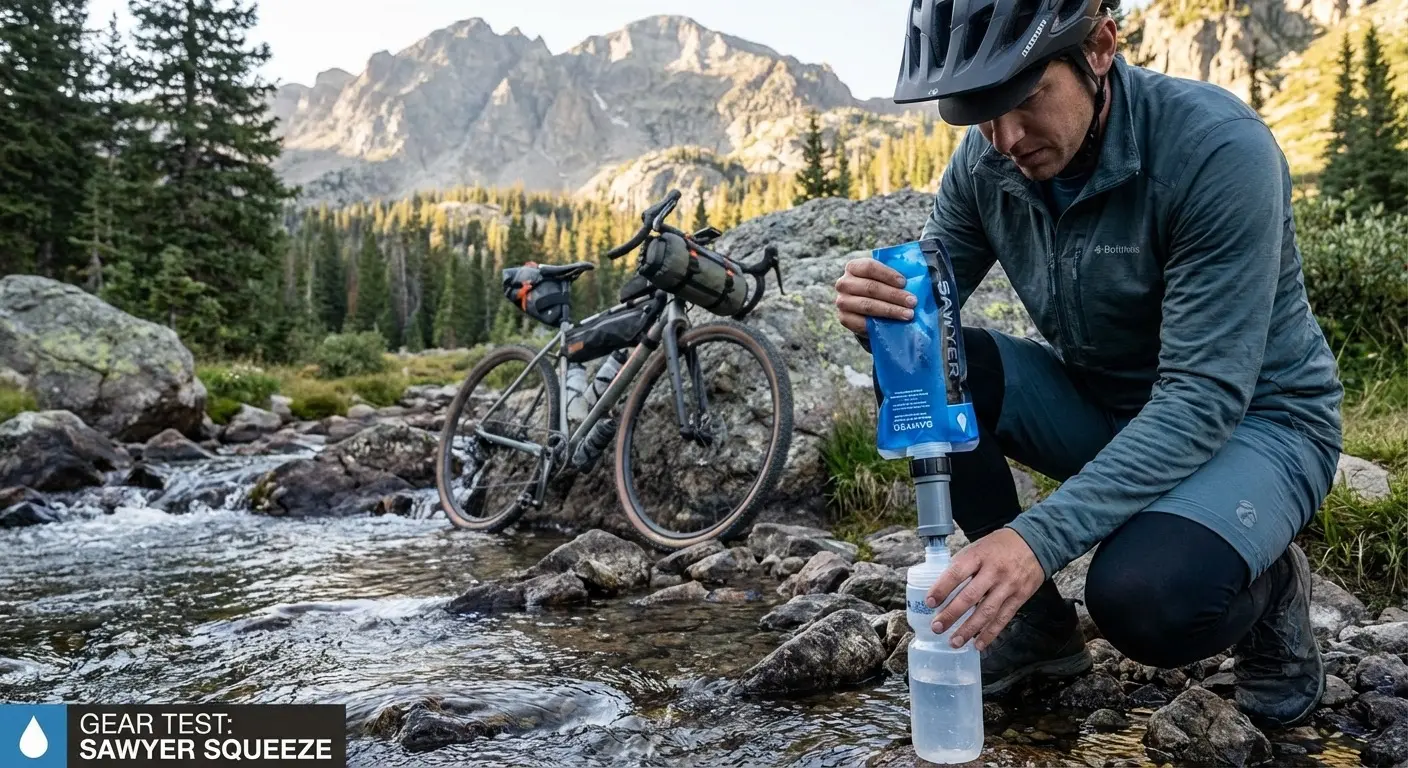
The dominant category for bikepackers. You fill a soft flask or pouch, then squeeze water through a filter into a clean bottle.
Advantages:
- Lightweight (3-4 oz for filter)
- Fast filtering (1-2 liters/minute)
- Simple operation
- No pumping required
- Filter lasts indefinitely
Disadvantages:
- Soft pouches can fail (carry backup)
- Requires compatible bottles/pouches
- Cold weather may freeze and damage filter
Best for: Most bikepackers—the default choice for good reason.
Straw Filters
You drink directly through the filter from water sources or bottles. Some integrate into water bottle caps.
Advantages:
- Ultralight
- Simple—no containers needed
- Works for personal drinking
Disadvantages:
- Can't easily filter water for cooking
- Must drink at source or from dirty bottle
- Slower flow rate than squeeze
Best for: Ultralight minimalists, day rides, backup to squeeze filter.
Pump Filters
Manual pumping pulls water through filter. Traditional backpacking approach.
Advantages:
- Works with any water container
- Often higher capacity
- Some include purification
Disadvantages:
- Heaviest option
- Requires effort to pump
- More parts to maintain
- Overkill for most bikepacking
Best for: Groups, murky water sources, expedition-level trips.
Gravity Filters
Hang bag above, water drains through filter into clean container below.
Advantages:
- No effort—gravity does the work
- Filters large quantities efficiently
- Good for groups
Disadvantages:
- Requires hanging setup
- Slower than squeezing
- Bulkier to carry
Best for: Base camps, group trips, situations where you filter lots of water at once.
Chemical Treatment
Tablets or drops kill pathogens through chemical reaction.
Advantages:
- Ultralight
- Inexpensive
- Purifies (including viruses)
Disadvantages:
- Wait time (15-30 minutes or more)
- Leaves chemical taste
- Doesn't remove sediment
- Cold water requires longer treatment
Best for: Backup to mechanical filtration, international travel, ultralight redundancy.
UV Purification
Handheld UV lights (SteriPEN) purify water through UV exposure.
Advantages:
- Fast treatment (1-2 minutes)
- Effective against viruses
- No chemical taste
Disadvantages:
- Requires batteries
- Doesn't work in murky water
- Doesn't remove sediment
- Can fail (carry backup)
Best for: Clear water sources, international travel, supplement to filtration.
Featured Products
Sawyer Squeeze Water Filtration System
The Sawyer Squeeze has become the default choice for weight-conscious adventurers, and bikepacking is no exception. The 3-ounce filter removes 99.99999% of bacteria and 99.9999% of protozoa through 0.1 micron absolute filtration. Flow rate hits about 1 liter per minute—fast enough for practical use. The filter itself lasts effectively forever (rated to 100,000 gallons) with proper backflushing. The included pouches are the weak point—many users upgrade to CNOC or Evernew bladders for durability. Versatile, reliable, and proven on countless bikepacking trips worldwide.
- 3 oz filter weight
- 0.1 micron filtration
- ~1 liter/minute flow
- 100,000 gallon lifespan
- Backflushable maintenance
Katadyn BeFree 1L
The BeFree prioritizes speed—flow rate reaches 2 liters per minute, nearly twice the Sawyer's speed. The integrated soft flask is convenient: fill, squeeze, drink. No separate pouches or bottles needed. The 0.1 micron hollow fiber membrane provides same-level filtration as competitors. The trade-off: shorter filter lifespan (~1,000 liters vs. Sawyer's near-infinite rating) and slightly fragile flask design. For bikepackers who prioritize convenience and speed over longevity, the BeFree delivers. New 2025 models improve durability.
- 2 L/min fast flow rate
- Integrated soft flask
- 0.1 micron filtration
- Collapsible design
- Convenient one-piece system
Katadyn BeFree AC 0.5L
The AC version adds activated carbon filtration to improve taste while fitting a smaller 0.5L flask. Ideal for cyclists who want to filter into a cycling bottle or carry in a jersey pocket. The compact size makes it easy to always have with you—important for spontaneous water stops. Same 2 L/min flow rate as the larger BeFree. The smaller capacity means more frequent filling, but the convenience may be worth it for bikepacking's quick-stop style.
- Compact 0.5L size
- Activated carbon for taste
- 2 L/min flow rate
- Fits in jersey pocket
- Quick hydration stops
Choosing Your System
For Most Bikepackers
The Sawyer Squeeze provides the best combination of:
- Reliability (proven over years)
- Filter longevity (essentially unlimited)
- Versatility (works with various bottles/bladders)
- Reasonable flow rate
Pair with durable soft flasks (CNOC or Evernew) for best results.
For Speed and Convenience
The Katadyn BeFree offers:
- Fastest flow rate
- Integrated all-in-one design
- Simplest operation
Accept the shorter filter lifespan trade-off.
For Ultralight Minimalists
Combine:
- BeFree 0.5L as primary
- Water treatment tablets as backup
Total weight: ~2.5 oz for complete system.
For International Travel
Add virus protection:
- Squeeze filter for bacteria/protozoa
- SteriPEN or tablets for viruses
Or choose a purifier system (MSR Guardian, Grayl).
Using Your Filter
Finding Water Sources
Good sources:
- Flowing streams and rivers
- Springs (best quality)
- High mountain lakes
- Moving water in wilderness
Marginal sources:
- Stagnant ponds
- Low-lying swamps
- Water near livestock
- Heavily used camping areas
Avoid if possible:
- Agricultural runoff
- Near mining operations
- Downstream from settlements
The Filtering Process
- Select source: Clearest, most flowing water available
- Pre-filter if murky: Bandana or pre-filter removes large sediment
- Fill pouch/flask: Keep threads clean (don't submerge threaded opening)
- Squeeze into clean bottle: Apply steady pressure
- Store filter properly: Keep damp but not frozen
Cold Weather Considerations
Freezing destroys hollow fiber filters. If frozen, the filter may appear fine but let pathogens through.
Cold weather strategies:
- Sleep with filter in sleeping bag
- Carry against body during cold days
- Use chemical treatment as backup
Maintenance
Backflushing
Most squeeze filters require backflushing when flow rate decreases:
- Fill syringe (included) with clean water
- Connect to filter outlet
- Push water backwards through filter
- Repeat until flow restores
Do this after every trip and during trips when flow slows.
Storage
Between trips:
- Backflush thoroughly
- Let dry completely
- Store in clean, dry location
- Some manufacturers recommend damp storage—check your filter's instructions
Never:
- Store wet in sealed container (mold risk)
- Freeze
- Store with dirty water inside
Replacement
Sawyer filters: Essentially never need replacement with proper maintenance
Katadyn BeFree: Replace after ~1,000 liters or when flow doesn't restore with cleaning
Pouches/flasks: Replace when showing wear, holes, or seal problems
Backup Strategies
Why Carry Backup
Filters can fail:
- Dropped and damaged
- Frozen without realizing
- Seals worn out
- Lost
One broken filter shouldn't mean unsafe water for the rest of your trip.
Backup Options
Chemical tablets: Ultralight, reliable backup. Carry enough for emergency use.
Second filter: Some carry backup mini filter (Sawyer Mini, LifeStraw).
Know your route: Identify where potable water exists (towns, campgrounds with taps).
The Belt-and-Suspenders Approach
Experienced bikepackers often carry:
- Primary squeeze filter
- Chemical tablets (Aquatabs or similar)
- Knowledge of emergency water treatment (boiling)
Calculating Water Needs
Daily Consumption
Bikepacking water needs vary dramatically:
- Mild weather: 3-4 liters/day
- Hot weather: 5-7+ liters/day
- Cooking adds: 0.5-1 liter/day
Carrying Capacity
Most bikepacking setups carry 2-4 liters comfortably using:
- Frame bottle cages (1-1.5L total)
- Fork cages (1-2L total)
- Bladders in bags (variable)
For a complete overview of bottles, bladders, and hydration accessories, see our Bikepacking Hydration Guide.
Water Strategy
- Know source locations before each section
- Fill up at every opportunity in dry conditions
- Don't pass reliable water when bottles aren't full
- Filter at source rather than carrying untreated water
Planning water sources ties directly into your overall resupply strategy. For guidance on timing your town stops and managing supplies, see our Bikepacking Resupply Guide.
FAQ
Do I need to filter tap water in town stops?
Generally no. Municipal water is treated. Save filtration for backcountry sources.
Can I filter salt water?
No. Filters remove pathogens, not dissolved minerals. Salt water requires desalination, not filtration.
How do I know if my filter is working?
Flow rate is your indicator. Working filters flow reasonably fast. Blocked filters slow dramatically. Damaged filters may flow fast but not filter—this is why backflushing and proper care matter.
Should I pre-filter murky water?
Yes. A bandana or coffee filter removes large particles that would clog your filter quickly. It doesn't make water safe alone, but it extends filter life.
What about boiling water?
Boiling works but requires fuel, time, and waiting for water to cool. Filter for convenience; know boiling as backup if filter fails.
Quick Recommendations
Best overall: Sawyer Squeeze—proven reliability, unlimited filter life.
Fastest filtering: Katadyn BeFree 1L—2 L/min flow, convenient design.
Most compact: Katadyn BeFree AC 0.5L—pocket-sized with carbon filtration.
Backup tablets: Aquatabs or Katadyn Micropur—ultralight emergency purification.
For complete hydration and camp strategies, see our Camp Gear Guide. For trip planning that accounts for water sources, check our First Trip Planning Guide.
Drink safe. Ride far.