Camp Pillows and Comfort Items for Bikepacking
20+ years testing gear in Colorado backcountry
The Case for Comfort
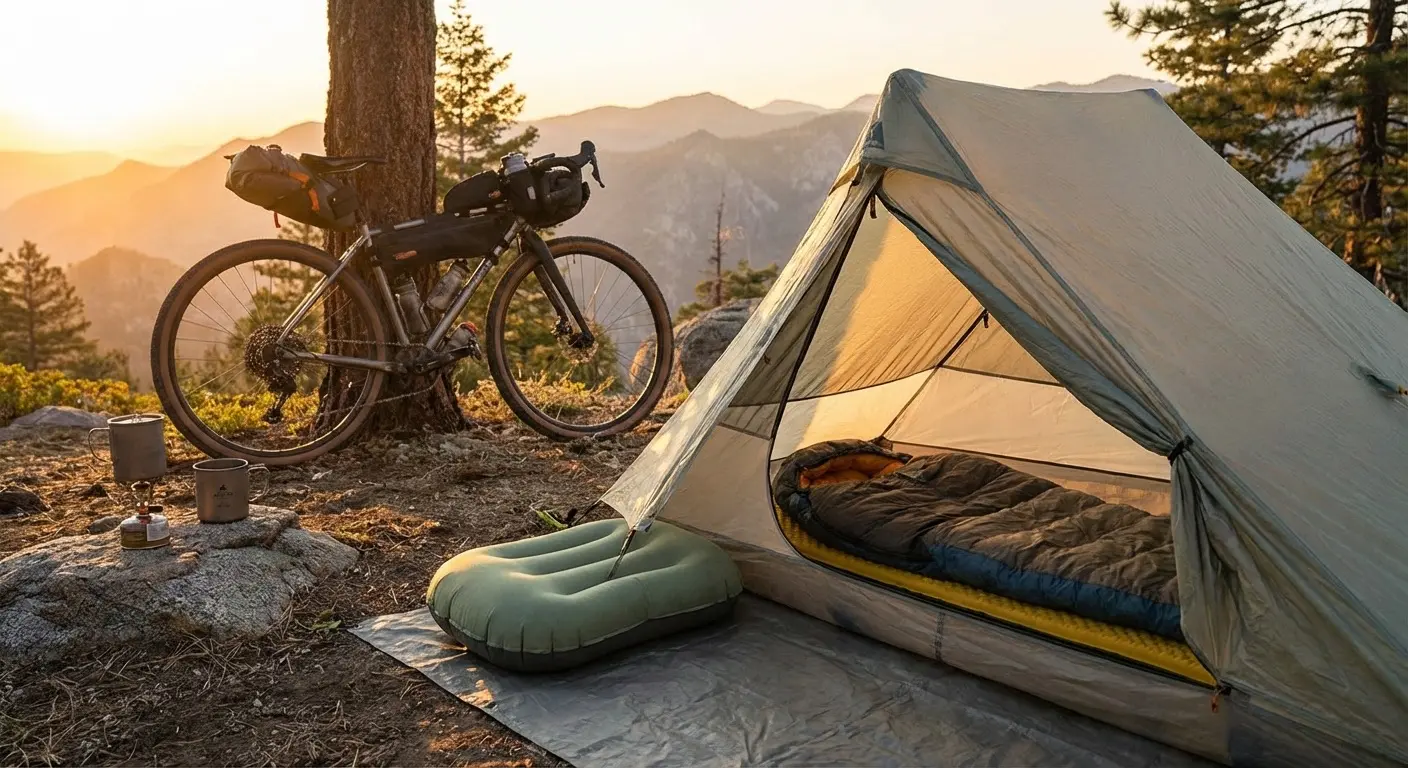
Ultralight philosophy says cut everything possible. But sleep quality directly affects performance. A few ounces of pillow can mean the difference between restful recovery and miserable exhaustion. As Outdoor Gear Lab's pillow reviews confirm, even ultralight bikepackers often find dedicated pillows worth their weight.
The debate isn't whether pillows are worth carrying—it's finding the right balance between weight, pack size, and actual comfort improvement. Some bikepackers stuff a jacket under their head and call it good. Others swear by dedicated pillows.
This guide covers camp pillows and other comfort items that improve bikepacking sleep without sabotaging your weight goals.
For complete sleep systems, see our Sleeping Bag Guide and Sleeping Pad Guide.
Why Pillows Matter
Sleep Quality Affects Performance
Poor sleep compounds over multi-day trips. Night one with a rolled jacket isn't bad. Night three becomes survival mode. Proper neck support improves sleep depth and duration.
The progression:
- Night 1: "This is fine"
- Night 2: "Bit stiff but manageable"
- Night 3: "Everything hurts"
- Night 4+: Performance collapse
Weight vs. Recovery Trade-Off
A quality pillow adds 2-5 ounces. That weight buys measurable recovery improvement. For multi-day trips, the weight penalty pays dividends in sustained performance.
The math:
- 3 oz pillow weight penalty
- 20% better sleep quality
- 5+ days of improved recovery
- Net positive for any serious trip
The Multi-Night Test: Do You Actually Need a Pillow?
Before buying, run this experiment on your next trip:
Night 1: The Control Use your current improvised solution (stuffed jacket, rolled clothes, nothing). Rate your sleep 1-10 in the morning. Note any neck stiffness.
Night 2: Borrow a Pillow Ask a riding partner to borrow theirs, or bring a cheap inflatable to test. Same conditions, same camp timing. Rate sleep 1-10.
Night 3+: Compare Did the pillow make a measurable difference? Some riders notice immediate improvement. Others sleep fine either way.
What the Test Reveals:
- If Night 2 scored 2+ points higher: Pillow is worth the weight for you
- If scores were similar: Save the money and ounces
- If you can't tell: You're probably fine without one
The Sleep Position Factor:
- Back sleepers: Often fine with improvised pillows or nothing
- Side sleepers: Almost always benefit from dedicated pillows (need more loft)
- Stomach sleepers: Usually prefer no pillow or very thin support
Your sleeping position at home predicts your camp pillow needs better than any recommendation.
Pillow Types
Inflatable Pillows
Air-filled pillows pack small and weigh almost nothing. Most popular for weight-conscious bikepackers.
Pros:
- Ultralight (1-3 oz)
- Extremely packable
- Adjustable firmness
Cons:
- Can feel bouncy/unstable
- Puncture risk
- May slide around
Best for: Ultralight-focused riders, those prioritizing pack size.
Compressible Pillows
Foam or insulation-filled pillows that compress for packing but expand to use.
Pros:
- More natural feel
- Won't pop
- Consistent support
Cons:
- Heavier (3-8 oz)
- Larger packed size
- Absorb moisture
Best for: Comfort-focused riders, those with more pack space.
Hybrid Pillows
Combine inflatable core with foam or fabric outer layer.
Pros:
- Balance of weight and comfort
- Stable surface
- Moderate pack size
Cons:
- Heavier than pure inflatables
- More complex construction
- Higher cost
Best for: Those wanting middle ground between ultralight and comfort.
DIY/Improvised
Stuffing a stuff sack with clothes, using a rolled jacket, or repurposing other gear.
Pros:
- Zero additional weight
- Always available
- Free
Cons:
- Often uncomfortable
- Uses clothes you might need
- Inconsistent support
Best for: Weight extremists, emergency backup.
Featured Products
Sea to Summit Aeros Ultralight Pillow
The Aeros Ultralight sets the standard for inflatable camp pillows. At just 2.1 ounces for the regular size, it packs into your palm yet inflates to comfortable support. The curved internal baffles prevent the 'water balloon' feel common to cheap inflatables. The brushed 20D polyester top provides grip without slipping. Multi-functional valve allows precise inflation adjustment. It won't replace your pillow at home, but for bikepacking, the weight-to-comfort ratio is unmatched.
- 2.1 oz ultralight
- Curved internal baffles
- Brushed fabric top
- Multi-function valve
- Packs into palm
Therm-a-Rest Air Head Lite
The Air Head Lite combines an inflatable core with a brushed polyester cover that feels more like a real pillow. The contoured shape cradles your head naturally. At 3.5 ounces, it's slightly heavier than pure inflatables but significantly more comfortable. The stuff sack doubles as a pillowcase for added softness. If pure inflatables feel too bouncy for you, the Air Head Lite offers the middle ground. Durable construction survives seasons of use.
- Hybrid inflatable/foam
- Contoured shape
- Brushed fabric cover
- 3.5 oz weight
- Stuff sack pillowcase
Nemo Fillo Elite
The Fillo Elite is for bikepackers who refuse to compromise on sleep quality. The integrated foam layer over an inflatable core creates genuinely comfortable support. Memory foam feel in a 3.4-ounce package. The micro-suede cover prevents sliding and feels soft against skin. Larger surface area than most ultralight options. Yes, it costs more and weighs slightly more than basic inflatables—and it's worth it if you value sleep. Thoughtful design details throughout.
- Integrated foam layer
- Memory foam feel
- Micro-suede cover
- Large surface area
- Premium construction
Klymit X Pillow
Klymit's X Pillow offers solid performance at an accessible price. The x-shaped baffles provide stable support without the bouncy instability of single-chamber designs. At 1.95 ounces, it matches premium competitors on weight. The fabric is comfortable enough, if not as refined as higher-end options. For bikepackers testing whether they like dedicated pillows, the X Pillow is an excellent entry point. Reliable performer that won't break the bank.
- X-shaped baffles
- 1.95 oz ultralight
- Budget-friendly
- Stable support
- Compact packed size
Choosing Your Pillow
For Ultralight Priority
The Sea to Summit Aeros Ultralight or Klymit X Pillow deliver the best weight-to-comfort ratio. Under 2.5 ounces each, tiny packed size, genuine improvement over improvised solutions.
For Maximum Comfort
The Nemo Fillo Elite offers the most home-like feel in a field pillow. The foam layer transforms the experience. Worth the extra ounce if you sleep poorly on pure inflatables.
For Budget Testing
Start with the Klymit X Pillow. Good enough to determine if you value dedicated pillows before investing more.
For Side Sleepers
Hybrid pillows like the Therm-a-Rest Air Head Lite provide better loft for side sleeping. Pure inflatables may not support neck alignment for side sleepers.
Other Comfort Items
Earplugs
Often overlooked, earplugs dramatically improve sleep in noisy environments—wind, wildlife, other campers.
Weight: ~0.1 oz Value: Extremely high for weight
Carry a few pairs. They're effectively weightless and can save a night's sleep.
Eye Masks
Useful for summer camping when daylight starts at 4am, or when stealth camping near light sources.
Weight: 0.5-1 oz Value: Situational but high when needed
Camp Footwear
Some bikepackers carry ultralight camp shoes or sandals to give cycling shoes a break and let feet breathe.
Options:
- Crocs or knock-offs: Heavy but comfortable
- Ultralight sandals: 3-6 oz, good middle ground
- Neoprene camp socks: Lightest, limited protection
Weight: 3-16 oz Value: Personal preference; many skip this entirely
Extra Clothing for Sleep
Dedicated sleep clothes stay dry and clean. Some carry lightweight base layer specifically for sleeping.
Weight: 3-5 oz Value: High for multi-day trips in wet conditions
The DIY Approach
Stuff Sack Method
Fill a stuff sack with clothing for improvised pillow:
What works:
- Down jacket (soft, lofty)
- Fleece mid-layer
- Extra socks/underwear
What doesn't work:
- Rain jacket (crinkly, slippery)
- Cycling jerseys (too thin)
- Dirty clothes (smell)
Tips:
- Use a soft stuff sack, not waterproof bag
- Pack consistently for even loft
- Position opening away from face
Saddle Bag Pillow
Some use their saddle bag as a base with clothes on top. Mixed results depending on bag design.
When DIY Works
DIY pillows work fine for some people. If you've tried it and slept well, save the money and weight. If you've tried it and slept poorly, invest in a dedicated pillow.
Care and Maintenance
Inflatable Pillows
Field care:
- Deflate fully before packing
- Store in protective bag
- Keep valve clean
Home care:
- Air out after trips
- Wash with mild soap if needed
- Store loosely inflated or flat
Repair:
- Patch kits fix punctures
- Same patches work as sleeping pad repairs
- Carry repair kit on trips
Compressible/Hybrid Pillows
Field care:
- Air out in mornings when possible
- Don't store wet/compressed
Home care:
- Machine washable (check instructions)
- Fully dry before storage
- Store uncompressed
FAQ
Is a dedicated pillow really worth carrying?
For most people, yes. The weight penalty is minimal (2-4 oz), and sleep quality improvement is measurable. If you sleep fine with improvised solutions, stick with them. If you don't, a pillow solves the problem.
Inflatable or compressible—which is better?
Inflatable packs smaller and weighs less. Compressible feels more natural but takes more space. Try both if possible—personal preference varies significantly.
Can I use a pillow without sleeping pad?
Technically yes, but your pad provides insulation that a pillow doesn't. They're complementary, not interchangeable. For pad recommendations, see our Best Sleeping Pads for Bikepacking guide.
How do I keep my pillow from sliding around?
Some integrate with sleeping pads. Others use non-slip fabrics. DIY solution: rough side of a bandana under the pillow. Some bikepackers attach pillow to pad with small cord or rubber band.
What size pillow should I choose?
Regular size works for most. Tall/large bikepackers may prefer large. Small/ultralight models sacrifice comfort for weight—only choose if weight is critical.
Sleep Well, Ride Well
Comfort items are personal choices without universal right answers. Some bikepackers carry camp pillows, sandals, and sleep clothes. Others carry nothing beyond their sleep system. For a complete overview of camp gear including shelters, cooking systems, and sleep essentials, see our Bikepacking Camp Gear Guide.
The question isn't what's objectively correct—it's what helps you sleep well enough to perform the next day.
Start with a basic pillow. See if it improves your sleep. Adjust from there. Sleep quality is worth its weight in ounces.
For complete sleep systems, see our Sleeping Bag Guide and Sleeping Pad Guide. For shelter options, check our Tent Guide.
Sleep well. The trail continues tomorrow.