Stretching and Mobility Routine for Bikepackers
20+ years testing gear in Colorado backcountry
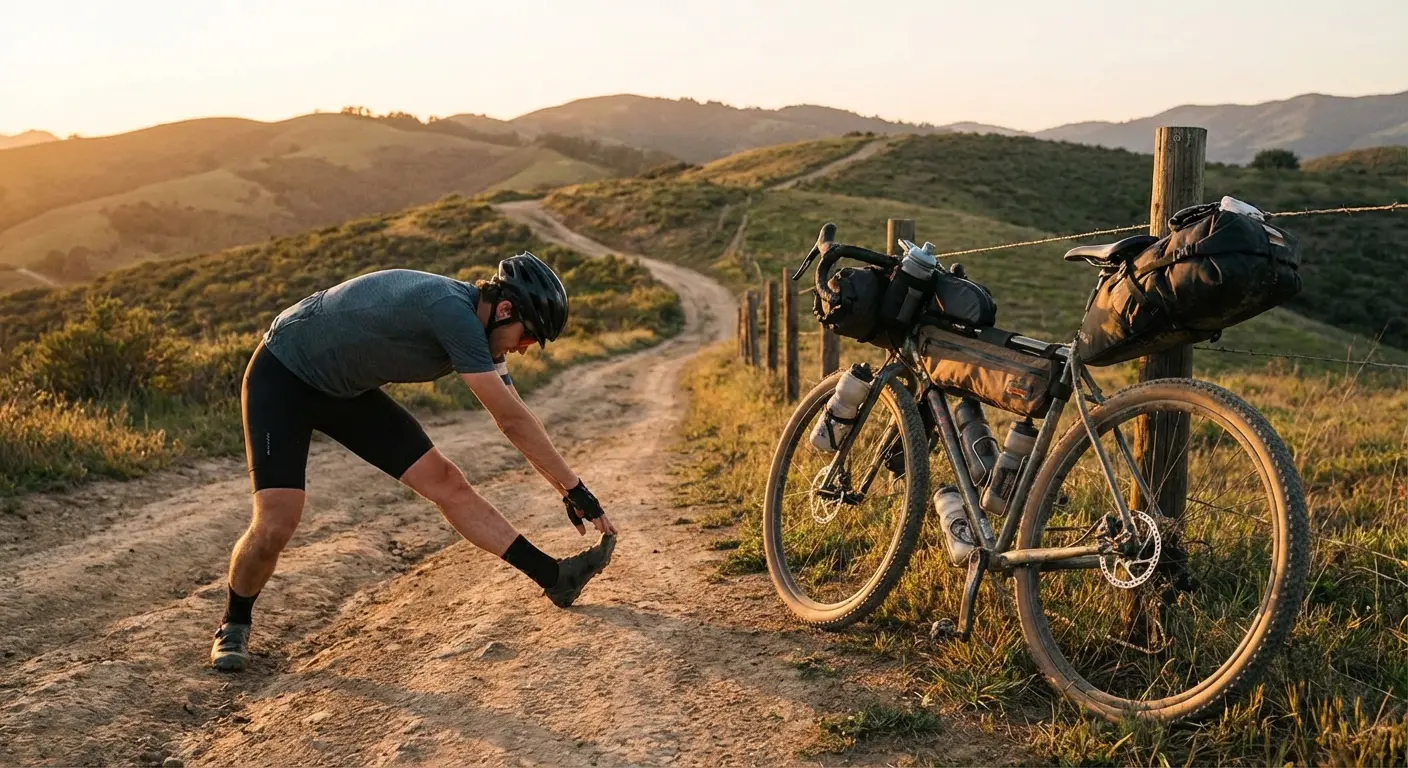
Why Stretching Matters for Bikepackers
Cycling tightens muscles in predictable patterns. Hip flexors shorten, hamstrings stiffen, and shoulders round forward. Without intervention, this tightness accumulates until it causes pain and limits performance.
Multi-day bikepacking amplifies every flexibility issue. Hours in a fixed position, day after day, create progressive tightness that a single rest day won't fix. Riders who skip stretching often find themselves stiffer and more uncomfortable as trips progress.
The solution isn't complicated. A few minutes of targeted stretching—before riding, during breaks, and in the evening—maintains the mobility needed for comfortable cycling position. This guide provides specific routines for each opportunity.
For complete comfort guidance, see our Complete Bikepacking Comfort Guide.
The Cyclist's Tight Spots
Cycling creates predictable tightness patterns. Understanding these helps target stretching effectively.
Hip Flexors
Why they tighten:
- Never fully extend during pedaling
- Shortened position for hours
- Also tight from sitting generally
What happens when tight:
- Pelvis tilts forward
- Lower back strain increases
- Saddle comfort decreases
Hamstrings
Why they tighten:
- Repeatedly loaded during pedal stroke
- Never fully stretched while riding
- Adapt to shortened range
What happens when tight:
- Limits hip hinge ability
- Forces more lumbar flexion
- Contributes to back pain
Hip External Rotators (Piriformis/Glutes)
Why they tighten:
- Stabilize pelvis during pedaling
- Work constantly
- Limited variety of movement
What happens when tight:
- Can compress sciatic nerve
- Hip discomfort
- Lower back pain
Chest/Pectorals
Why they tighten:
- Arms forward on handlebars
- Shoulders rounded for hours
- Normal posture also contributes
What happens when tight:
- Shoulders roll forward
- Upper back rounds
- Neck strain increases
Neck Extensors
Why they tighten:
- Hold head up while forward-leaning
- Contract constantly while riding
- Often already tight from desk work
What happens when tight:
- Neck pain and stiffness
- Headaches
- Limited range of motion
Pre-Ride Routine (5 Minutes)
Morning stretching prepares muscles for the day's effort. Focus on dynamic movements that warm up without overstretching cold muscles.
Dynamic Stretches
Leg swings (1 minute):
- Hold bike or object for balance
- Swing one leg forward and back
- Controlled swings, increasing range
- 15-20 swings each leg
- Then swing side to side (15-20 each)
Hip circles (1 minute):
- Hands on hips
- Large circles with hips
- 10 circles each direction
- Feel hip joint loosening
Arm circles (30 seconds):
- Arms out to sides
- Small circles, gradually larger
- 15 forward, 15 backward
- Warms shoulders for riding position
Torso rotations (30 seconds):
- Feet shoulder-width apart
- Rotate upper body left and right
- Arms swing naturally
- 15-20 rotations total
Cat-cow standing (1 minute):
- Hands on thighs or knees
- Round back (cat), then arch (cow)
- Move through full range
- 10-15 repetitions
Neck movements (1 minute):
- Slow neck circles (don't force)
- Look left, look right
- Ear toward shoulder each side
- Chin to chest, then look up
- All movements slow and controlled
Why Dynamic Before Riding
Cold muscles don't stretch well—static stretching before exercise can actually reduce power and increase injury risk. Dynamic movement increases blood flow and temperature, preparing muscles without overstretching them.
Mid-Ride Stretches (2-3 Minutes)
At rest stops, brief stretches prevent cumulative tightness. These can be done while still in cycling shoes.
Quick Break Routine
Standing quad stretch:
- Hold bike for balance
- Pull one foot toward buttock
- Keep knees together
- Hold 20-30 seconds each leg
Standing hamstring stretch:
- Place heel on low surface (rock, curb, pedal)
- Leg straight, hinge at hip
- Feel stretch in back of thigh
- Hold 20-30 seconds each leg
Hip flexor lunge:
- Big step forward
- Back knee can lower toward ground
- Push hips forward
- Hold 20-30 seconds each side
Chest stretch:
- Clasp hands behind back
- Lift arms and open chest
- Look slightly upward
- Hold 20-30 seconds
Neck releases:
- Ear toward shoulder (10 seconds each)
- Look left and right (10 seconds each)
- Chin tucks (5-10 repetitions)
During the Ride
Some stretching can happen while riding (when safe):
- Shrug and drop shoulders
- Roll neck gently
- Arch and round back
- Point toes down to stretch feet
- Stand on pedals and stretch legs
Evening Routine (10-15 Minutes)
After riding, your muscles are warm and respond well to deeper stretching. This is the best time for static holds that improve flexibility.
Lower Body Stretches
Hip flexor stretch (2 minutes):
- Kneeling lunge position
- Back knee on ground (pad with clothing)
- Front knee at 90 degrees
- Push hips forward gently
- Feel stretch in front of back hip
- Hold 60 seconds each side
- Optional: raise same-side arm overhead for deeper stretch
Hamstring stretch (2 minutes):
- Seated or lying down
- One leg straight, other bent
- Reach toward straight leg foot
- Don't round back excessively
- Hold 60 seconds each side
- Or use strap/towel around foot
Piriformis/glute stretch (2 minutes):
- Lying on back
- Cross one ankle over opposite knee
- Pull uncrossed leg toward chest
- Feel stretch in crossed leg's buttock
- Hold 60 seconds each side
IT band stretch (1 minute):
- Standing, cross one leg behind other
- Lean away from back leg
- Feel stretch along outside of back leg
- Hold 30 seconds each side
Upper Body Stretches
Chest/shoulder stretch (1 minute):
- Doorway or tree available: forearm on frame, lean through
- No doorway: clasp hands behind back, lift and hold
- Feel stretch across chest
- Hold 30-45 seconds
Triceps and lat stretch (1 minute):
- Reach one arm overhead
- Bend elbow, hand toward opposite shoulder
- Other hand gently pulls elbow
- Hold 30 seconds each side
Upper back stretch (1 minute):
- Clasp hands in front of body
- Round upper back, push hands forward
- Feel stretch between shoulder blades
- Hold 30-45 seconds
Neck stretches (2 minutes):
- Ear to shoulder, gentle hand pressure (30 sec each)
- Look down, hands behind head (30 sec)
- Look to side, gentle chin pressure (30 sec each)
- All stretches gentle—never force neck
Spinal Mobility
Lying spinal twist (2 minutes):
- Lie on back
- Pull one knee toward chest
- Let knee fall across body to opposite side
- Keep both shoulders on ground
- Look away from knee
- Hold 60 seconds each side
Child's pose (1 minute):
- Knees on ground, sit back on heels
- Arms extended forward
- Forehead toward ground
- Relax and breathe
- Hold 60 seconds
Stretching by Problem Area
If you're experiencing specific discomfort, focus extra attention on these stretches.
For Lower Back Pain
Priority stretches:
- Hip flexors (tight hip flexors pull on lower back)
- Hamstrings (tight hamstrings affect pelvic position)
- Piriformis/glutes
- Cat-cow for mobility
Also helpful:
- Core strengthening (see below)
- Proper bike fit check
Related guide: Neck and Back Pain Solutions
For Knee Pain
Priority stretches:
- Quadriceps
- IT band
- Hip flexors
- Calf muscles
Also important:
- Bike fit (saddle height especially)
- Gradual increase in volume
Related guide: Knee Pain Prevention
For Neck/Shoulder Pain
Priority stretches:
- Neck extensors
- Chest/pectorals
- Upper trapezius
- Levator scapulae (side of neck)
Also important:
- Handlebar height
- Position variety while riding
Related guide: Neck and Back Pain Solutions
For Hand Numbness
Priority stretches:
- Wrist flexors and extensors
- Chest (affects shoulder position)
- Forearms
Also important:
- Handlebar setup
- Grip pressure
Related guide: Hand Numbness Solutions
Featured Products
TriggerPoint GRID Foam Roller
Self-massage complements stretching for maintaining muscle health. The GRID's multi-density surface provides varied pressure for different areas—use the flat zones for broad coverage and ridged zones for deeper work. The compact 13-inch size packs for trips where you really need recovery tools. Roll quads, IT bands, glutes, and upper back before and after riding. More effective than generic smooth rollers for releasing tight muscles. Not essential for weekend trips but valuable for longer expeditions.
- Multi-density surface
- Compact 13-inch size
- Packable for trips
- Effective self-massage
- Durable construction
RAD Roller Massage Ball
For tight spots a foam roller can't reach, a massage ball provides precise pressure. Place between body and ground (or wall) and let body weight do the work. Excellent for piriformis, glutes, and specific back tension points. The density is firm enough to be effective without being painful. Small enough to pack easily—weighs almost nothing. Use in the evening after stretching for deeper release.
- Targeted pressure
- Packs easily
- Firm density
- Versatile use
- Lightweight
OPTP Stretch Out Strap
Reaching your own feet for hamstring stretches while lying down is awkward. A stretching strap solves this, allowing relaxed holds without contorting. Multiple loops let you adjust the leverage. Use for hamstrings, quadriceps, hip flexors, and shoulder stretches. The rigid loops are easier to use than stretchy bands. Light enough to pack for any trip. Makes evening stretching routine more effective and comfortable.
- Multiple loop positions
- Non-stretch design
- Better leverage
- Lightweight
- Versatile stretches
Yoga Mat (Compact Travel Version)
Stretching on rocky ground or wet grass isn't comfortable. A compact travel yoga mat provides clean, cushioned surface for evening routines. Folds small enough to strap to bags. The cushion protects knees during kneeling stretches. Also works as additional sleeping pad insulation or sitting pad at camp. Look for versions that fold rather than roll for easier packing.
- Foldable design
- Knee protection
- Clean surface
- Multi-use item
- Compact packing
Core Exercises for Stability
Strong core muscles complement flexibility for riding comfort. These exercises can be done in camp without equipment.
Essential Exercises
Plank:
- Forearms and toes on ground
- Body in straight line
- Hold 30-60 seconds
- Build to multiple sets
Side plank:
- One forearm on ground
- Body in straight line on side
- Hold 20-30 seconds each side
- Easier version: bottom knee down
Dead bug:
- Lying on back, arms up, knees bent 90 degrees
- Slowly extend opposite arm and leg
- Keep lower back pressed to ground
- 10 reps each side
Glute bridge:
- Lying on back, knees bent, feet flat
- Lift hips, squeeze glutes
- Hold 5 seconds at top
- 15-20 repetitions
When to Do Core Work
- After stretching (muscles warm)
- Every evening during trips
- 3-4 times per week at home
- Core strength builds over weeks
Building a Stretching Habit
Consistency matters more than duration.
Making It Stick
Attach to existing routine:
- Stretch while water boils for coffee
- Stretch while tent dries
- Stretch immediately after stopping
Keep it short:
- 5 minutes is better than skipping 15 minutes
- Focus on worst areas if time limited
- Any stretching beats none
Notice the benefits:
- Pay attention to how you feel afterward
- Compare flexibility over days/weeks
- Let positive reinforcement build habit
Progressive Improvement
Flexibility improves with consistent practice:
- Don't force—ease into stretches
- Slight improvement over weeks is normal
- Pushing too hard causes injury
- Patience beats aggression
FAQ
Should I stretch before or after riding?
Both, but differently. Before: dynamic movements (swinging, circles) to warm up. After: static holds to improve flexibility. Cold muscles don't stretch safely, so save deep stretching for when you're warm.
How long should I hold a stretch?
For maintenance: 20-30 seconds. For improvement: 45-60 seconds or longer. Deep stretches need time—rushing through 10-second holds has minimal benefit.
Is it normal to be tighter as a trip progresses?
Without stretching, yes—cycling accumulates tightness. With consistent stretching, you should maintain or improve. If you're getting tighter despite stretching, you may need more recovery time or fit adjustments.
Can I stretch too much?
Yes. Overstretching—especially with cold muscles or forced holds—can cause injury. Stretch to the point of mild tension, not pain. If stretching causes more discomfort rather than relief, you're pushing too hard.
Do I need to stretch on rest days?
Rest days are excellent for stretching—muscles recover from riding demands while maintaining flexibility. A longer, relaxed stretching session on rest days helps prepare for the next riding day.
Is foam rolling as good as stretching?
Different mechanisms: stretching lengthens muscles, foam rolling releases tension and increases blood flow. Both are valuable. Foam rolling before stretching can make stretching more effective.
Related Guides
- Complete Bikepacking Comfort Guide - Full comfort overview
- Recovery Strategies - Between-ride recovery
- Neck and Back Pain Solutions - When stretching alone isn't enough
- Knee Pain Prevention - Flexibility affects knee health
- Building Saddle Time - Conditioning your body
Stretching isn't glamorous, but it's the difference between progressively tightening up and maintaining the mobility needed for comfortable riding. A few minutes each day compounds into significant benefits over a long trip.
Build the habit. Do a little every day. Your body will reward you with less pain and more enjoyable miles.
Stay loose, ride long.