Neck and Back Pain Solutions for Bikepackers: Ride Without Suffering
20+ years testing gear in Colorado backcountry
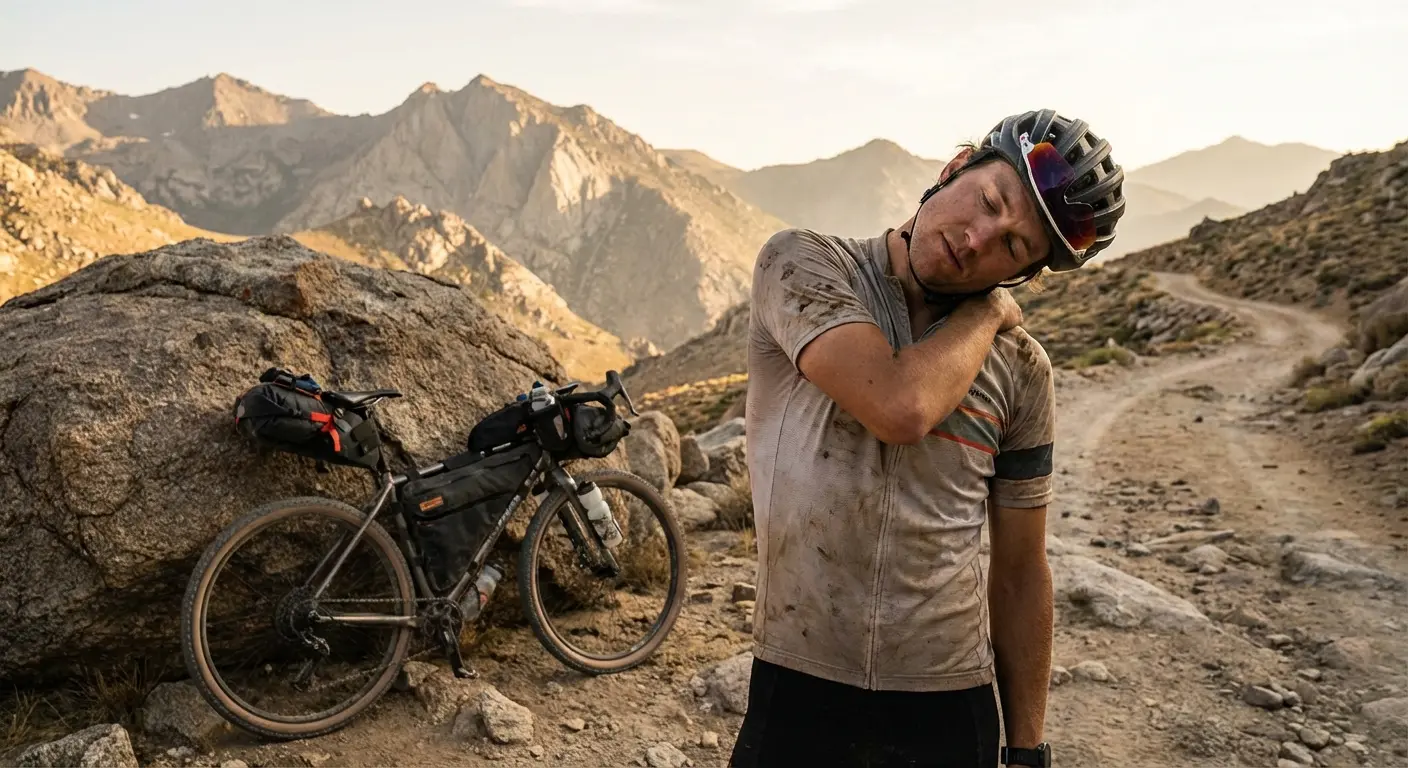
The Upper Body Problem
Your body wasn't designed to hold a forward-bent position for hours while supporting a 10-pound head. Cycling forces this posture, and without proper setup and habits, your neck and back pay the price.
Neck and back pain are among the most common complaints from bikepackers. The combination of a forward lean, head craned upward to see the road, and hours of vibration creates strain that accumulates throughout the ride. By day three of a tour, many riders are suffering.
Unlike saddle or hand issues that have obvious contact point solutions, neck and back pain often stems from multiple factors: bike fit, core strength, flexibility, and riding habits all play roles. The good news is that addressing these factors can dramatically reduce or eliminate symptoms.
This guide covers the causes of cycling-related neck and back pain and provides practical solutions for prevention and relief—both on the bike and off.
For complete comfort guidance, see our Complete Bikepacking Comfort Guide.
Why Cycling Hurts Your Neck
Understanding the mechanics helps target solutions.
The Head-Up Problem
The physics:
- Your head weighs 10-12 pounds
- Looking forward while bent over creates significant neck extensor load
- Muscles at the back of your neck work constantly
- Hours of this position cause fatigue, spasm, and pain
The angle factor:
- More aggressive (lower) position = more neck strain
- Road racing positions are worst
- Bikepacking-appropriate positions reduce strain significantly
- Still not a natural posture for extended periods
Contributing Factors
| Factor | How It Contributes |
|---|---|
| Low handlebars | Increases forward lean, neck extension |
| Long reach | Arms stretch forward, trunk drops |
| Locked elbows | Transmits vibration to spine |
| Tight shoulders | Limits comfortable range of motion |
| Weak neck muscles | Fatigue faster under load |
| Heavy helmet | Adds to head weight |
| Looking at computer | Increases downward gaze angle |
Symptoms and Progression
Early signs:
- Stiffness at end of rides
- Urge to move head frequently
- Mild aching in neck muscles
Progressing issues:
- Pain during rides
- Headaches (tension type)
- Reduced neck range of motion
- Pain radiating to shoulders
Warning signs:
- Numbness or tingling in arms/hands
- Sharp pain with movement
- Symptoms persisting days after riding
Why Your Back Hurts
Lower back pain has different mechanics but often accompanies neck issues.
Flexion and Load
Cycling posture:
- Lumbar spine flexed (curved forward)
- Hip flexors shortened
- Core may or may not engage
- Vibration absorbed through spine
Loading factors:
- Heavy backpack dramatically increases load
- Poor core engagement shifts load to passive structures
- Repeated bumps stress discs and joints
- Limited position changes increase static loading
Lower Back vs. Upper Back
Lower back pain (lumbar):
- Often related to flexibility (tight hamstrings/hip flexors)
- Core weakness a major factor
- Saddle position affects spinal curve
- Most common complaint
Upper back pain (thoracic):
- Often tension-related
- Shoulders rolling forward
- Related to handlebar reach
- Can accompany neck pain
When Back Pain Is Serious
Most cycling back pain is muscular and responds to the approaches in this guide. However, some symptoms warrant medical attention:
- Pain radiating down legs
- Numbness in legs or feet
- Bowel or bladder changes
- Pain that worsens with rest
- History of spinal problems
Bike Fit Solutions
Adjusting your bike position is often the fastest path to relief.
Raising the Handlebars
Higher bars = less forward lean = less neck strain.
Options:
- Flip stem upward (if reversible)
- Add headset spacers under stem
- Install shorter stem with rise
- Switch to higher-rise handlebars
The trade-off:
- Slightly less aerodynamic
- Completely irrelevant at bikepacking speeds
- Dramatic comfort improvement
How much higher? Start with 20-30mm and assess. Many bikepackers end up with handlebars at or above saddle height. There's no rule that says bars must be low.
Reducing Reach
If you're stretched too far forward, upper body strain increases.
Signs of excessive reach:
- Locked elbows when riding
- Feeling stretched out
- More weight on hands
- Difficulty breathing deeply
Solutions:
- Shorter stem (10-20mm can make a significant difference)
- Handlebars with less reach
- Saddle moved forward slightly (affects other fit parameters)
Saddle Position Effects
Your saddle position affects spinal posture:
Saddle nose down:
- Slides you forward
- May increase lumbar flexion
- Can worsen lower back issues
Saddle too far back:
- Increases reach to bars
- More trunk flexion required
- Upper back and neck strain
Level saddle in proper position:
- Balanced weight distribution
- Neutral spinal curves achievable
- Starting point for fit adjustments
For complete bike fit guidance: Bike Fit for Loaded Bikepacking
Core Strength: The Hidden Factor
Weak core muscles are a primary contributor to cycling back pain.
Why Core Matters
Without core engagement:
- Upper body weight hangs from spine
- Passive structures (ligaments, discs) bear load
- Fatigue and pain result
With proper core engagement:
- Muscles actively support trunk
- Load distributed across muscular system
- Sustainable for longer periods
Key Muscles
Transverse abdominis:
- Deep core stabilizer
- Wraps around trunk like corset
- Provides spinal support
Multifidus:
- Small muscles along spine
- Stabilize individual vertebrae
- Often weak in people with back pain
Erector spinae:
- Run along spine
- Control forward flexion
- Need both strength and endurance
Building Cycling-Specific Core
Effective exercises:
Planks:
- Front plank: 30-60 seconds
- Side plank: 30 seconds each side
- Build to multiple sets
- Focus on form over duration
Dead bugs:
- Lying on back
- Opposite arm/leg extension
- Maintain neutral spine
- 10-15 reps each side
Bird dogs:
- On hands and knees
- Opposite arm/leg extension
- Hold 5 seconds
- 10 reps each side
Glute bridges:
- Lying on back, knees bent
- Lift hips, squeeze glutes
- Hold 5 seconds
- 15-20 reps
Train core 3-4 times per week for noticeable improvement in riding comfort.
Flexibility and Mobility
Tight muscles limit comfortable positioning and contribute to pain.
Key Areas for Cyclists
Hip flexors:
- Chronically shortened by cycling
- Pull pelvis forward, affecting lower back
- Critical to stretch regularly
Hamstrings:
- Tight hamstrings limit hip hinge
- Force more lumbar flexion
- Affect saddle comfort too
Chest/pectorals:
- Tight from forward position
- Pull shoulders forward
- Contribute to upper back rounding
Neck extensors:
- Work constantly while riding
- Often tight and short
- Need both stretching and strengthening
Essential Stretches
Hip flexor stretch:
- Kneeling lunge position
- Back knee on ground
- Push hips forward gently
- Hold 30-60 seconds each side
Doorway chest stretch:
- Forearm on door frame
- Lean through doorway
- Feel stretch across chest
- Hold 30 seconds each side
Cat-cow:
- Hands and knees
- Arch back (cat), drop belly (cow)
- Move through full range slowly
- 10 repetitions
Chin tucks:
- Seated or standing
- Pull chin straight back (make double chin)
- Hold 5 seconds
- Repeat 10 times
Complete routine: Stretching and Mobility for Bikepackers
On-Bike Habits
How you ride matters as much as how the bike is set up.
Position Changes
Static positions cause strain. Movement prevents it.
Every 15-20 minutes:
- Shift hand positions
- Shrug shoulders up and down
- Look down briefly (when safe)
- Arch and round back slightly
Every hour:
- Get out of saddle briefly
- Stretch arms overhead if safe
- Roll neck gently
Relaxation
Tension compounds strain. Conscious relaxation helps.
Death grip:
- Tight grip creates arm tension
- Tension transfers to shoulders and neck
- Practice loose grip on smooth sections
Shoulder tension:
- Shoulders often creep up toward ears
- Check and drop shoulders periodically
- Shake out arms when safe
Breathing:
- Shallow breathing increases tension
- Consciously breathe deeply
- Belly should expand, not just chest
Looking Ahead
The problem: Looking at your front wheel requires maximum neck extension.
Better approach:
- Look further up the road
- Requires less neck strain
- Also improves bike handling
Cycling computers:
- Mounting on stem requires looking down
- Out-front mounts allow easier glancing
- Consider head-up displays for navigation
Featured Products
Profile Design Aeria Ultimate Stem
When standard stems don't provide enough rise, the Aeria Ultimate offers -10 to +45 degrees of adjustment. Find exactly the right bar height without buying multiple stems. The integrated design looks clean and handles normally. For bikepackers trying to dial in the perfect position, the adjustability is valuable. Once you find your ideal angle, the stem locks securely. More expensive than fixed stems but solves the position problem permanently.
- -10 to +45 degree range
- Dial in perfect position
- Secure once set
- Clean integrated design
- Solves height problems
Ritchey Comp 4-Axis Stem
A more affordable adjustable stem option with a similar range of motion. The 4-axis design allows both angle and reach adjustment within limits. Build quality is solid if not premium. For riders experimenting with position, this lets you find the right setup before committing to a fixed stem. The adjustment mechanism is simple and reliable. Available in multiple lengths.
- Adjustable angle
- Affordable option
- Solid construction
- Multiple lengths
- Good for experimentation
Spank Flare 25 Vibrocore Handlebar
Handlebar vibration contributes to upper body fatigue and pain. Spank's Vibrocore technology uses a foam core inside the aluminum bar to damp vibration before it reaches your hands and body. The 25mm flare provides a natural wrist angle. Noticeable vibration reduction on rough roads without the price of carbon. The reduced vibration means less tension required to maintain control, reducing neck and shoulder strain.
- Vibrocore dampening
- 25mm flare for wrists
- Aluminum durability
- Reduces upper body fatigue
- Affordable performance
TriggerPoint GRID Foam Roller
Self-massage for tight back muscles helps maintain mobility and reduce pain. The GRID's multi-density surface provides varied pressure for different muscle groups. Compact enough to pack for trips where recovery matters. Roll your upper back, lats, and IT band before and after riding. Regular use maintains the flexibility needed for comfortable cycling position. More effective than generic smooth rollers.
- Multi-density surface
- Compact for travel
- Targets multiple areas
- Durable construction
- Effective self-massage
Theraband CLX Resistance Band
Building the core and back strength needed for pain-free cycling requires some resistance. The CLX's consecutive loops make it easy to perform exercises with different grip points. Use for dead bugs, bird dogs with resistance, rows for upper back, and various stretches. Light enough to pack on trips. The color indicates resistance level—start with yellow or red. Progressive training builds the strength that prevents pain.
- Consecutive loop design
- Multiple exercises possible
- Light and packable
- Progressive resistance
- Versatile tool
Bike Mirror (Handlebar or Helmet Mount)
Looking behind you requires significant neck rotation—repeated dozens of times per ride. A mirror eliminates most of this need. Handlebar mirrors work well for steady riding; helmet mirrors stay with your sight line. Some riders resist mirrors as uncool, but reducing repetitive neck strain is practical. On multi-day trips, any strain reduction compounds. Choose whichever mounting style you'll actually use.
- Eliminates neck rotation
- Multiple mounting options
- Clear rearward view
- Reduces checking strain
- Safety benefit too
Rest Stop Routine
Brief stretches during stops provide significant relief.
2-Minute Stretch Sequence
Neck rolls (30 seconds):
- Slow circles, both directions
- Don't force range
- Feel stretch, not pain
Shoulder rolls (30 seconds):
- Forward 10 times
- Backward 10 times
- Shrug and release
Side bends (30 seconds):
- Ear toward shoulder each side
- Arm overhead adds intensity
- Hold 10-15 seconds each
Cat-cow standing (30 seconds):
- Hands on hips or knees
- Round back, then arch
- Full range of motion
Extended Break Routine
When time allows (15+ minutes):
- Full hip flexor stretch
- Lying spinal twist
- Cobra or upward dog
- Child's pose
- Walk around before remounting
Equipment Considerations
Some equipment choices affect neck and back comfort.
Helmet Weight
Heavy helmets increase neck load.
Lighter options:
- Modern helmets often under 300g
- Significant reduction from older heavy designs
- Worth considering if neck strain is an issue
Backpacks vs. Bike Bags
Backpack problems:
- Weight on shoulders and spine
- Increases forward lean compensation
- Restricts breathing
- Causes sweating and discomfort
Better approach:
- Use bike-mounted bags
- Keep weight off your body
- See our Complete Bag Storage Guide
Handlebar Accessories
Computer mounting:
- Stem-mounted requires looking down
- Out-front mounts allow easier viewing
- Less neck flexion needed
Heavy accessories:
- Weight at bar ends affects handling
- May require more grip strength
- Consider positioning carefully
Long-Term Prevention
Sustainable comfort requires ongoing attention.
Training Adaptations
Your body can adapt to cycling demands:
- Core strength improves with training
- Muscles develop endurance
- Position becomes more natural
Keys to adaptation:
- Consistent training (not sporadic long rides)
- Progressive increase in duration
- Maintenance of flexibility
- Core work off the bike
Professional Help
When to seek it:
- Pain not responding to self-treatment
- Recurring issues despite adjustments
- Any concerning symptoms
- Before long expeditions
Types of help:
- Bike fit professional
- Physical therapist (cycling-experienced ideal)
- Sports medicine physician
- Massage therapist
FAQ
Should I take ibuprofen before long rides to prevent pain?
Preventive use of anti-inflammatories isn't recommended. They mask warning signals and have side effects with regular use. Address root causes instead. Occasional use for recovery is different from preventive use.
Will my neck pain go away if I keep riding?
Some adaptation occurs, but pain that persists or worsens suggests a problem that riding alone won't fix. If pain doesn't improve within a couple of weeks despite position adjustments, investigate further.
How much should I raise my handlebars?
Start with 20-30mm and assess. There's no upper limit—whatever is comfortable is correct. Some bikepacking riders have handlebars well above saddle height. Aerodynamics matter little at touring pace.
Is a suspension seatpost worth it for back pain?
Suspension seatposts reduce vibration reaching your spine, which can help with lower back issues. They add weight and complexity but may be worthwhile for rough roads. Test if possible before committing.
Can a different saddle help with back pain?
Indirectly, yes. Saddle position affects pelvic tilt, which affects spinal position. A saddle that allows proper positioning can reduce back strain. Saddle fore-aft and angle matter more than the specific saddle model.
Should I stretch before or after riding?
Both, but differently. Before: dynamic movements (arm circles, leg swings, gentle cat-cow). After: static stretches held for 30+ seconds. Cold muscles don't stretch well, so pre-ride stretching should be gentle.
Related Guides
- Complete Bikepacking Comfort Guide - Full comfort overview
- Bike Fit for Loaded Bikepacking - Position fundamentals
- Stretching and Mobility Routine - Complete stretching guide
- Hand Numbness Solutions - Related upper body issue
- Recovery Strategies - Between-ride recovery
- Complete Bag Storage Guide - Keep weight off your body
Neck and back pain aren't inevitable parts of bikepacking. With proper bike fit, adequate core strength, regular stretching, and good riding habits, most riders can eliminate or dramatically reduce symptoms.
Address the causes, not just the symptoms.
Your spine will thank you for the investment.