Tubeless Tire Maintenance for Bikepacking: Sealant, Repairs, and Trail Fixes
20+ years testing gear in Colorado backcountry
The Tubeless Advantage—When It Works
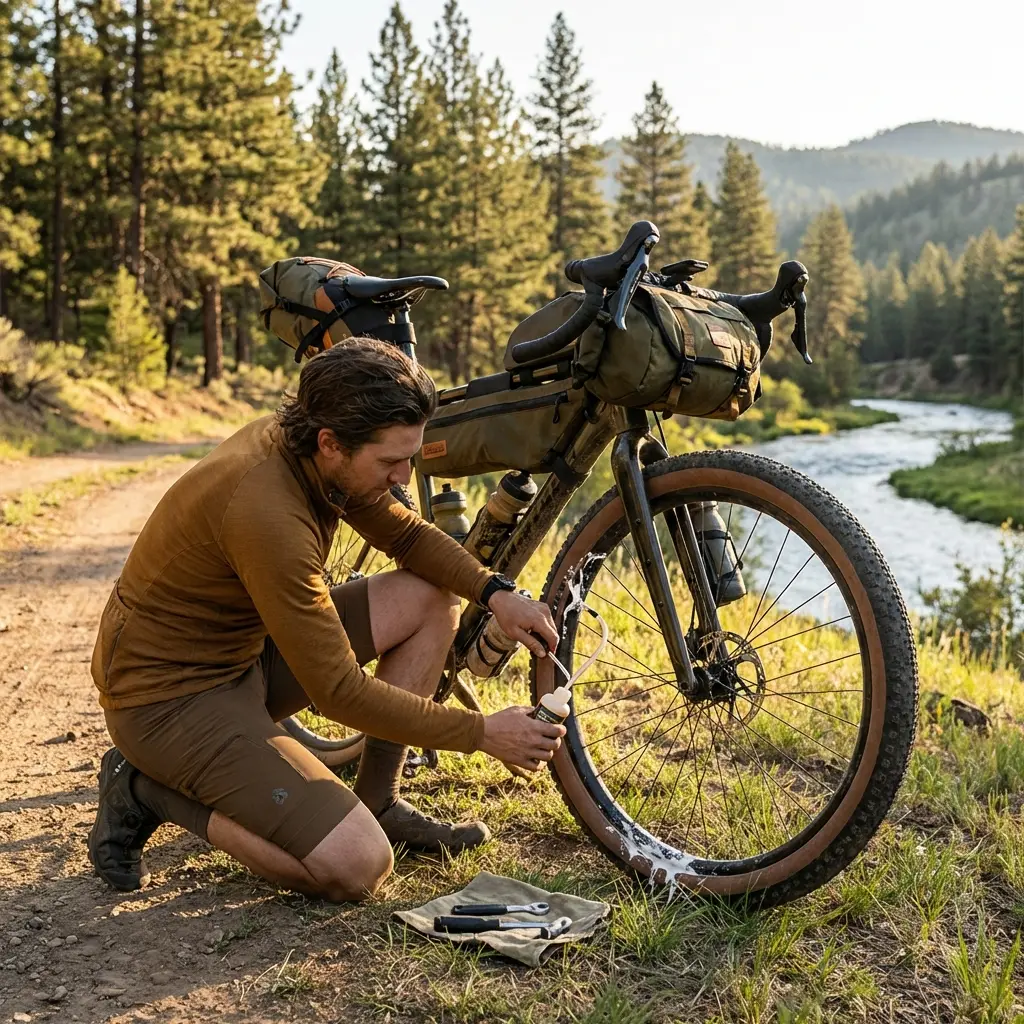
Tubeless tires seal their own punctures and run at lower pressures for better traction. But that magic requires maintenance. Neglect your sealant, and tubeless becomes a liability instead of an asset.
Tubeless has transformed bikepacking. Lower pressures mean better traction and comfort. Self-sealing punctures mean fewer stops. No tubes mean no pinch flats on rocky trails. The technology is genuinely superior—when properly maintained.
The catch: tubeless isn't set-and-forget. Sealant dries out. Beads can burp on hard impacts. Large punctures overwhelm the system. Understanding tubeless maintenance keeps you rolling instead of stranded.
This guide covers everything you need to maintain tubeless tires at home and repair them on trail. For the complete picture, see our Complete Bikepacking Maintenance Guide and Tire Repair Guide.
Understanding Tubeless Systems
Before diving into maintenance, understand what makes tubeless work.
How Tubeless Works
Components:
- Tubeless-ready tire - Airtight bead and casing
- Tubeless-ready rim - Sealed spoke holes, compatible bead seat
- Rim tape - Covers spoke holes, creates airtight seal
- Tubeless valve - Seals against rim tape with rubber base
- Sealant - Liquid that plugs punctures automatically
The system: Air pressure holds the tire bead against the rim's tubeless bead seat. Rim tape seals spoke holes. The valve seals through the tape. Sealant coats the inside of the tire, plugging any air leaks—including punctures.
Why Sealant Is Critical
Sealant is the heart of tubeless. When air escapes through a puncture, sealant rushes to the hole, coagulates around it, and creates a plug. This happens automatically while you ride. Most small punctures seal before you notice them.
But sealant doesn't last forever. It dries out, coagulates into balls, and loses effectiveness. Regular checking and refreshing is essential.
Sealant: Checking, Adding, and Choosing
Sealant Lifespan
Sealant lifespan depends on brand, climate, and riding conditions:
| Sealant Type | Typical Lifespan | Notes |
|---|---|---|
| Stan's NoTubes | 2-4 months | Most common, good sealing |
| Orange Seal | 3-6 months | Longer lasting, good for hot climates |
| Finish Line | 3-5 months | Reliable middle ground |
| Muc-Off | 2-4 months | Good sealing, shorter duration |
| Homebrew | Variable | Can be cost-effective but requires testing |
Factors that reduce lifespan:
- Hot weather (accelerates drying)
- Dry, arid climates
- Low tire pressures (more flexing)
- Frequent punctures (uses up sealant)
- Riding on rim (extreme low pressure events)
Checking Sealant Level
Method 1: The dip test
- Remove valve core with valve core tool
- Insert a spoke or straightened paperclip
- Push to tire interior
- Withdraw and check for sealant on the probe
- If dry past 1/2" depth, add sealant
Method 2: Shake and listen
- Hold wheel horizontally
- Shake side to side
- Listen for sloshing liquid
- No sloshing = add sealant
Method 3: The weight test
- Weigh wheel before adding sealant
- Note weight
- Weigh periodically
- Significant weight loss = sealant has dried
Adding Sealant
Through the valve (easiest):
- Remove valve core
- Position valve at 4 or 8 o'clock (sealant pools away from valve)
- Attach sealant injector syringe
- Inject recommended amount (usually 2-4 oz per tire)
- Reinstall valve core
- Inflate and spin wheel to distribute
Breaking the bead (thorough):
- Deflate tire completely
- Push bead off rim shelf with thumbs
- Pour sealant directly into tire
- Reseat bead
- Inflate and distribute
The bead method lets you clean out dried sealant residue—recommended every 6-12 months.
Choosing Sealant
Stan's NoTubes:
- Industry standard
- Seals punctures up to 6mm reliably
- 2-4 month refresh cycle
- Available everywhere
Orange Seal:
- Longer lasting in heat
- Excellent sealing performance
- Higher viscosity
- Good for desert/summer bikepacking
Stan's Race Sealant:
- Lower viscosity
- Better for smaller punctures
- Shorter duration
- Best for racing, not touring
Bead Seating and Maintenance
Initial Setup
Getting a tubeless tire to seat can be challenging. Techniques from easiest to most aggressive:
Floor pump:
- Remove valve core for faster airflow
- Pump rapidly without breaks
- Listen for bead popping onto rim shelf
- Reinstall valve core once seated
Tubeless-specific pump:
- Reservoir stores compressed air
- Releases burst of pressure
- Much more reliable than regular floor pump
- Worth the investment if running tubeless
CO2 inflation:
- Rapid air delivery
- Excellent for stubborn tires
- Some sealants react poorly to CO2 (check compatibility)
- Wasteful for regular use, great for emergencies
Compressor:
- The gold standard
- Works on nearly any tire/rim combination
- Available at bike shops and gas stations
- Ask before using gas station compressors on Presta valves
Trail Bead Seating
If your tire burps (bead separates from rim momentarily) on trail:
-
Stop riding immediately - Continued riding with an unseated bead damages rim
-
Assess damage - Check for bead damage, rim damage
-
Reseat attempt 1: Remove valve core
- Gives maximum airflow for quick inflation
- Pump fast, watch for bead movement
- Reinstall core once seated
-
Reseat attempt 2: Zip tie method
- Wrap several zip ties around tire circumference
- Tighten to compress tire and push bead outward
- Inflate, remove ties once seated
-
Reseat attempt 3: Install tube
- If bead won't seat, install backup tube
- Ride to camp or town
- Reseat tubeless with proper tools later
Bead Problems
Repeated burping:
- May indicate bead or rim damage
- Check rim tape is fully covering bead shelf
- Verify tire is tubeless-compatible (not just "tubeless-ready")
- Consider a tighter-fitting tire
Bead won't seat:
- Verify rim tape is correct width and properly installed
- Check for debris between bead and rim
- Try different tire position (rotate 90 degrees)
- Lubricate bead with soapy water
Trail Tubeless Repairs
Punctures: The Self-Sealing Process
Most small punctures seal automatically:
- Air escapes through hole
- Sealant is pushed toward leak
- Sealant coagulates around puncture
- Plug forms, sealing the hole
- Process takes seconds to minutes
Help it along:
- Keep riding (centrifugal force distributes sealant)
- Or spin wheel with puncture at bottom
- Watch for bubbling to stop
When Self-Sealing Fails
Signs sealant won't seal it:
- Large/persistent bubbling
- Visible hole larger than 3mm
- Audible hiss that doesn't slow
- Tire going flat despite sealant
Using Tire Plugs
Tire plugs ("bacon strips") handle punctures too large for sealant:
Technique:
- Locate the hole - Mark bubbling spot
- Insert plug tool - Push plug into puncture
- Remove tool - Leave plug in hole
- Spin wheel - Distribute sealant over plug
- Inflate and ride - Check periodically
Tips:
- Insert plug perpendicular to tire surface
- Don't remove debris that's no longer leaking
- Multiple plugs can fill larger holes
- Trim protruding plug ends flush
Sidewall Damage
Sidewall cuts require internal reinforcement:
The tire boot:
- Locate cut on inside of tire
- Clean area if possible
- Apply boot material (dollar bill, gel wrapper, Tyvek, Park Tool tire boot)
- Boot should extend 1" beyond cut on all sides
- Add extra sealant
- Inflate carefully, monitor cut
When boots aren't enough:
- Large sidewall tears need tube installation
- Structural damage may be unrideable
- Consider tire replacement at next opportunity
When to Install a Tube
Sometimes tubeless can't be saved on trail:
- Multiple large punctures
- Bead damage preventing seal
- Complete sealant loss with no spare
- Large sidewall tears
- Rim tape failure
Tube installation:
- Break bead, remove tire
- Remove as much sealant as practical
- Clean rim if possible
- Install tube (watch for sealant contamination on valve area)
- Reinstall tire
- Inflate and ride
Sealant Refresh and Seasonal Maintenance
Regular Refresh
Every 2-6 months (depending on sealant and climate):
- Check existing sealant level (dip test)
- If adequate, add 1 oz to top up
- If dry or balled up:
- Break bead
- Remove old sealant chunks
- Clean interior if heavily coated
- Add fresh sealant
- Reseat bead
Deep Cleaning
Annually or when sealant has solidified:
- Remove tire completely
- Peel out dried sealant (usually comes off in sheets)
- Inspect casing for damage
- Check rim tape integrity
- Clean rim bead seat
- Reinstall tire with fresh sealant
Valve Maintenance
Sealant can clog valves:
Prevention:
- Position valve at top before deflating
- Store bike with valves at 4 or 8 o'clock
- Clean valve core periodically
If clogged:
- Remove valve core
- Clear with small wire or blast with air
- Soak in isopropyl alcohol if heavily clogged
- Replace if necessary (cores are cheap)
Before Multi-Day Trips
Include tubeless maintenance in your overall bike preparation—see our Pre-Trip Inspection Checklist for the complete walkthrough.
Pre-trip tubeless checklist:
- Check sealant level (both tires)
- Top up or refresh sealant
- Verify bead seated fully around entire circumference
- Check for embedded debris that might cause slow leaks
- Verify valve cores tight and functional
- Carry spare sealant, plugs, and backup tube
- Know your pump works (test inflation from flat)
Featured Products
Stan's NoTubes Tire Sealant
The industry standard for good reason. Stan's seals punctures quickly and reliably, handles holes up to 6mm, and is available at virtually every bike shop. The formula works with all common tire casings and doesn't degrade rubber over time. 2-4 month refresh cycle depending on conditions, but consistent performance trip after trip. We've run Stan's on everything from road tubeless to plus-sized bikepacking tires. The 32 oz bottle provides enough for multiple refreshes or full setup of both wheels plus backup.
- Seals punctures up to 6mm
- Available everywhere
- Works with all tire types
- Proven formula
- 32 oz for multiple setups
Orange Seal Endurance Sealant
When you need sealant that lasts longer between refreshes, Orange Seal Endurance delivers. The higher-viscosity formula resists drying in hot climates where Stan's might need monthly attention. Excellent sealing performance with the added benefit of 60-120 day longevity. We switch to Orange Seal for summer desert tours where heat accelerates sealant breakdown. Slightly more expensive per ounce, but worth it if refresh frequency is a concern.
- Lasts longer in heat
- 60-120 day refresh cycle
- Excellent sealing performance
- Higher viscosity formula
- Ideal for desert/summer
Dynaplug Racer Pro
The fastest and most reliable tubeless plug kit available. The machined aluminum body holds five pre-loaded plugs plus a brass insertion tip that slides smoothly through punctures without tearing. Just push through the hole, pull out the tool, and ride. No need to remove the wheel or fight with sealant-covered tires. The soft compound plugs seal immediately. We've used the same Dynaplug for years—it's been through dozens of puncture repairs and shows no wear. Worth every penny.
- Pre-loaded plugs—no fumbling
- Brass tip prevents tearing
- 5 plugs included
- Machined aluminum body
- Made in USA, lifetime warranty
Stan's NoTubes Dart Tool
Stan's Dart system uses a unique approach: pre-loaded plug-and-sealant darts that seal from the outside. Push the dart through the puncture, the internal barb holds it in place, and the integrated sealant reservoir helps seal around the plug. Slightly faster than traditional plugs since there's no separate sealant step. The refill cartridges are affordable. A good alternative to Dynaplug with a different insertion mechanism some riders prefer.
- Pre-loaded plug-and-sealant darts
- Seals from outside
- Barbed design holds securely
- Quick insertion process
- Affordable refills
Milkit Tubeless Sealant Injector
The cleanest way to add sealant through your valve. The Milkit system includes a valve core remover, syringe with measurement markings, and a hose that threads directly onto your valve stem. No mess, no waste, exact measurement of sealant amount. The kit also includes check valves that let you measure existing sealant level by pushing a probe through the valve. For bikepackers who want precision without mess, this is the tool. Small enough to carry on extended trips.
- Clean, mess-free injection
- Measures sealant accurately
- Includes level checker
- Threads onto valve directly
- Compact and portable
Park Tool TB-2 Tire Boots
When sidewalls cut, tire boots provide internal reinforcement that sealant and plugs can't. Park Tool's TB-2 patches are self-adhesive, flexible, and strong enough to handle significant damage. Apply to the inside of the tire over cleaned surface, and the boot bridges the gap while the tire casing does the structural work. Three boots in the pack—keep at least one in your repair kit. Combined with a backup tube, these handle nearly any tire emergency.
- Self-adhesive application
- Flexible, durable material
- Handles sidewall cuts
- 3 boots per pack
- Lightweight emergency essential
Tubeless Troubleshooting
"My tire loses air overnight"
Possible causes:
- Low sealant level
- Slow leak at valve base
- Rim tape not sealing properly
- Porous tire casing (cheap tires)
- Bead not fully seated
Diagnosis:
- Submerge wheel in water, look for bubbles
- Check valve base first (common culprit)
- Inspect rim tape through valve hole
- Spin and reposition, check if leak location changes
"Sealant won't seal this puncture"
Escalation ladder:
- Add more sealant
- Insert plug
- Insert multiple plugs
- Apply internal boot + plug
- Install tube
"Bead burps on hard cornering"
Solutions:
- Run slightly higher pressure
- Check rim tape covers bead shelf fully
- Consider tire insert (CushCore, Tannus) for extreme cases
- May need different tire/rim combination
"Sealant keeps clogging my valve"
Prevention:
- Store bike with valve not at bottom
- Clean cores regularly
- Use valves with removable cores
- Consider valve cores designed for sealant (larger openings)
Tubeless Maintenance Schedule
| Interval | Action |
|---|---|
| Every ride | Visual pressure check |
| Weekly | Spin and check for slow leaks |
| Monthly | Check sealant level |
| Every 2-4 months | Refresh sealant |
| Annually | Remove tire, clean, inspect tape, full refresh |
| Before multi-day trips | Full check and refresh |
FAQ
Should I carry CO2 or mini pump for tubeless?
Both have advantages. Mini pump is unlimited but slower. CO2 is fast but finite. Most bikepackers carry a mini pump for regular inflation and CO2 for emergency bead seating. Check your sealant's CO2 compatibility—some formulas are affected by cold CO2 gas.
Can I convert non-tubeless wheels to tubeless?
Sometimes. Rims need to be reasonably airtight with proper tape, and tires must be tubeless-compatible. Conversion is not recommended for bikepacking—the reliability isn't there. Use purpose-built tubeless wheels for touring.
How much sealant should I use?
Typically 2-4 oz per tire depending on tire volume. Larger tires (40mm+) need 3-4 oz; smaller tires (28-35mm) need 2-3 oz. When in doubt, slightly more is better than not enough. Too much just adds weight.
Is tubeless worth the hassle?
For bikepacking, yes. The reduced flat frequency and ability to run lower pressures significantly improve the riding experience. The maintenance overhead is modest once you have a routine. We wouldn't go back to tubes for off-road bikepacking.
What if I get a puncture with no sealant?
Install your backup tube. This is why you carry one. Then address tubeless setup at camp or in town.
Can I mix sealant brands?
Generally not recommended. Different formulas may react poorly, and the mixture may seal less effectively than either alone. When refreshing, fully clean out old sealant if switching brands.
Related Guides
- Complete Bikepacking Maintenance Guide - Full maintenance overview
- Tire Repair Guide - Patches and plugs
- Pumps: Mini vs CO2 - Inflation options
- Building Your Tool Kit - What to carry
- Emergency Field Repairs - When tubeless can't be saved
Tubeless requires attention, but the payoff is worth it. Fewer flats, better traction, lower pressures for comfort—all yours with regular sealant maintenance and the right repair skills.
Keep your sealant fresh, carry your backup tube, and trust the system.
The trail awaits.