Severe Weather Safety: Lightning, Storms, and Extreme Heat on the Trail
20+ years testing gear in Colorado backcountry
Bikepacking Severe Weather Safety: What to Do When the Sky Turns on You
When severe weather catches you on a bikepacking trip, the plan is simple: get off exposed terrain before lightning arrives, ride early and rest through dangerous heat, never cross moving floodwater, and stop early — dry and fed — before cold rain becomes hypothermia. Every one of those moves is free. What they cost is discipline.
Weather is the hazard bikepackers most reliably meet. You may never crash badly or meet a bear, but ride enough nights out and you will get caught by a thunderstorm, a heat wave, or a cold front — usually on the day your route crosses its most exposed terrain.
Weather is also the most forecastable hazard out there, and almost every fix is a decision rather than a purchase. This guide — part of our bikepacking safety guide series — takes each hazard in turn with a concrete decision rule: what to check, what to watch, and exactly when to stop riding.
Forecast Discipline: The Cheapest Safety Gear You Own
Most severe-weather emergencies start days earlier, as a forecast nobody read. Our routine has three parts:
- Before the trip: Pull the NWS point or zone forecast for each day's actual terrain, not the nearest town — a valley town and an 11,000-foot pass are different climates. Note thunderstorm probability, highs and lows, and wind.
- At every resupply: Any time you have signal, re-check the next 48 hours. Mountain forecasts go stale fast; the Tuesday outlook you memorized on Sunday is a rumor by the time you're climbing.
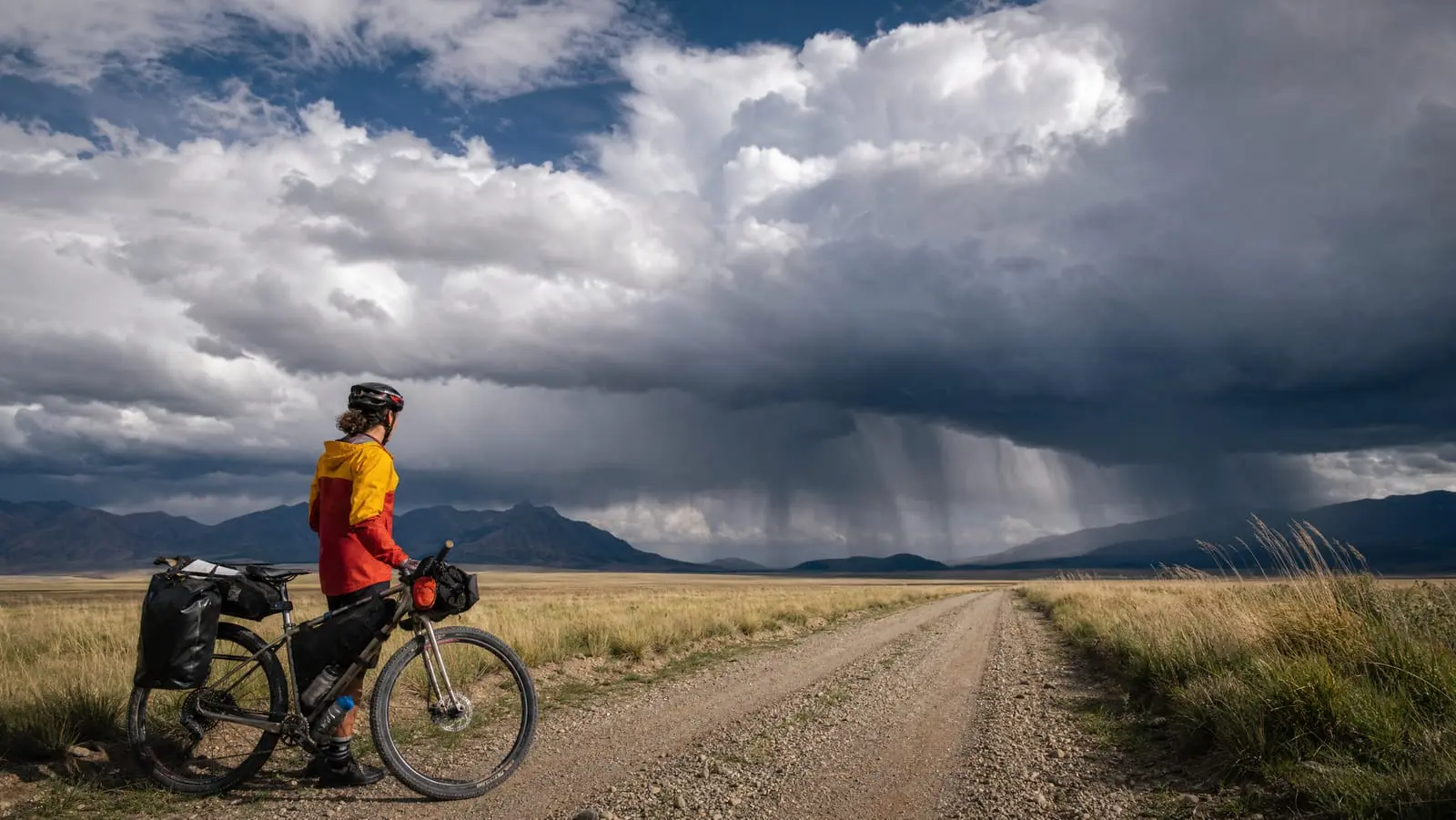
- All day, with your eyes: In summer mountains, watch the morning sky. Puffy cumulus by mid-morning that keep building into cauliflower towers with darkening bases are the standard prelude to afternoon thunderstorms.
That afternoon pattern is remarkably dependable. According to the American Hiking Society, mountain thunderstorms typically develop in the early afternoon, and the standard advice is to travel early and be off high terrain by around noon.
Decision rule: On any day with thunderstorms in the forecast, schedule exposed terrain — passes, ridgelines, open plains — for the morning, and be somewhere lower by early afternoon. If the climb won't fit before noon, it waits for tomorrow.
Cycling Lightning Safety: There Is No Safe Place Outdoors
Let's say the hard part plainly, because the National Weather Service says it plainly: there is no safe place outside during a thunderstorm. According to the NWS, if you can hear thunder, you are within striking distance, and the only genuinely safe options are a substantial building or a hard-topped metal vehicle. Everything a bikepacker can do outdoors merely reduces risk — it never removes it.
That's why cycling lightning safety is really a timing game, played before the storm arrives:
- Use the 30-30 rule. Per NOAA guidance, count the seconds between flash and thunder: 30 seconds or less means the storm is within about six miles — time to head for real shelter, not finish the climb. Don't resume riding until 30 minutes after the last thunder.
- Don't trust blue sky overhead. The NWS notes lightning can strike more than 10 miles from a storm's rain. Hearing thunder at all means you're in range.
- Know your real shelters. Per the NWS, that means a substantial building with electricity or plumbing — a store, a ranger station — or a car with a metal roof. A picnic pavilion, a vault toilet outbuilding, a shed, a rock overhang, a tent, or a lone tree does not count.
Caught on a ridge or open plain anyway?
Sometimes the storm builds faster than the forecast promised. NWS backcountry lightning guidance is blunt about what to do next:
- Descend immediately. At the first thunder, get off summits, ridgelines, and open slabs toward lower terrain — on a bike you can descend faster than any hiker, so roll downhill now.
- Avoid the tallest things around. Lone trees, signposts, towers — and stay away from wire fences and other long metal conductors that can carry current from a distant strike.
- Spread the group out. Per NWS backcountry guidance, groups should separate — far enough apart that one strike can't injure everyone, so someone is left to help.
- Lightning position, last resort only. If you truly cannot get lower, NOLS describes squatting or sitting and balling up, arms wrapped around your legs, staying as low as possible without lying flat. NOLS and the NWS are explicit that this only slightly reduces risk — it's a last resort, not a substitute for descending early.
Lay the bike down well away from you and wait it out. The bike is replaceable.
Extreme Heat: Heat Exhaustion, Riding Schedule, and Water Math
Heat is sneakier than lightning because it degrades your judgment first. Heat exhaustion on a bikepacking trip rarely announces itself; it shows up as slowing pace, irritability, and skipped snacks an hour before it becomes a medical problem.
Know the signs. According to the CDC, warning signs of heat exhaustion may include heavy sweating, weakness, dizziness, headache, nausea or vomiting, muscle cramps, and fainting — and you should seek medical help if symptoms worsen, last longer than an hour, or include vomiting. Heat stroke is the medical emergency: the CDC lists confusion or altered mental status, slurred speech, hot skin that may be dry or sweaty, seizures, and loss of consciousness, with body temperature able to rise to 106°F or higher within 10 to 15 minutes. If anyone shows heat stroke signs, call 911 immediately, get them to shade, and cool them however you can while help is coming. Confusion is the line: a rider who seems disoriented or "off" needs emergency care, not a pep talk.
Our heat playbook is schedule-first:
- Dawn starts. Big miles before 10 a.m. are cheap; the same miles at 3 p.m. are expensive and risky.
- Siesta through the peak. From roughly noon to 4 p.m. on genuinely hot days, we stop — real shade, shoes off, food in. Two lost midday hours routinely buy back a whole evening of good riding.
- Do the water math out loud. Before every dry stretch: distance to the next reliable water, hours at loaded pace, carrying capacity. In real heat we plan on roughly a liter per hour of hard riding as a rule of thumb, plus a buffer bottle for the flat tire or wrong turn. If the math doesn't work, the route changes — our guide to bikepacking water storage covers how to carry it.
- Electrolytes, not just water. On long hot days, salty snacks or electrolyte mix belong in the resupply plan.
- Shade discipline. Every stop happens in shade, even a 5-minute one — sun exposure is cumulative.
Decision rule: If someone stops sweating heavily, becomes confused, or can't cool down and recover in shade within the hour, the ride is over — the day is now about cooling and getting medical care.
Riding Through a Storm: Wind, Downpours, and Flash Floods
Not every storm is a lightning emergency. Sometimes riding through a storm is just wet, miserable, and reasonably safe — and sometimes the rain itself is the killer. The difference is water on the ground and wind in your face.
Flash floods: the black-and-white rules
Flash floods leave the least room for judgment, and the numbers explain why. According to the National Weather Service's Turn Around Don't Drown campaign, just six inches of fast-moving water can knock over an adult, and twelve inches can carry away most cars — and flooding kills more people in a typical year than any other thunderstorm-related hazard.
For bikepackers that means two absolute rules:
- Never camp in a wash, arroyo, slot canyon, or dry streambed. In desert country, the storm that floods your camp can fall miles away under a sky you never see. Pitch on high ground, every time.
- Never cross moving floodwater — walking or riding. You can't judge depth, current, or what the flood has done to the roadbed underneath. Turn around, wait, or reroute. A flooded crossing is often passable again within hours; a swept-away rider often isn't.
Wind and rain on a loaded bike
A loaded rig catches wind like a sail. In gusty crosswinds, slow down, get low, loosen your grip slightly, and lean the bike a touch into the wind so gusts push you upright instead of into traffic. Our decision rule: when gusts move you a full tire-width without warning, or you're steering constantly just to hold a line, we stop riding exposed sections — ridgelines, causeways, open shoulders — and wait or reroute.
Heavy rain and fog also wreck what drivers can see, which matters most on paved connectors. Lights, lane position, and when to just get off the road are covered in our guide to bikepacking road safety.
Cold Rain and Summer Hypothermia
The hypothermia cases that surprise people don't happen at 10°F — they happen on a 50°F July afternoon with rain and wind. According to the CDC, hypothermia can occur at cool temperatures well above freezing — even above 40°F — if a person becomes chilled from rain, sweat, or immersion in cold water. A soaked bikepacker descending a mountain pass is all three risk factors on one bike: wet clothing, evaporative cooling, and 25 mph of self-generated wind chill.
Watch for early signs in yourself and your partners: intense shivering, clumsy hands fumbling zippers and brake levers, slurred speech, sluggish thinking. Worsening symptoms — shivering that stops, confusion, drowsiness — may signal an emergency: stop and seek medical care.
The defense is the stop-early rule: get warm and dry while you still can, not when you finally must.
- Put the rain shell on before you're soaked, and add a warm layer at the top of every long descent.
- When you're wet, cold, and the weather is worsening, stop early — pitch the shelter, get into dry layers, eat, get in the bag. Camping at 3 p.m. feels like quitting; it's the move experienced riders make and beginners wish they had.
- Never ride into evening cold and rain hoping the next town "isn't far." Fatigue, falling temperatures, and darkness stack faster than you can pedal.
Layering that keeps a margin of dry clothing is the whole game — our bikepacking clothing guide covers the wet-weather system, and our winter bikepacking guide covers cold as the forecast rather than the surprise.
Summer hypothermia doesn't feel like a winter emergency. It feels like being tired, wet, and a little clumsy — right up until it doesn't. Stop early, while stopping is still easy.
When the Weather Wins: Rebuilding the Plan
Sitting out severe weather isn't a failure state; it's the plan working. Build the retreat into the route before you leave:
- Mark bailout points. Note every road crossing, town, and shortcut that exits the route, so retreat is a navigation decision, not an improvisation.
- Budget a flex day. One unscheduled day per week of riding means a storm costs you a zero day, not a summit-in-a-thunderstorm gamble.
- Tell someone the plan changed. If you sit out a day or reroute, your check-in contact needs to know — otherwise a smart weather decision can trigger a needless search. That's where satellite texting earns its place; we cover the full system in our guide to emergency communication when there is no cell signal.
Weather is also the most common reason riders end up walking out of the backcountry instead of riding — we cover self-rescue for bikepackers in a dedicated guide.
A short note on kit
Nothing here requires new gear. The severe-weather kit is stuff you already carry, done right — a real rain shell and warm layer, sun protection, enough water capacity for the route, and a shelter you can pitch fast in wind. The clothing, hydration, and winter guides linked above cover all of it.
The Takeaway
Severe weather safety on a bikepacking trip comes down to a handful of decision rules, applied without negotiation:
- Thunderstorms forecast? Exposed terrain happens before noon or not at all — and when thunder roars, you're already late.
- Lightning close? Real shelter or low terrain, spread out, wait 30 minutes after the last thunder.
- Serious heat? Dawn starts, midday siesta, honest water math — and confusion means emergency care, now.
- Water moving across the route? Turn around. Don't camp in washes. No exceptions.
- Wet, windy, and 50°F? That's hypothermia weather. Stop early, get dry, get warm.
None of it costs a dime, and all of it beats toughness. The riders who finish long routes aren't the ones who ride through everything — they're the ones who read the sky, respect the forecast, and are happy to drink coffee in a tent while the storm gets bored. For the rest of the system — navigation, wildlife, first aid, and trip planning — start with our complete guide to bikepacking safety.