Solar Charging for Bikepacking: Worth the Weight?
20+ years testing gear in Colorado backcountry
Is a Solar Charger for Bikepacking Worth It? The Short Answer
For almost every bikepacking trip, no. A panel strapped to a bag is a trickle source rather than a charging system, and the same weight spent on a bigger battery or a dynamo hub buys more usable electricity. Solar earns its keep in one narrow band of trips, which we define precisely below.
This article contains affiliate links. We may earn a commission if you make a purchase through our links, at no extra cost to you.
That is an unpopular answer in a category full of "best bikepacking solar panel" lists, so the rest of this article earns it: where the number on the box comes from, what a panel can physically do bolted to a moving bicycle, and the arithmetic that settles it. If you have not read how bikepacking power and charging works, start there, because solar sits third in that guide's ranking for the reasons below.
Rated Watts Versus Real Solar Panel Output on a Bikepacking Trip
A 15 W panel is a panel that produced 15 W in a test lab. According to PVEducation's page on solar cell efficiency, terrestrial cells are rated with an input power of 1 kW per square metre, at a cell temperature of 25 degrees C, under the AM1.5 spectrum. Those three conditions are a defensible way to compare one panel against another. They are not a forecast of your Tuesday.
Three things pull a panel's real output below that benchmark on a bike, and they stack.
Heat. Silicon gets worse as it warms. PVEducation's page on the effect of temperature puts the fall in maximum power output at "0.4% to 0.5% per °C for silicon." And modules run hot: PVEducation's nominal operating cell temperature page notes that modules "typically operate at higher temperatures and at somewhat lower insolation conditions" than the rating assumes, and reports that most modules have a NOCT "around 40-45°C," with the best at 33 degrees C and the worst at 58 degrees C. You can multiply those two published figures yourself: a module running at 45 degrees C sits 20 degrees above its rating temperature, and 20 times 0.4 to 0.5 percent is 8 to 10 percent off peak power from heat alone. Note what NOCT assumes, though: an open-backed module in 20 degrees C air. A dark panel pressed flat against a dark nylon bag in desert sun has nowhere to dump its heat.
Angle. Penn State's EME 812 course material on the cosine effect states the rule plainly: the useful share of the direct beam falls off with the cosine of the angle of incidence, measured between the incoming light and a line perpendicular to the panel. Do that arithmetic for a flat panel on a seat pack with the sun 30 degrees above the horizon: the beam arrives 60 degrees off perpendicular, and the cosine of 60 degrees is 0.5. Half the irradiance before anything else goes wrong, and that is most of the morning and evening.
Shade. This is the one that surprises people, because the penalty is wildly out of proportion to the shaded area. PVEducation's page on shading is unambiguous.
Shading just one cell in a module to half causes the output power of the whole module to fall to half.
The same page adds that "completely shading one cell causes the output power of the module to fall to zero," and that bypass diodes are what isolate the shaded cell. Now picture the panel lashed to your bars with the shadow of a bar bag, a cable, or your own forearm crossing one cell for part of every hour.
Why We Will Not Give You a Percentage
Search this question and you will meet a confident-sounding range, usually "60 to 80 percent of rated output." We went looking for the measurement behind it and did not find one. There is no published test we could locate of folding USB panels strapped to bikepacking bags, across realistic angles, shading patterns and operating temperatures, that would justify any single number.
So we are not going to invent one. What we can give you is the direction and rough size of each error term, which is the section above, plus the one measurement that applies to you: put a USB power meter between the panel and your battery and watch it for an afternoon on your own route. That cheap reading beats every number on the internet, including ours.
Treat any article that hands you a tidy percentage here as a signal about that article.
Mounting a Solar Panel on Bikepacking Bags: The Reality
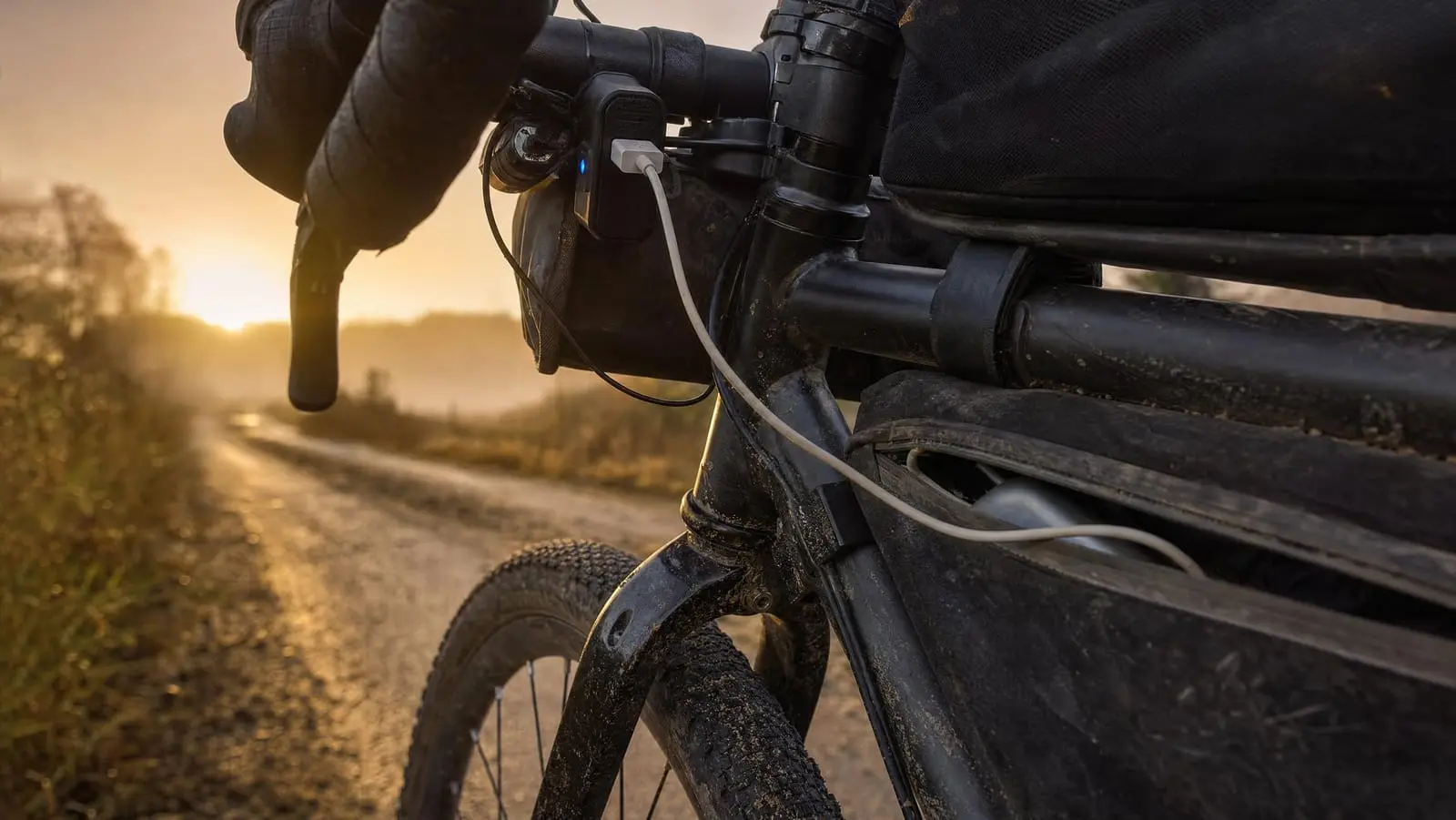
The pitch is that you charge while you ride. The reality is that a bike is close to the worst available mounting platform.
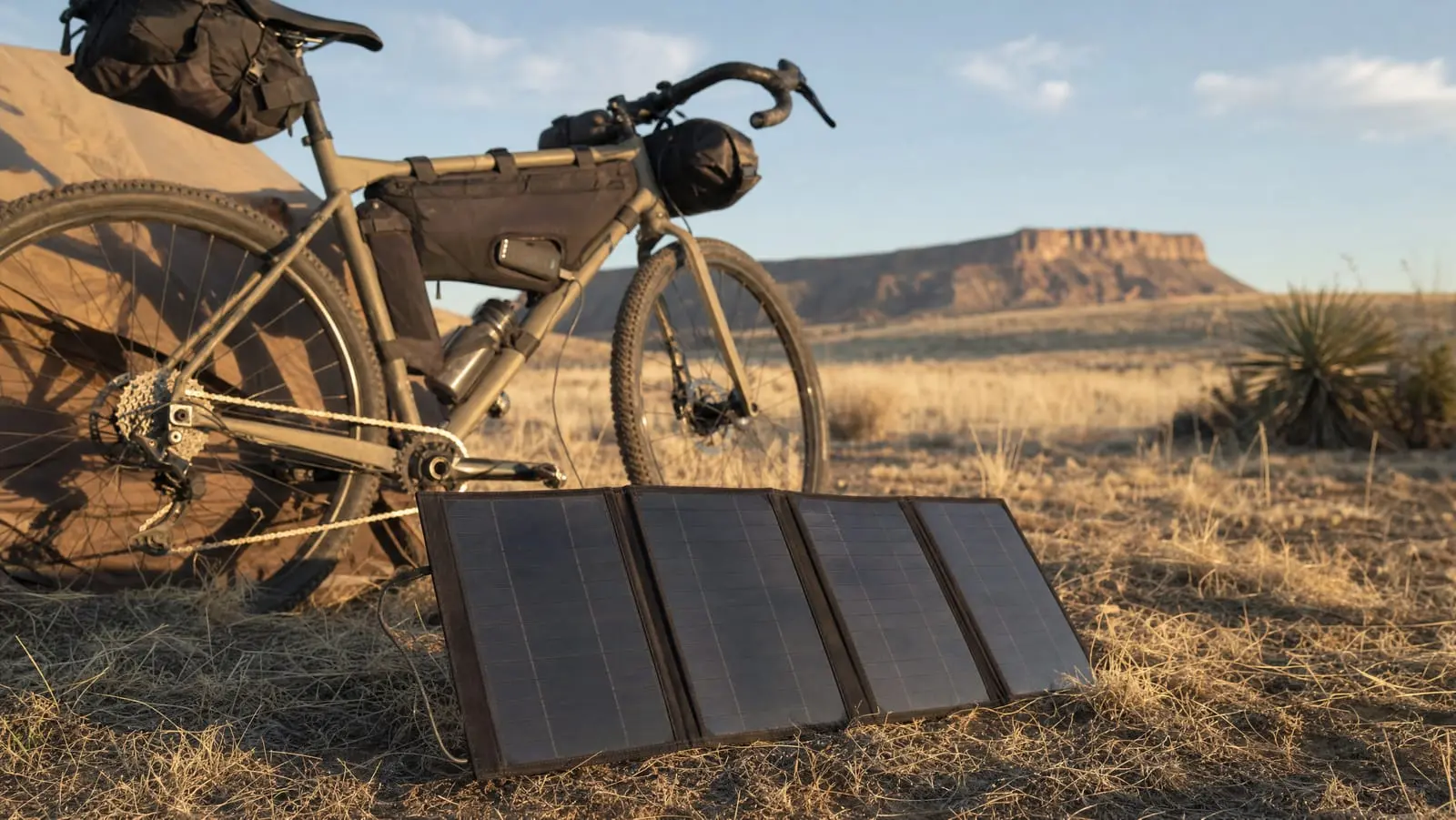
A panel lashed over a seat pack lies horizontal, aimed at the sky rather than the sun, and it rotates with the bike every time the route turns. It sits in the moving shadow of the rider, the bags and the cables, and it chews its own grommets over every washboard section. The connector end is where the trouble concentrates: the FlexSolar 15W Foldable Solar Panel carries an IP67 rating on the panel itself, but the listing states that the junction box is not waterproof. So the electronics have to live wherever you can keep them dry, not wherever the sun is.
The most useful published field account we found is an Adventure Cycling Association trip report from November 2022, in which Rebecca Saulsberry carries a 10 W panel that "fits easily at the bottom of my framebag" and runs "a fairly long cable so I could place the panels in the sun," leaving the phone in the shade so it did not overheat. Her verdict on anything short of open sun:
the panels can maintain a device's existing charge, but they hardly add any power, if at all.
Cycling UK's technical editor Richard Hallett reached the same place in the organisation's guide to electric power generation on tour, first published in Cycle magazine's April/May 2017 issue. Small solar arrays, he writes, need "both sunlight and a position that takes advantage of it," which makes them "better suited for use in camp rather than on the road."
The Arithmetic That Settles It for Most Trips
Work the demand side before you shop the supply side. Our walkthrough of a bikepacking power budget turns your actual device list into a number of watt-hours per day, and it takes about ten minutes.
Here is why. A 10,000 mAh power bank holds roughly 37 Wh of cell energy, which is 10,000 divided by 1,000 times a nominal 3.7 V, and it arrives full. The FlexSolar panel above weighs 450 g per its listing, arrives holding nothing, and produces only when the sun is out, the panel is aimed and nothing is shading it. For a three-day trip the battery wins on every axis, including the number of things that can fail.
The break-even is a function of trip length, not panel quality. Carried energy is a fixed lump that runs out on a known day; a generator is still producing on day twelve. We lay that comparison out properly in dynamo hub versus power bank. Solar is a generator with an unusually unreliable fuel supply, which is why it ranks behind the other one.
One more adjustment: you probably need less than you think. The settings and habits in stretching device battery life routinely cut a daily budget enough to delete the problem, and on any route with towns finding sockets on route is faster, lighter and free.
When Solar Does Earn Its Weight
There is a real band where the answer flips. All of these need to be true at once.
- Long and genuinely remote. More than roughly a week between any mains socket. On anything shorter, carried capacity covers it.
- Reliable, strong sun. Desert, high plateau, low latitude in the dry season. Overcast is not a weak version of sun for this purpose, it is close to nothing, per the Adventure Cycling account above.
- Low daily mileage. Expedition pace, heavy hike-a-bike, packrafting hybrids. This is the case where a dynamo genuinely struggles, because a hub that is barely turning is barely generating.
- Long static camp hours in open ground. Hours, not minutes, and not under forest canopy. This is where a panel can be deployed, aimed, and re-aimed as the sun moves.
- No realistic resupply plan. If you can post a battery ahead or buy one, that is usually the lighter answer.
A months-long crossing of Central Asia or the Andes can tick all five. A rider doing four-day gravel loops out of a trailhead ticks none of them, and no panel upgrade changes that.
If You Are Carrying One Anyway, Do It Properly
Three rules separate a panel that contributes from a panel that is ballast.
- Deploy it at camp, do not commute with it. Unfold it aimed at the sun and move it when the sun moves. Riding with it strapped on flat is the lowest-yield configuration available.
- Keep the junction box dry and out of the sun. It is usually the least weatherproof part, and heat costs you output at 0.4 to 0.5 percent per degree C.
- Never let anything shade a cell. Not a strap, not a cable, not a water bottle. Half a cell is half the panel.
For reference, the FlexSolar 15W is rated at 15 W, unfolds to 23.5 by 8.8 inches, folds to 7.8 by 8.8 by 0.7 inches, weighs 450 g, and offers a single USB-A output at 5 V and up to 3 A. It is $35.99 as of November 2026, and stock was down to single figures when we checked. Its listing also warns that output drops when charging through glass, in case you had pictured propping it inside a cafe window.
One coverage note: the folding panels riders discuss most, from Anker, BigBlue, Lixada and similar brands, are not in the product data behind this article, so we will not rank them or quote specs we have not seen. The FlexSolar is not our pick for best panel. It is the one we can describe accurately.
The Honest Alternatives: Carry It, or Generate It From the Wheel
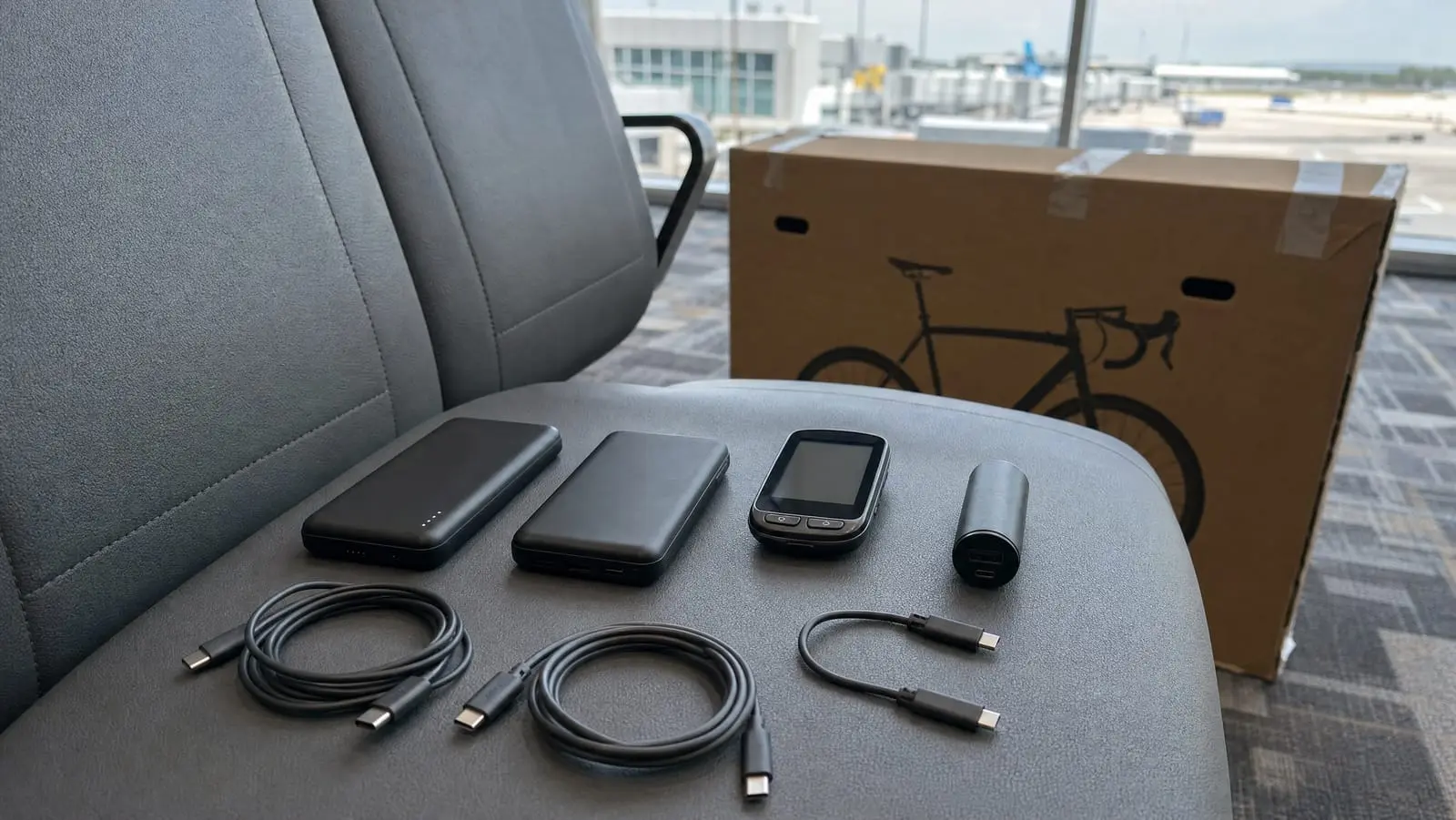
Carry it. For the overwhelming majority of trips, the right answer is a rugged brick and a plan for topping it up in towns. The INIU Outdoor Rugged 10000mAh Power Bank is the shape of thing we mean: 3.6 by 2.3 by 1.1 inches and 6.9 oz per its listing, a 45 W output, an IP67 rating, a quarter-inch thread and a carabiner, at $54.99 as of November 2026. Availability varies on this one, so check before you plan around it. Its 10,000 mAh is about 37 Wh of carried energy at 3.7 V nominal. No sun required, no deployment ritual, nothing to aim.
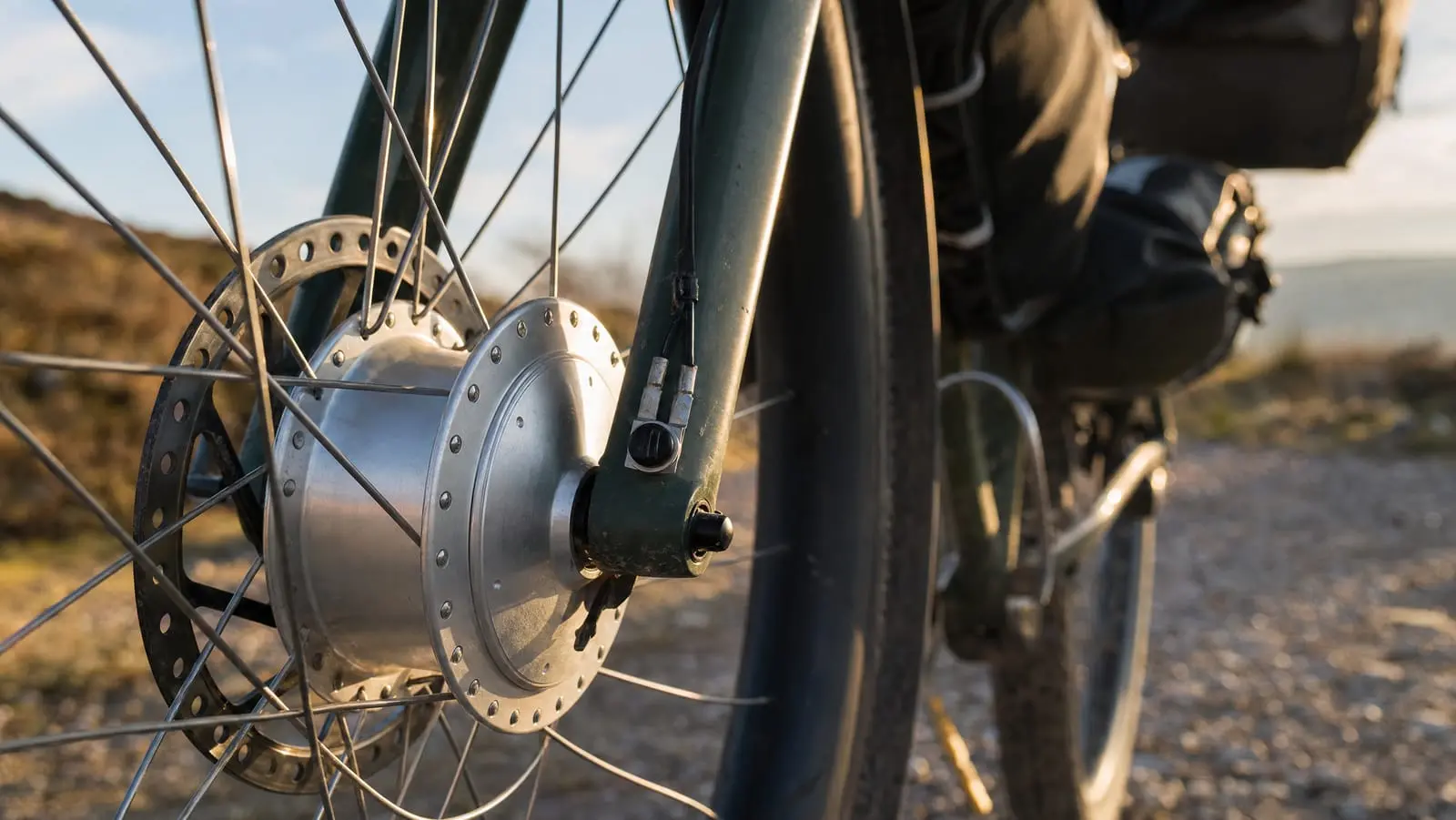
Generate it. If your trips are long enough that carried capacity runs out, a hub is the better generator for almost everyone: it works at dawn, in rain, under canopy, and on the days your route turns into a headwind. Choosing one comes down to drag, weight and serviceability rather than output, which is the ground covered in the best dynamo hubs for bikepacking.
On the long expedition bikes where solar appears at all, a hub plus a cache battery does the work and the panel is a third layer of redundancy for the weeks without a socket. Solar as the supplement. Never solar as the supply.
What We Would Actually Do
Skip it. Buy a good power bank, learn your real daily consumption, and spend the saved money and the saved 450 g on something that improves every night. If your riding genuinely is long, slow, remote and sunny, carry a folding panel as a supplement to storage you already have, deploy it at camp rather than on the bars, and expect it to hold a line rather than fill a battery.
The ranking has not changed: mains sockets first, dynamo second, solar third. Solar is not a scam, it is just the option with the worst match between what a bicycle offers and what a photovoltaic module needs. For how all three fit together and what to buy in which order, read our bikepacking power and charging guide.