Flying With Power Banks and Bike Batteries: The Current Rules
20+ years testing gear in Colorado backcountry
Flying With Power Banks: The Rules for Cyclists in Four Sentences
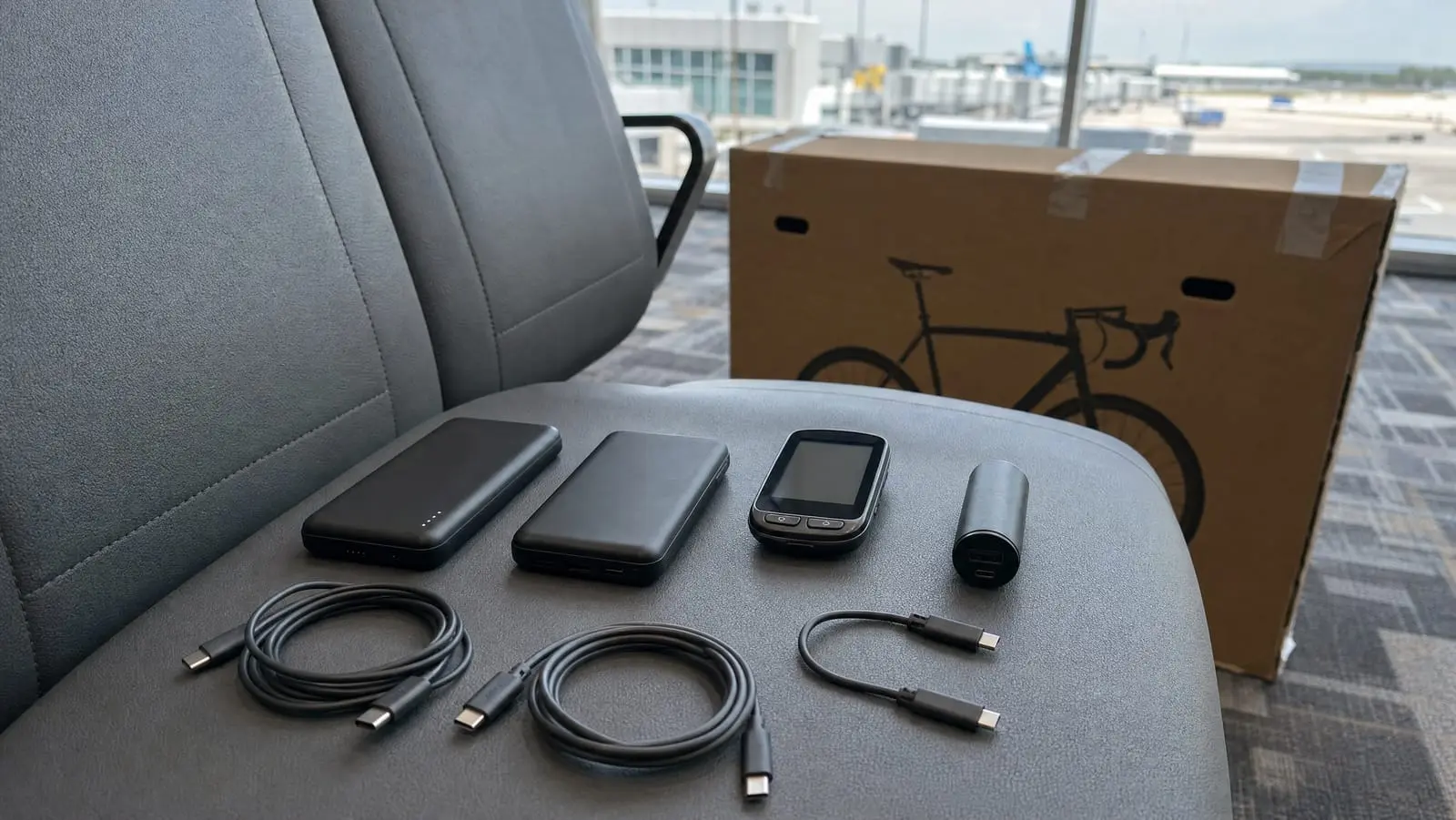
Every power bank and spare battery flies in the cabin, never in the hold. Since 27 March 2026 the global floor is two power banks per person, and you must not recharge one on board. Under 100 watt-hours needs no permission from anyone; over 160 Wh does not fly at all. An e-bike battery is over 160 Wh, so it stays home.
This article contains affiliate links. We may earn a commission if you make a purchase through our links, at no extra cost to you.
The detail is where riders lose packs at the gate, because a bikepacking kit is unusually battery-dense: head unit, light, messenger, phone, electronic shifting, and a brick or two to feed it all. If you are still sizing that kit, start with bikepacking power and charging.
This is the battery half of flying with a bike. Stoves, fuel, CO2 cartridges, sharps, sealant, bear spray and the bike box itself all live in flying with bikepacking gear and TSA rules. Here we only do cells.
The Watt-Hour Bands, and How to Find Your Actual Number
The bands are the stable part. Per the FAA's PackSafe page on lithium batteries, updated 11 August 2026, spare and uninstalled lithium batteries — including power banks — must be carried in carry-on baggage only, are limited to 100 Wh each, and with airline approval may run to two spares rated 101 to 160 Wh. Above 160 Wh they do not fly.
Which band you are in is arithmetic. The FAA's instruction is to multiply volts by amp-hours:
Wh = mAh × V ÷ 1000
Use the nominal cell voltage, roughly 3.6 to 3.7 V — not the 5 V printed beside the USB port. A 25,000 mAh pack is 92.5 Wh at 3.7 V and a frightening 125 Wh at 5 V. The FAA notes newer batteries have the Wh rating marked on them, and that printed number is the one that counts. The hard cases are the ones nobody writes about.
Two capacities on one label. Where a pack prints both a large "capacity" and a smaller "rated output" at 5 V, the regulator's figure comes from the cells: use the larger number at 3.7 V. Usable energy for trip planning is a different sum, in our bikepacking power budget.
The label has rubbed off. A frame bag sands silkscreen to nothing in a season. Look the model up, write the figure on the case, and if you cannot establish a rating treat the pack as unflyable: ICAO requires a battery be "of a type which meets the requirements of each test in the UN Manual of Tests and Criteria, Part III, subsection 38.3", and an unmarked no-name brick is what nobody can show that for.
A multi-cell dynamo cache. The rating is the whole pack's energy however it is wired: four 3,400 mAh 18650 cells at 3.6 V is about 49 Wh in series or in parallel. That is our arithmetic, not a manufacturer's claim.
How Many Power Banks on a Plane? Two — and That Is New
ICAO added Addendum No. 1 to its Technical Instructions for the Safe Transport of Dangerous Goods by Air, applicable from 27 March 2026 (ICAO Doc 9284-AN/905). It pulls power banks out of the spare-battery entry into one of their own, in wording short enough to quote.
Power banks: must be carried as carry-on baggage; must not be recharged while on board the aircraft; should not be used to recharge a portable electronic device while on board the aircraft; no more than two power banks may be carried per person.
Read the verbs. Must be carry-on, must not be recharged and no more than two per person are requirements; "should not be used to recharge a portable electronic device" is a recommendation. IATA's guidance for operators, 31 March 2026, labels them exactly that way.
The two-bank cap is separate from the spare-battery cap. IATA says the addendum "separate[s] out power banks from spare batteries", which are "no longer referred to as spare batteries". Its passenger table caps power banks at two, with no approval route past that, and separately allows 20 spare batteries and 15 devices before the operator's approval is needed. A spare Di2 battery does not eat a bank slot.
Over 100 Wh, power banks are becoming the exception. ICAO still permits 101 to 160 Wh with the operator's approval, and the UK Civil Aviation Authority states the same for passengers from 27 March 2026. But IATA's passenger table marks a power bank over 100 Wh forbidden, and its operator guidance says that provision "will not be carried into the 68th edition of the DGRs" — in force 1 January 2027.
US domestic flyers, note the gap: the FAA page still lists quantity limits as "none for most batteries", warning instead that "many airlines ... may have stricter quantity and Wh limits to include how many power banks/portable chargers each passenger is allowed to travel with". The cap is real; at home it reaches you through your airline.
Carrier by Carrier: Who Went Further, and When
Several airlines moved before ICAO did, and all are stricter than the floor.
- Virgin Australia from 1 December 2025, and Qantas, QantasLink and Jetstar from 15 December 2025 — barred using or charging a bank on board, the Qantas rules explicitly covering in-seat USB and power outlets. Both allow two banks; Qantas sets a 160 Wh ceiling per bank, Virgin 100 Wh outright and 100 to 160 Wh with prior approval (Virgin Australia; start dates per the NRMA, 24 November 2025).
- Lufthansa Group from 15 January 2026 — neither used nor charged on board, and 100 to 160 Wh needs advance approval (Lufthansa Group).
- Korean Air, Asiana, Jin Air, Air Busan and Air Seoul from 26 January 2026 — use and charging "strictly prohibited", banks within personal reach and "must not be stored in the overhead bins" (Onboard Hospitality, 2 February 2026).
- Southwest, first US carrier to restrict power banks in May 2025, from 20 April 2026 limits passengers to one bank, in plain sight rather than an overhead bin, and bars recharging it from in-seat power (Paddle Your Own Kanoo).
Those bin rules followed a January 2025 fire aboard an Air Busan A321, most likely started by a power bank in an overhead bin (ABC News).
Spares Versus Installed: Lithium Battery Air Travel for a Cycling Kit
A battery installed in a device travels in either bag; a spare must be in the cabin; a power bank is now its own third category.
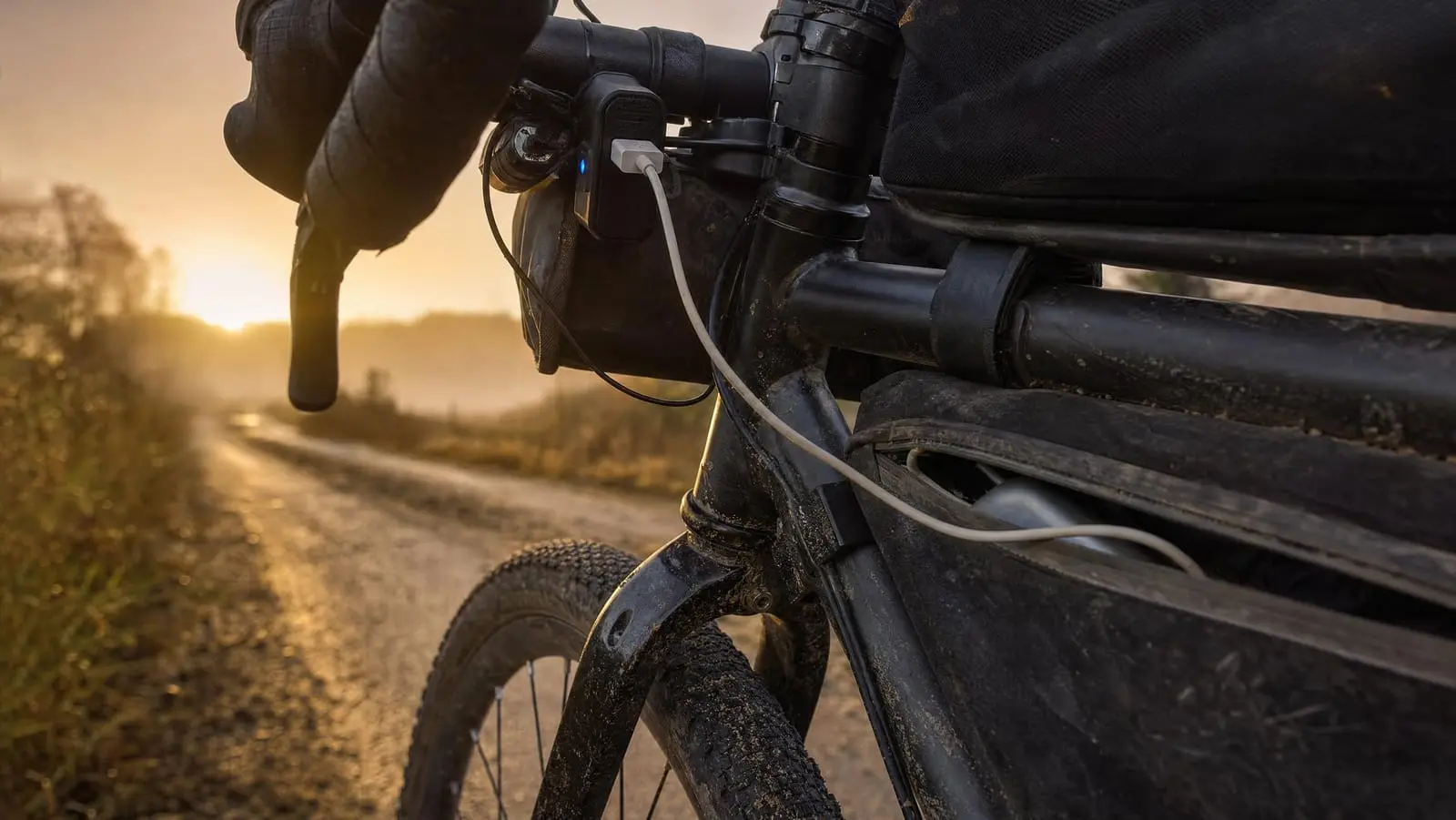
- Power bank. Cabin only, counts against your two, individually protected, no recharging in the air.
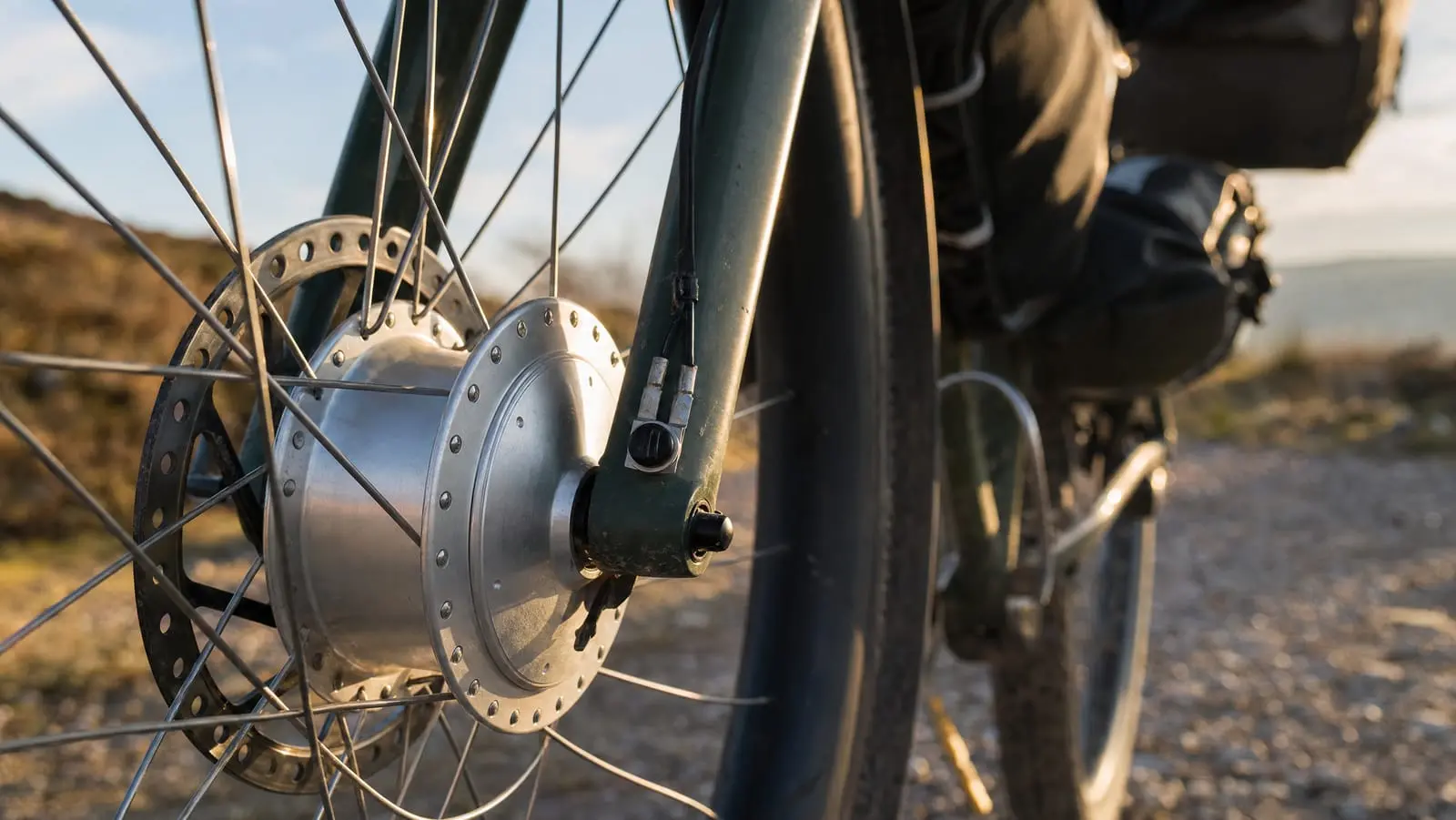
- Dynamo cache battery. IATA defines a power bank as "an easily carried universal external power source, capable of providing power to multiple devices", against a spare battery "designed to be inserted into or directly affixed to a specific device". A cache with a USB output is the former, so our reading is that it counts as a power bank and takes a slot. The hub itself is a generator and raises no hazmat question — which quietly changes dynamo hub versus power bank if you fly to your routes.
- Head unit, phone, messenger, lights. Installed batteries in portable electronic devices: either bag permitted, but IATA's table requires a device in checked baggage to be completely switched off, not in sleep or hibernation, once its battery is above 2.7 Wh. A bike light that can be knocked on inside a taped box fails that. Carry them on.
- Di2 and AXS batteries. Out of the bike these are spares in the regulatory sense: cabin, terminals protected, under the 20-spare cap rather than the two-bank cap. The energy is trivial — retail listings for Shimano's BT-DN320 give 305 mAh at 7.6 V, or 2.32 Wh (Veloplus). The passenger tables are written around devices, not bicycles, so there is no clean entry for a battery installed in a frame inside a checked bike box — a good argument for pulling it and carrying it on.
One buying note: IATA flags wireless induction power banks as "an emerging concern", susceptible to being mass-produced without evidence of UN 38.3 testing, with several passengers reporting them entering thermal runaway. Fly the cabled one.
The E-Bike Battery Flight Ban Is Arithmetic, Not Policy
No approval gets an e-bike battery into a cabin, because the problem is the number. A Specialized Turbo Levo SL battery is 320 Wh and a Brompton Electric battery 300 Wh (BikeRadar); the passenger ceiling is 160 Wh. Nothing bridges that.
So you rent at the destination or you ship — and shipping is regulated freight, not a parcel. The FAA's Lithium Battery Shipping Guide puts a lithium ion battery over 100 Wh shipped on its own, UN3480, as forbidden on passenger aircraft, accepted only on cargo aircraft at 35 kg net per package, at a state of charge of 30 percent or less, with Class 9 and Cargo Aircraft Only labels and a shipper's declaration (FAA, 2026). For an e-bike, shipping a bike versus flying with it becomes the only option, not the expensive one.
What a Flight-Legal Pack Actually Looks Like
The 100 Wh threshold is more generous than it sounds. A 10,000 mAh pack is about 37 Wh at 3.7 V nominal; a 15,000 mAh pack about 55.5 Wh. Two of either sits inside both the watt-hour band and the two-bank cap, and you have to reach about 27,000 mAh before the line enters the conversation.
The INIU Outdoor Rugged 10000mAh Power Bank is the right shape: 3.6 by 2.3 by 1.1 inches and 6.9 ounces per the listing, 45 W output, IP67, with a quarter-inch thread. About 37 Wh, so no approval from anybody. It lists at $54.99 as of November 2026, though availability varies — no firm ship date, so do not plan around it.
For a bigger number in one brick, the JUOVI 45W 15000mAh Power Bank runs about 55.5 Wh, with a built-in USB-C cable, a percentage display and two USB-A plus two USB-C ports, at $32.99 as of November 2026. Its listing claims a "TSA-approved size": there is no such thing as a TSA-approved power bank.
Whatever you carry, protect the terminals: the FAA accepts retail packaging, tape, a battery case, a sleeve, or each battery in its own plastic bag, under 49 CFR 175.10(a)(18). A pouch that keeps banks away from a multi-tool beats a clever cable, and we spec ours in your bikepacking charging kit.
At the Airport: Gate-Checks, Bins and Refusals
Your carry-on gets gate-checked. Constant on full flights and the small aircraft that serve trailheads. The FAA is explicit: when a bag is checked at the gate or planeside, all spare lithium batteries and power banks must be removed and kept with the passenger in the cabin. Keep yours where you can pull them in fifteen seconds.
The overhead bin. Several carriers bar it outright. Treat it as closed everywhere; keep yours in the seat pocket or at your feet.
A pack is refused. There is no legal route into the hold for a spare, so the choices are surrender it or do not fly — and arguing the rating only works if the pack is marked. The FAA also bars damaged or recalled batteries and battery-powered devices unless the battery has been removed or otherwise made safe, so a swollen case should not come to the airport. IATA notes an operator may require multiple spares be carried under 25 percent indicated charge, which is a good reason to arrive with near-empty banks anyway.
Connections, Codeshares and Non-US Departures
On a multi-leg itinerary the strictest rule wins, and it may not belong to the airline on your booking. IATA tells operators that "codeshare partners and outsourced or contracted service providers also need to be aligned", so your marketing carrier's page may describe a policy the operating carrier applies differently.
Check the operating carrier for each segment and pack to the strictest. If one leg is Southwest, you are a one-bank traveller for the whole trip — the per-segment discipline of airline bike fees and policies.
The Night-Before Checklist
- Count your banks. Two maximum, or one if an operating carrier says one.
- Read or compute the Wh: mAh × 3.7 ÷ 1000. Write it on the case.
- Pull every spare out of the hold bag — banks, Di2 or AXS cells, dynamo cache, headlamp cells.
- Protect terminals: retail packaging, tape, or one pouch per battery.
- Carry lights and head units on, switched off, not in the bike box.
- Check the operating carrier's page for every segment.
- Inspect for swelling, and run the banks down toward a low charge.
- If you ride an e-bike, arrange the rental or ground shipment now.
The Part Worth Remembering
These rules are not hard, just young — they changed while everyone was still learning the old ones. Carry-on only. Two power banks. No recharging on board. Under 100 Wh and you never have the conversation; over 160 Wh and there is none to have. The claim worth retiring is the comfortable one that no global limit exists on how many banks you can carry: there has been one since 27 March 2026.
The rest is housekeeping: know your watt-hours, mark your packs, and read the page of the airline actually flying you. For sizing the kit itself, work through the complete bikepacking power and charging guide before you price bricks.