Emergency Communication When There Is No Cell Signal
20+ years testing gear in Colorado backcountry
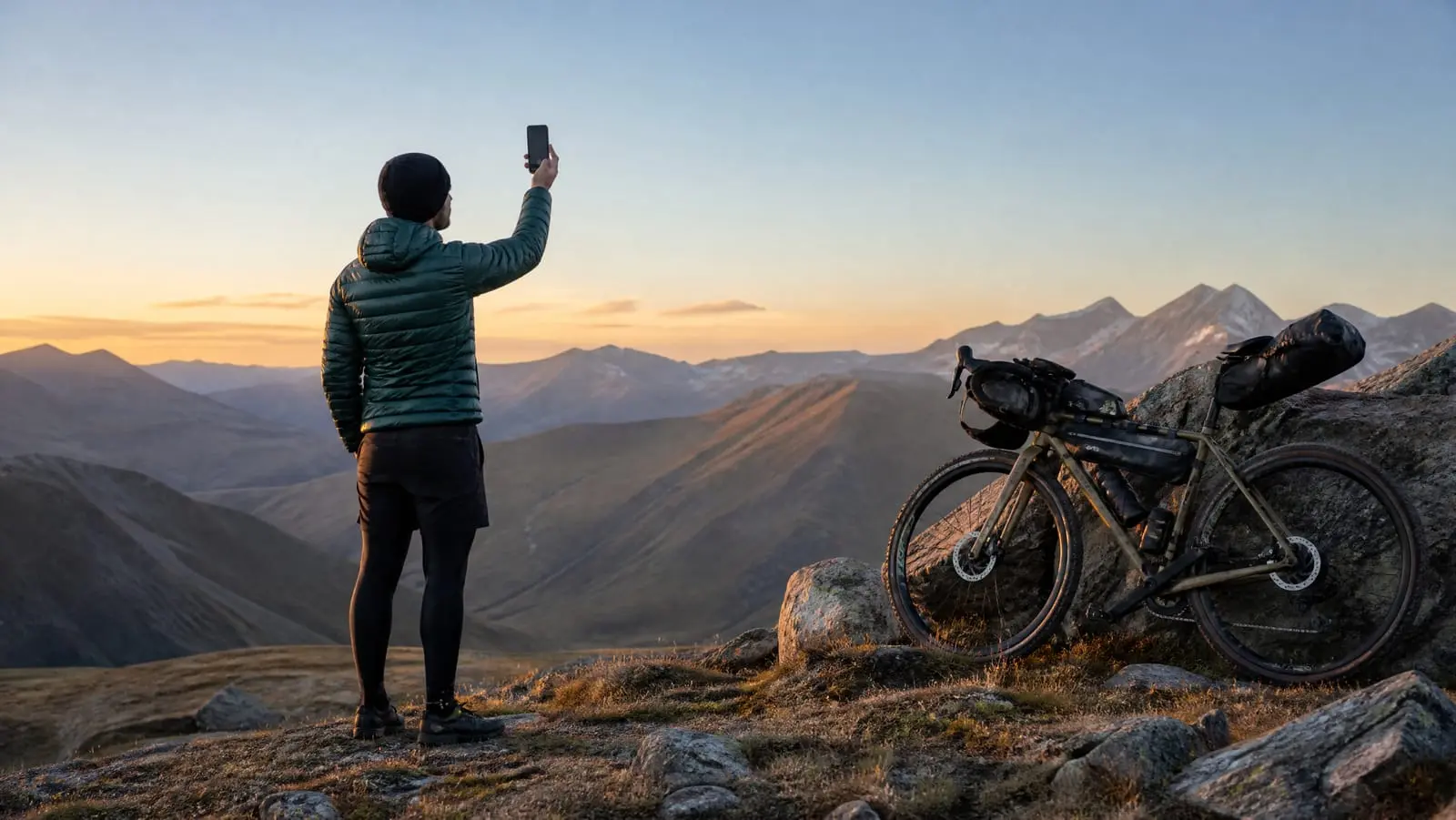
How to Call for Help Bikepacking With No Cell Signal
Emergency communication with no cell signal works in layers: a trip plan and check-in schedule left with someone at home, the satellite SOS already built into most recent phones, a dedicated satellite messenger for genuinely remote routes, and old-school signals — whistle, mirror, ground symbols — if every battery dies. Stack those layers before you leave, and a dead zone becomes an inconvenience instead of an emergency.
Most routes worth riding spend hours or days outside coverage. That's normal and manageable. The riders who get into real trouble aren't the ones who lose signal — they're the ones who lose signal with no plan for what happens next.
This guide — part of our larger bikepacking safety series — covers the communication layer: what to set up before the trip, what your phone can already do, when dedicated hardware earns its weight, and what happens on the other end of an SOS.
The Layered Communication Plan
Think of backcountry communication the way you think of clothing: layers, each covering the failure of the one before it.
- Layer 1 — People. A written trip plan and check-in schedule left with a reliable contact. Costs nothing, survives any crash, and starts a search without you doing anything at all.
- Layer 2 — The phone you already own. Recent iPhones and Pixels can send an SOS to emergency services by satellite, with no extra hardware.
- Layer 3 — A dedicated satellite messenger. Purpose-built two-way devices with multi-day batteries and a physical SOS button.
- Layer 4 — No-tech signals. A whistle, a mirror, and ground-to-air symbols. Gram-for-gram, the cheapest insurance in your kit.
No single layer is the plan. The stack is the plan. A satellite messenger with a dead battery is a paperweight; a trip plan with no way to send updates triggers searches for riders who are merely slow.
The Check-In Protocol: The Highest-Value Free Habit in Bikepacking
Build this habit before any gear talk, because it works even when you're unconscious. A check-in protocol has four parts, and vagueness in any of them turns a dead phone battery into a needless search — or a real emergency into three days of nobody noticing.
1. The itinerary. Give one reliable person your route (the actual GPS track link, not "the desert near Moab"), planned camps or towns for each night, bail-out options, and your bike and clothing colors. Searchers look for colors and objects, not names.
2. The check-in times. Agree on specific windows, not "I'll text when I can." Evening works best — it confirms you're stopped and safe for the night.
3. The overdue trigger. Decide, in advance, exactly how much silence means something is wrong. Build in slack, because backcountry plans slip for boring reasons.
4. The escalation step. Name precisely who your contact calls and what they say. In the US, that's usually the county sheriff's office where you're riding, since sheriffs coordinate most ground search and rescue.
Written down, for a three-day ride:
- Check-in: "I'll message you each evening between 6 and 9 p.m. with my location."
- Overdue rule: "If you hear nothing by 9 a.m. the next morning, I'm overdue — but wait until noon before acting, in case I'm just out of coverage."
- Escalation: "At noon, call the Gunnison County Sheriff's Office, tell them I'm an overdue cyclist on the marked route, and send them the track link and my last known position."
Ten minutes of writing, and a search starts within hours of something going wrong instead of days. If you ride alone, this protocol is the spine of the whole safety system — we go deeper on it in our guide to solo bikepacking.
What Your Phone Can Already Do Without Signal
The biggest change in backcountry communication in decades is sitting in your top tube bag. If your phone is reasonably recent, it can probably reach emergency services by satellite right now.
Satellite SOS on iPhone
According to Apple's support documentation, Emergency SOS via satellite is available on all iPhone 14 and later models: when you try to call or text 911 with no cellular or Wi-Fi coverage, the phone offers to connect by satellite, walks you through a short questionnaire, and uses on-screen guidance to help you aim at a passing satellite. You need to be outside with a clear view of the sky and horizon — dense foliage, canyons, and steep terrain can slow or block the connection.
Apple includes satellite features free for two years after activating an eligible iPhone, and per MacRumors, in September 2025 it extended free access for iPhone 14 and 15 models activated before September 9, 2025 through November 2026. Recent iPhones also support Messages via satellite, so you can tell your check-in contact "running late, all fine" from a dead zone — exactly the message that prevents false alarms.
Satellite SOS on Android
Pixel owners have a close equivalent. According to Techlicious's 2026 guide to satellite messaging, Satellite SOS is built into the Pixel 9 series (except the 9a) and all Pixel 10 models, connecting through Skylo's satellite network when you attempt an emergency call with no coverage.
Carrier-based satellite texting has arrived on top of that. T-Mobile's T-Satellite service, built on Starlink's direct-to-cell satellites, launched commercially in July 2025; according to T-Mobile, it supports free 911 texting for its customers, works on more than 60 phone models, is open to customers of other carriers by subscription, and now carries data for select apps including WhatsApp and Google Maps. Pricing and eligibility shift quickly — check your own carrier before a trip rather than assuming.
Squeezing Help Out of a Weak Signal
Even before satellites enter the picture, a few habits stretch what marginal coverage you find:
- Text before you call. A text needs only a sliver of connection; a call needs a sustained one. On one flickering bar, an SMS often goes through when a call won't.
- Try 911 anyway. In the US, phones can attempt 911 calls over any carrier's tower in reach — so an emergency call sometimes works even when your screen shows no service.
- Move for signal deliberately. Ridgelines, saddles, and open clearings beat valley bottoms and dense timber. Climbing for coverage costs energy, so treat it as a decision, not a reflex.
- Practice airplane-mode discipline. A phone hunting for towers all day drains itself fast. Keep it in airplane mode with offline maps downloaded, and pair that with the charging strategy from our guide to keeping your phone and GPS alive.
When a Dedicated Satellite Messenger Earns Its Place
If phones can do satellite SOS now, why does dedicated hardware still exist? Because your phone already has four other jobs — map, camera, journal, entertainment — which makes it your most-dropped, most-drained, most mission-critical device. A dedicated messenger is a separate battery, a separate radio, and a physical SOS button that keeps working after your phone has died, cracked, or gone swimming at a creek crossing.
We think a dedicated device earns its weight when any of these are true:
- You'll be out of coverage for multiple days, not hours.
- You ride solo on remote routes, where nobody is there to go for help.
- Your route has serious consequences — exposure, water scarcity, grizzly country, big weather.
- You want two-way messaging and tracking so your check-in protocol runs over satellite instead of hoping for bars.
That last point is underrated. The best thing a messenger sends isn't an SOS — it's the nightly "all good, camped here" that keeps your overdue trigger honest. We're deliberately not reviewing devices here; we've already tested the field in our roundup of the best satellite messengers for bikepacking, covering options, subscription models, and bike mounting. A messenger also slots into a broader kit — see our guide to emergency gear every bikepacker should carry for how it fits alongside first aid and repair.
No-Tech Signaling: When Every Battery Is Dead
Layer 4 weighs almost nothing and never needs charging.
The whistle. Hunter education courses teach that the international distress signal is three of anything — and three whistle blasts, repeated with a pause between sets, is the version that works from a bike. A whistle carries farther than your voice and costs no energy; clip one where you can reach it with one hand.
The mirror. A signal mirror can flash sunlight for miles at aircraft, vehicles, or ridgelines. Sight your target through the hole and sweep the reflected spot across it — three flashes, pause, repeat.
Ground-to-air symbols. The international ground-to-air code used in aviation search and rescue keeps it simple: a large V means "require assistance" and a large X means "require medical assistance." Build them big and high-contrast — rocks on sand, branches on snow, your brightly colored gear on open ground — in a clearing visible from above.
Stay findable. If you've triggered a search, the worst move is wandering. Get to open ground near your last known position, make yourself visually loud — bike reflectors and bright bags help here — and stay put unless staying is dangerous.
Electronics summon rescuers. Whistles, mirrors, and ground symbols help rescuers actually find you. Searches often come down to the last hundred meters.
What Happens When You Trigger an SOS
Knowing what's on the other end of the button removes a lot of fear — and helps you communicate well under stress.
With a Garmin inReach, according to Garmin, an SOS goes to the Garmin Response center (the International Emergency Response Coordination Center, formerly GEOS), staffed around the clock: coordinators confirm your location, open two-way messaging, contact the appropriate local emergency services, notify your emergency contacts, and monitor the incident until it's resolved. Phone-based SOS works similarly, connecting you to emergency services or relay centers that pass your messages and location to local dispatch.
When that conversation starts, be ready to give rescuers what they actually need:
- Who and how many: riders in your group, ages, relevant medical conditions.
- What happened: the injury or problem, stated plainly — "crashed, suspected broken collarbone, alert and breathing" beats a paragraph of context.
- Where exactly: coordinates if you have them, plus terrain description — "open meadow west of the creek, room for a helicopter."
- What you have: shelter, water, insulation, how long you can stay warm and hydrated.
- What's changing: weather moving in, bleeding controlled or not, daylight remaining.
Short, factual, updated when things change. Two-way devices exist so rescuers can ask follow-ups — answer them, then conserve battery. And the scenarios that put you here aren't always mechanicals; a crash triggered by a loose dog or a bad animal encounter is a classic one, which is why this guide pairs with our piece on wildlife safety for bikepackers.
Stay or Move? A Simple Decision Framework
The hardest backcountry decision isn't how to call for help — it's whether to. Here's the framework we use:
- Trigger an SOS when someone can't ride and can't safely walk out, when a medical situation could worsen fast, when you're immobile with weather incoming, or when continuing would clearly make things worse. SOS is not an admission of failure; late calls are harder on everyone than early ones.
- Self-evacuate when the injured rider is stable and mobile, the bail-out is short and known, and moving doesn't risk making the injury worse. Message your contact first if you can, so your route change doesn't trip the overdue alarm.
- Stay put when a search is already coming, when you're hurt and unsure, or when night or weather makes movement risky. Rescuers head to your last known position — be there, be visible, be warm.
One question cuts through most gray areas: "If this goes badly, which choice would I regret?" Riding out on adrenaline with an injury you haven't honestly assessed is the classic wrong answer. Getting yourself out under your own power — field repairs, injury management, improvised solutions — deserves its own deep treatment, which is exactly what our guide to self-rescue for bikepackers covers.
Build the Stack Before You Need It
Dead zones aren't a reason to stay home. They're a design constraint, and the design is straightforward: file a trip plan with a real overdue trigger, learn what your phone's satellite SOS can do and demo it once, add a dedicated messenger when your routes demand it, and carry a whistle and mirror as the layer that never runs out of battery.
Do the free part this week — write the check-in protocol for your next ride and hand it to someone who'll take the job seriously. Then zoom out: our complete guide on how to stay safe while bikepacking ties this plan into weather, wildlife, traffic, and camp security. Signal comes and goes out there. A good plan doesn't.