Bikepacking Road Safety: Riding Safely in Traffic
20+ years testing gear in Colorado backcountry
Bikepacking Road Safety Starts With Four Habits
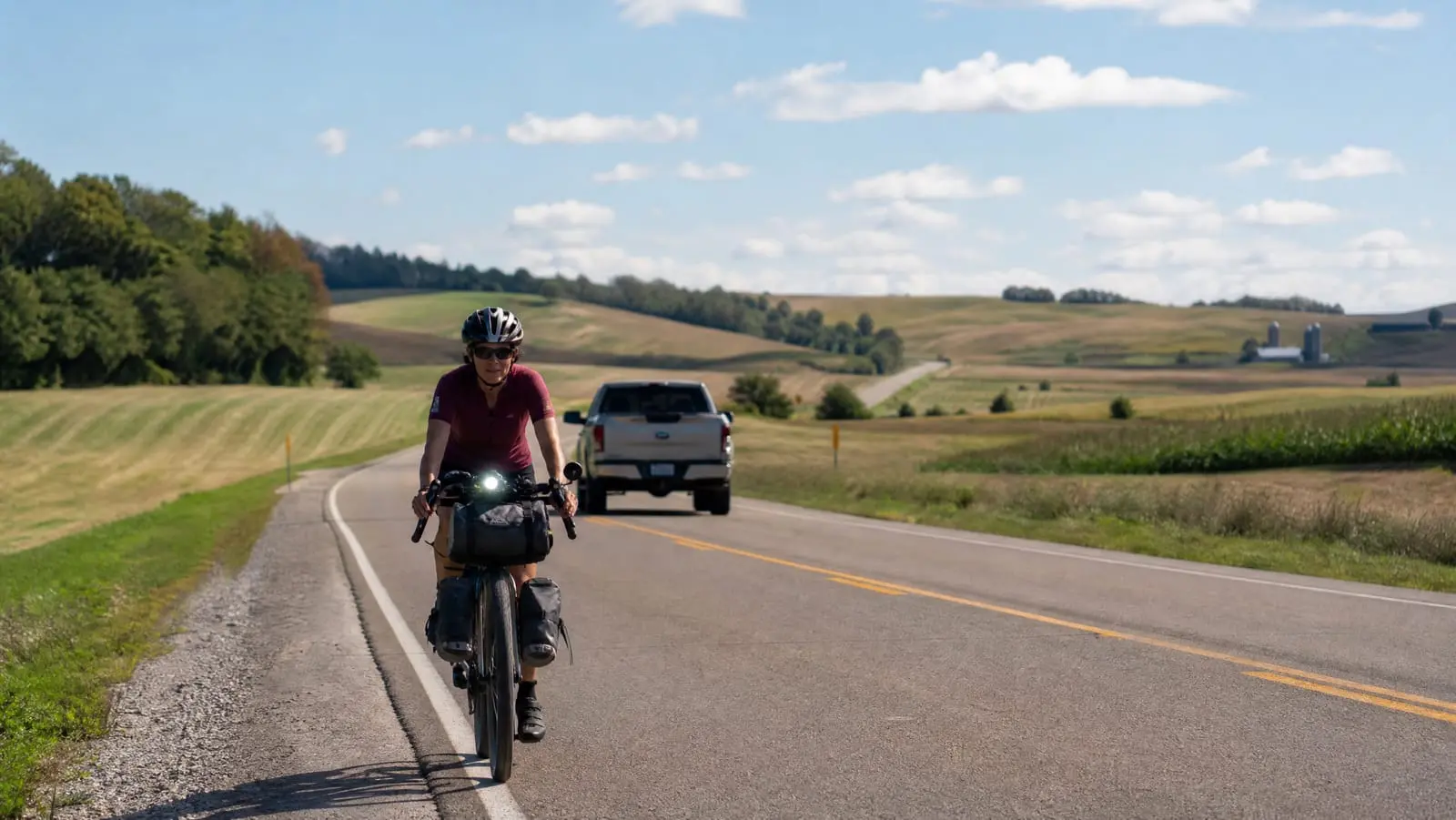
Riding safely in traffic on a loaded bikepacking rig comes down to four habits: ride predictably where drivers expect a vehicle to be, take the lane when it's too narrow to share, run daytime lights so you're seen from a distance, and plan routes that minimize high-speed pavement in the first place.
Most bikepacking routes are designed to minimize pavement, but almost every route includes connector roads — the five miles of two-lane highway between gravel segments, the ride through town to resupply. Those connectors are where you share space with two-ton vehicles, on a bike that handles differently than the one most of us learned traffic skills on.
The stakes are real but manageable. According to NHTSA, 1,166 cyclists were killed in traffic crashes in 2023 — about 2.9 percent of all traffic fatalities. That's not a reason to stay home; it's a reason to ride the connectors with intention instead of gritting your teeth and hoping.
This article is a spoke of our complete bikepacking safety guide. Here, we go deep on one thing: sharing the road with cars when your bike weighs sixty pounds.
You can't control every driver. You can control where you ride, how visible you are, and how predictable you look — and those three do most of the work.
Why a Loaded Bike Changes the Game
Before tactics, understand what your rig actually does differently in traffic.
- Stopping distances are longer. More mass means more momentum, especially descending. Leave bigger gaps and brake earlier than feels necessary.
- Acceleration is slow. Clearing an intersection or merging across a lane takes longer. A gap that works on a road bike may not exist on a loaded rig — wait for the bigger one.
- You're wider than you think. Fork bags and handlebar rolls add inches on both sides. A squeeze between a car and a curb that you'd take unloaded can clip a bag, and a snagged bag at speed is a crash.
- Wind pushes you around. A loaded bike presents more side area, and gusts — especially the pressure wave off a passing truck — can shove you a foot sideways. Leave lateral buffer whenever wind or traffic is heavy.
None of this makes road riding unsafe. It just means your margins need to grow with your gear — and it's worth practicing loaded handling on quiet roads before your route forces it in traffic.
Lane Positioning: The Core Skill of Riding in Traffic
Where you ride in the lane matters more than almost anything else you control. The goal: be where drivers are already looking, and be unambiguous about what you're doing next.
The League of American Bicyclists' Smart Cycling curriculum teaches the principle plainly: if a lane is wide enough to share safely with a car — about 14 feet — ride about three feet to the right of the passing traffic; if it isn't wide enough to share, take the lane by riding in the middle of it.
Taking the lane feels counterintuitive, but it removes the worst option from the table. Hugging the edge of a narrow lane invites drivers to squeeze past with inches to spare. Riding the center forces them to do what they should do anyway: slow down, wait, and pass fully in the other lane when it's clear.
A few positioning rules that earn their keep on a loaded bike:
- Ride a straight, steady line. Don't weave between parked cars or drift into gaps at the road edge — unpredictable is what gets cyclists hit.
- Take the lane early on descents and pinch points. With longer braking distances, you want control of the space before a driver tries to share it.
- Signal early and briefly. A loaded bike is less stable one-handed, so make a clear arm point, then get both hands back on the bars.
- Check behind before every lateral move. This is where mirrors shine — more below.
The law is broadly on your side here. According to NHTSA's Countermeasures That Work, as of September 2021, 35 states and the District of Columbia had laws requiring drivers to give cyclists at least three feet when passing, and the National Conference of State Legislatures notes some states require more — Pennsylvania and New Jersey mandate four feet. Laws vary by state, but the takeaway is the same: you're allowed to occupy the space you need to be safe.
The Shoulder Question: Use It, But Judge It
A wide, clean shoulder is a gift — take it. But rural shoulders are rarely wide and clean for long, and a loaded bike pays a bigger price for bad surface. Judge each shoulder on three things:
- Rumble strips. If the milled strip leaves a clean ribbon of pavement to its right, great. If not, it becomes a hazard itself — a loaded bike hitting a rumble strip mid-swerve is hard to keep straight. Pick one side and commit.
- Debris. Shoulders collect what the travel lane sheds: gravel, glass, retread wire. Scan well ahead so you can drift around debris gradually instead of flinching sideways into the lane.
- Disappearing shoulders. Shoulders vanish at bridges, guardrails, and town limits. Don't ride the shoulder until it ends and pop into traffic unannounced — when you see a pinch coming, check behind, signal, and merge early, while drivers still have time to react.
When the shoulder is bad, the lane is the safer place. A debris-strewn eighteen-inch shoulder isn't rideable space, and pretending it is puts you in the squeeze zone.
Being Seen: Visibility Tactics Backed by Data
Being seen on the road isn't about one magic accessory — it's a stack of small advantages. And this is one area where the evidence is unusually good.
Run daytime running lights. A controlled experiment with 3,845 cyclists in Odense, Denmark found that riders using permanent running lights had a 19 percent lower injury-crash rate than the control group, with multiparty crashes — the ones involving another road user — 47 percent lower. A rear light with a daytime flash mode, plus a white front light, should run whenever you're on pavement. Our roundup of the best bike lights for overnight bikepacking covers models with the battery life to flash all day and still light your camp.
Darkness is the enemy — plan around it. According to NHTSA's 2023 data, more cyclist fatalities occurred in the dark (53 percent) than in daylight (42 percent). Schedule road connectors in full daylight when you can. If your route forces road miles after dark, treat it as its own discipline — our guide to night riding safety gear covers the full setup.
Wear contrast, not camouflage. Earth-tone bikepacking kit looks great in photos and disappears against a tree line. On road days, put your brightest layer on top; fluorescent colors work in daylight, reflective elements work in headlights. We cover high-visibility gear in depth in its own article.
Add a mirror. A bar-end or helmet mirror lets you track overtaking traffic without the over-the-shoulder check that wobbles a loaded bike. You'll hear a truck before you see it, but a mirror tells you whether it's moving over.
Rural Roads: High Speeds, Big Trucks, Blind Crests
NHTSA's 2023 data shows that 81 percent of cyclist fatalities happen in urban areas — but don't let that lull you on rural highways. The rural share is smaller likely in part because far fewer people ride there, and rural crashes tend to involve higher vehicle speeds, which physics makes far less forgiving. Rural two-lanes demand their own habits:
- High-speed two-lanes. A 55 mph road with no shoulder is the classic bikepacking connector. Ride it with your full visibility stack running, take the lane through blind sections, and use your mirror to decide when to hold position versus give room.
- Log trucks and farm equipment. Their drivers often can't move over on a narrow road. When you hear one coming and there's a safe pull-off, consider taking it — losing thirty seconds beats negotiating a lane with a loaded truck. Wide farm equipment may straddle the centerline; get well clear.
- Blind crests and curves. Position yourself where a driver cresting the hill sees you soonest — usually further into the lane, not hugging the edge where you appear at the last moment.
- Dogs. Rural roads mean farm dogs, and a chase is a crash risk as much as a bite risk — our wildlife safety guide covers the calm, no-sprint response that works.
- Riding into low sun. At dawn and dusk, drivers behind you may be staring into the same sun that's in your eyes — which can make you effectively invisible even with lights.
Intersections and Towns With a Heavy Bike
According to NHTSA data, most cyclist fatalities occur away from intersections — but intersections and towns still concentrate conflict into small spaces, and a loaded bike changes how you handle them.
Assume you're slower than drivers expect. The classic town conflict is a driver misjudging your speed — turning left across your line or pulling out of a side street. On a loaded bike you can't sprint out of trouble, so ride as if every waiting car might go: cover your brakes and make eye contact when you can.
Position by destination. Use the rightmost lane that serves your direction — riding the right edge past a right-turn lane when you're going straight invites the right hook. Move over early, while speeds are low.
Wait for the comfortable gap, not the barely adequate one. Clearing an intersection from a standstill takes real time — and downshift before you stop so you can accelerate when the light turns.
Watch door zones and driveways. Ride outside the reach of parked-car doors, and treat every driveway and parking-lot exit as a possible car.
Route Planning: The Best Traffic Tactic Is Avoiding It
The safest road mile is the one you never ride — before the trip is when you win most of this game.
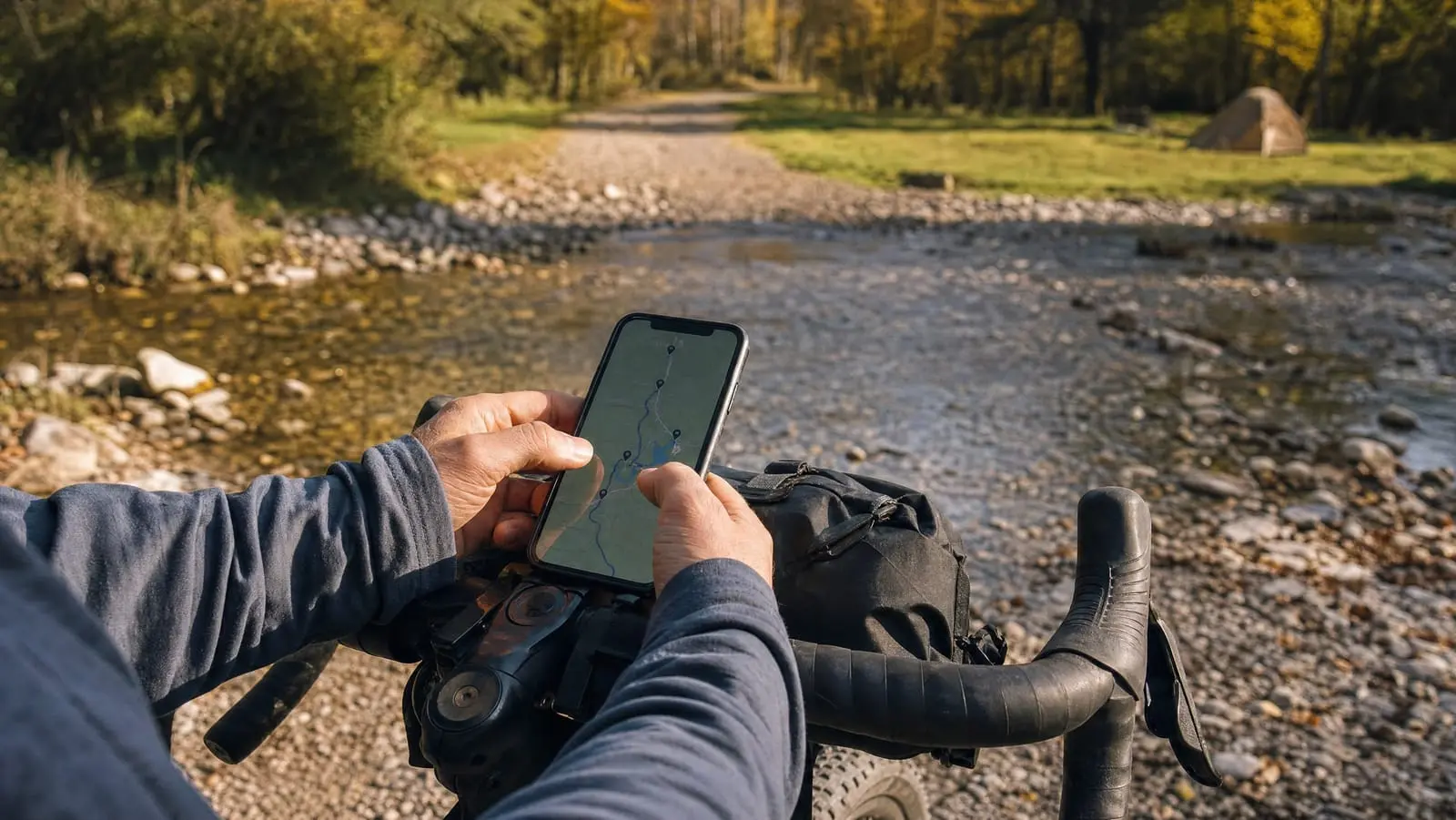
- Use traffic-stress layers. Route planners like RideWithGPS, Komoot, and Cycle.travel can weight routes away from high-speed, high-volume roads. Five extra miles on quiet roads is usually the better day.
- Choose gravel connectors when they exist. A dirt road paralleling a highway is almost always worth the extra rolling resistance. Established routes — like those in our guide to the best beginner bikepacking routes in the US — have already done this traffic-avoidance work for you.
- Time your road segments. Avoid weekday commute windows near towns, Friday-afternoon lake traffic in summer, and school bus hours on rural roads.
- Plan around weather, because drivers lose you in it. Rain, fog, spray, and low sun degrade driver vision far more than yours; a driver behind a smeared windshield may have half the sight distance you assume. If serious weather is moving in, get off trafficked roads first — our companion guide to severe weather safety covers when to shelter, when to reroute, and how to make the call early.
Group vs. Solo: How You Ride Together Changes How Drivers Treat You
Solo, you're small and easy to pass — but also easy to miss. Run your full visibility stack and be extra deliberate about lane position, because you're making every judgment alone.
In a group, ride single file on narrow or fast roads and keep the group compact — a strung-out line takes forever to pass and tempts drivers into squeezing by mid-group.
Communicate in both directions. Within the group, point out hazards and echo "car back" up the line. With drivers, be human: a wave-through when it's safe to pass, a raised hand of thanks after a courteous one, an early arm signal before every turn. Drivers extend far more patience to riders who visibly acknowledge them, and on a two-lane road that patience is a safety resource.
If You're Hit or Have a Close Call
One short, unglamorous note. If a vehicle hits you: get out of the roadway if you can, call 911, and get checked out even if you feel fine — adrenaline hides injuries. Get the driver's information and photos of the scene, then inspect your bike and bags before riding another mile. And if you're hurt or your bike's unrideable far from help, that's when preparation pays off — we cover self-rescue for bikepackers in its own dedicated guide.
Close calls deserve a response too: stop, let the adrenaline settle, and ask what you'd change — position, timing, route — because a close call is cheap tuition if you take the lesson.
The Takeaway: Ride Like Traffic, Plan Like a Bikepacker
Bikepacking road safety isn't about fear — it's about treating connector roads as a skill instead of an obstacle. Ride predictably, take the lane when it's too narrow to share, judge each shoulder honestly, run daytime lights, respect rural speed and low sun, and plan routes so the hardest traffic decisions never come up.
Start with the easiest win: put your lights on daytime-flash duty for every pavement mile, and pull up your next route in a planner with a traffic-stress layer. Then keep building the bigger picture — our bikepacking safety guide ties road skills together with weather, navigation, wildlife, and communication so the whole system works when you need it.
The road miles between the good parts don't have to be the scary parts. Ride them like you belong there — because you do.