Bikepacking Bike Security: Preventing Theft on the Road
20+ years testing gear in Colorado backcountry
Bikepacking Bike Security Starts With an Honest Admission
How do you keep a loaded bike from getting stolen on a bikepacking trip? You layer three cheap defenses: a lightweight deterrent lock for cafe and grocery stops, a hidden tracker for the day the lock fails, and habits — line-of-sight parking, bike inside at motels — that cost nothing. No packable lock can do the job alone.
This article contains affiliate links. We may earn a commission if you make a purchase through our links, at no extra cost to you.
We'll say the quiet part out loud, because lock marketing won't: every lightweight lock is a deterrent, not a vault. No one carries a 4-pound U-lock over a mountain pass, and every lock light enough to pack can be defeated with the right tool and a little privacy. That's not a reason to skip bikepacking bike security — it's the reason to build it in layers, so a thief has to beat all of them at once. This is the theft-prevention chapter of our larger bikepacking safety guide.
Why Bike Theft Works Differently on a Bikepacking Trip
City cyclists face a static problem: same rack, same hours, thieves with time to work. Bikepackers face a moving one, and the risk map is inverted from what most riders expect.
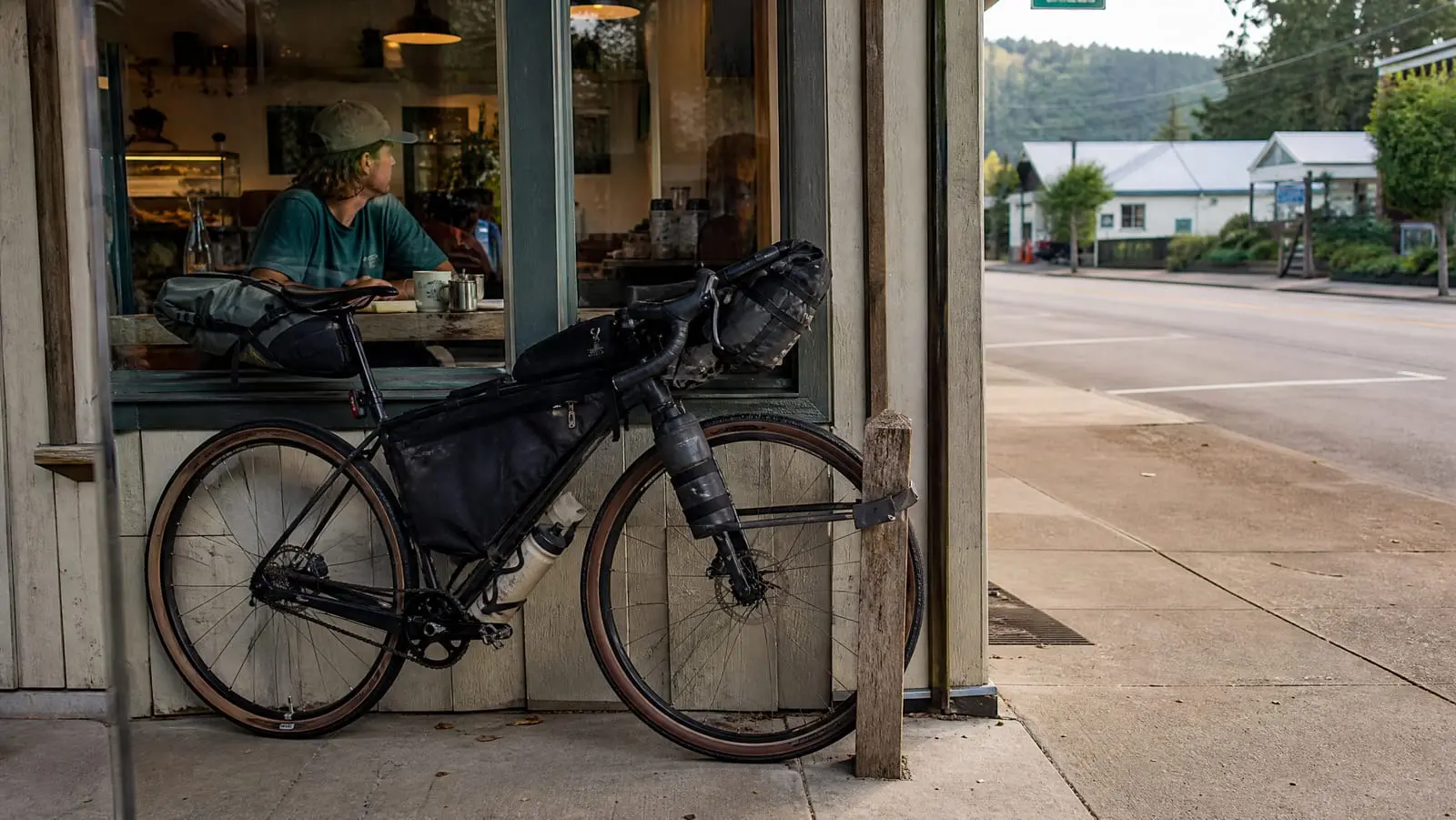
Remote miles are your safest miles. On a forest road 40 miles from pavement, theft risk is close to zero. The danger zones are where your route touches civilization: resupply towns, cafes, grocery stores, gas stations, and motel parking lots — anywhere an obviously expensive, fully loaded bike sits in public view while you're inside with your guard down.
The scale is real. According to bike-registry Project 529, roughly two million bikes are stolen across North America every year — about one every 15 seconds. And once a bike is gone, it's usually gone: an analysis of over 11,000 U.S. theft reports by Bike Bounty found an overall recovery rate of just 5.7 percent. Those numbers shape our approach: prevention beats recovery, and a tracker is the backup plan, not the plan.
One more bikepacking-specific wrinkle: your bags are targets too. A snatched seat pack with your sleep kit ends a trip as surely as a stolen frame. A security plan that only thinks about the frame is half a plan.
Layer 1: A Lightweight Lock for Bikepacking (Deterrence, Priced in Grams)
Here's the math nobody escapes. Serious urban locks weigh 2 to 4-plus pounds because resisting power tools takes steel mass. The UK's Sold Secure certification shows what real resistance costs: per lock-maker Litelok's summary of the standard, Bronze locks must withstand at least a minute of attack with basic tools, Silver three minutes with an enhanced tool list, Gold five minutes, and Diamond five minutes including a 90-second angle-grinder attack. Locks built to those upper standards ride like boat anchors — the packable locks below trade that certification-grade resistance for weight you'll actually carry.
At the bottom of the food chain sit plain cables: as the testing site The Best Bike Lock documents, small bolt cutters that fit in a backpack will cut through any cable lock in seconds. That doesn't make a cable useless — it makes it a deterrent, good for exactly the opportunistic, walk-by theft that resupply stops invite.
Best Lightweight Lock: OTTOLOCK Cinch (30-Inch)
The Ottolock Cinch is the lock we actually see on bikepacking rigs, because it solves the carry problem: the maker lists a weight of just 145 grams — about 5.1 ounces — coiling to about a 4-inch disc that disappears into a hip pack or feed bag. The band layers three strips of stainless steel inside an aramid-fiber jacket that resists cutting and sawing far better than a cable, and the resettable 3-dial combination means no key to lose in a gravel parking lot. To Otto's credit, the company is explicit that this is not a U-lock replacement — it's built to stop opportunity theft during quick stops, with redundant locking recommended in high-theft areas. That matches our experience: right tool for a 20-minute cafe stop, wrong tool for an overnight on a city street. It holds a 4.0-star average across 315 Amazon ratings, at about $79 as of July 2026 — you're paying a premium for grams saved.
OTTOLOCK Cinch Bike Lock (30-Inch)
A roughly 5-ounce (145 g) cinch-style band lock that coils to pocket size, built from three stainless-steel layers in a cut-resistant aramid jacket. The maker says plainly it's a quick-stop deterrent, not a U-lock replacement — the honest job description for a bikepacking lock. For gram-counters who want more bite than a cable.
- Coils to about 4 inches — lives in a hip pack or feed bag
- Steel-and-aramid band resists cutting and sawing
- Resettable 3-dial combination; no key to lose
- Deterrent for opportunity theft, not a vault
Price may vary
Best Security for the Weight: Kryptonite Folding Lock
If your route strings together towns, motels, and long unattended stops, step up to a folding lock. Kryptonite's compact folder articulates 3 mm hardened-steel bars — a genuinely harder cutting problem than any band or cable — into 34.8 inches (88.4 cm) of reach, enough to catch a rack or signpost a short loop can't. At 2.15 pounds it's the heaviest thing on this page, and that's the honest tradeoff: real resistance costs real grams. Kryptonite positions it for short stops and low-to-medium-risk areas — mid-tier security, not a heavy U-lock — and we'd treat it exactly that way. It ships with a frame-mount bracket and two keys, averages 4.5 stars across 94 Amazon ratings, and at about $25.43 as of July 2026 it's a startling bargain for the brand.
Kryptonite Folding Bike Lock (34.8-Inch)
Hardened 3 mm steel bars folding to a flat brick that mounts to your frame, with 34.8 inches of reach to wrap racks and posts a band lock can't. Meaningfully harder to cut than any cable, but 2.15 pounds — worth it on town-heavy routes, overkill for a remote weekend loop.
- 3 mm hardened-steel bars with tightened rivets
- 2.9 ft reach catches racks, posts, and fence rails
- Includes frame-mount bracket and two keys
- Maker-rated for short stops, low-to-medium-risk areas
Price may vary
Budget Deterrent: Master Lock 8122D Cable Lock
Let's be clear about what roughly thirteen dollars buys: a visual deterrent, nothing more. This is a 6-foot, 13 mm braided-steel cable with a set-your-own 4-digit combination, and it belongs to the lock class that bolt cutters open in seconds. So why include it? Because 6 feet of reach does things short locks can't — loop through both wheels, the frame, and a fixed object in one pass, or lace through every bag strap on the bike. Master Lock itself calls it basic security, best used as a theft deterrent, and that's the only role we'd give it: cafe stops in small towns, or the second layer that turns a quick bag-snatch into an awkward, time-consuming job. Never sole overnight protection in town. It carries a 4.4-star average across more than 12,900 Amazon ratings — cheap, useful, and honest about what it is if you are.
Master Lock 8122D Cable Lock (6 ft)
A 6-foot vinyl-coated steel cable with a resettable 4-digit combination and no pretensions. Cables are the easiest lock class to defeat, so treat it as a visual deterrent and bag-and-wheels layer for cafe stops and camp — never sole protection overnight in town.
- 6 ft reach loops both wheels, frame, and bags to a fixed object
- Set-your-own 4-digit combination — no key to lose
- Vinyl coating protects paint
- Deterrent only: the easiest lock class to cut
Price may vary
Layer 2: Hidden Trackers — the Honest Version of a GPS Tracker for Your Bike
First, a truth-in-advertising note. The affordable "bike trackers" below are not live GPS units — they're Bluetooth tags riding Apple's Find My or Google's Find My Device networks, so your bike's location updates only when a participating phone passes within range. That works surprisingly well in a town or trailhead lot, and lags badly on an empty forest road. The upside: no subscription, replaceable batteries rated for a year or more, prices around $20 to $36 as of July 2026. As a recovery layer behind a lock, a strong deal — as your only security, a lottery ticket.
This layered thinking should feel familiar from our guide to the best satellite messengers for bikepacking — the same logic that says "carry a communicator that works when your phone doesn't" says "hide a tracker that works when your lock didn't."
Best Hidden Tracker for iPhone: Orbit Velo
The Orbit Velo is purpose-built for bikes: it bolts under your bottle cage with tamper-resistant security bolts and a unique tool, so a thief can't flick it off the way they can a saddle-bag tag. It runs on Apple's Find My network with no subscription, claims up to a 3-year replaceable battery, and carries an IPX6 water-resistance rating — fine for the storms a bikepacking rig lives through. The whole point is that it doesn't look like a tracker; it looks like a cage mount. Remember the caveat: Find My is crowd-sourced, updates depend on passing Apple devices, and it's Apple-ecosystem only. It averages 4.3 stars across 267 Amazon ratings at about $35.94 as of July 2026.
Orbit Velo Bike Tracker
A Find My tracker that hides under your bottle cage behind tamper-resistant security bolts, with a claimed 3-year replaceable battery and IPX6 water resistance. No subscription, and it doesn't look like a tracker — which is the entire job. Crowd-sourced location, not live GPS; Apple households only.
- Hides under a bottle cage with security bolts and unique tool
- Apple Find My network — no subscription fees
- Up to 3-year replaceable battery; IPX6
- Full install kit included
Price may vary
Best AirTag Mount: typecase Seatpost Reflector Mount
Already own an AirTag? Then the cheapest upgrade in this guide is a mount that hides it in plain sight. The typecase mount disguises an AirTag on your bike as an ordinary rear reflector on the seatpost — the one component a thief never looks at twice. The IP68-rated shell seals against rain, mud, and dust, installs with a quarter turn, includes four rubber ring sizes covering 7/8-inch to 1-1/4-inch round seatposts, and doubles as a mount for Garmin Varia RTL315/510/515 radar units. Two things before you click: the AirTag is not included, and an AirTag requires an iPhone to set up and track. It rates 4.5 stars across 665 Amazon reviews at about $19.99 as of July 2026.
typecase AirTag Seatpost Mount
An IP68 waterproof enclosure that disguises an AirTag as a boring seatpost reflector — hidden in plain sight where thieves never look. Quarter-turn install, four ring sizes for round seatposts, and it doubles as a Garmin Varia radar mount. The AirTag itself is not included, and AirTags require an iPhone.
- Disguised as an ordinary rear reflector
- IP68-rated against rain, mud, and dust; quarter-turn install
- Fits 7/8 to 1-1/4 in round seatposts; mounts Garmin Varia radar too
- AirTag NOT included — and it requires an iPhone
Price may vary
Best for Android: PerfiPro Tracker Tag
Android riders get the same play through Google's network. The PerfiPro tag runs on Find My Device (Android 9 and newer), with a replaceable CR2032 battery the maker rates at about a year, IP67 sealing, and a 90 dB ring-to-find alarm. PerfiPro is refreshingly specific about the limits: location updates arrive every 3 to 30 minutes via crowd-sourcing, not in real time — solid around towns, long silences in the backcountry. Zip-tie it inside a frame bag or deep in a seat pack where it can't be spotted at a glance. It averages 4.0 stars across 102 Amazon ratings at about $20.89 as of July 2026.
PerfiPro Android Bike Tracker Tag
A Google Find My Device tag for Android 9+ with a year-rated replaceable CR2032 battery, IP67 sealing, and a 90 dB ring-to-find alarm. The maker states updates arrive every 3 to 30 minutes via crowd-sourcing — a recovery aid around civilization, not live GPS in the backcountry.
- Google Find My Device crowd-sourced network (Android 9+)
- Replaceable CR2032 battery rated for about a year
- IP67 sealing; 90 dB ring-to-find alarm
- Updates every 3-30 minutes — not real-time GPS
Price may vary
Layer 3: Free Habits That Secure Your Bike at Camp and in Town
This layer costs nothing, weighs nothing, and prevents more theft than anything you can buy.
In town — where the actual risk lives:
- Keep line of sight. Pick the cafe window seat and park the bike where you can see it from the register. Most resupply-stop theft is pure opportunism; eyes on the bike remove the opportunity.
- Lock to something fixed, every time. Rack, signpost, fence — anything a thief can't lift the bike over. Thirty seconds of effort defeats the walk-away theft.
- Strip the temptation. Don't leave bags on the bike while you shop. Electronics, documents, and wallet live in one grab-and-go bag that comes inside with you — we organize this in our bikepacking packing list so the valuables pouch is always one buckle away.
- Motels: bring the bike inside. Ask at check-in; most independent motels say yes. A bike in your room is the only 100-percent security on this page. If the answer is no, lock it to something structural in camera view and bring the bags in anyway.
At camp — lower risk, cheaper tricks:
- Make the bike part of the tent. Lean it against your shelter or run a guyline from bike to tent so any movement shakes your wall. Clip a bell or hang your cook pot from the top tube — a crude alarm, but at 2 a.m. in a quiet camp, it works.
- Sleep between the bike and the exit. Put the bike on the far side of the tent from the trail or road so nobody reaches it without passing you.
- Stay unseen in the first place. The short version of camp security and stealth camping safety: camp out of sight of roads, arrive late, leave early — no one can steal what no one knows is there.
- Break the silhouette. Drape something over the bike at night — a rain jacket, a groundsheet, even your high-visibility gear. A covered shape reads as junk; a clean bike silhouette reads as money.
Two situational notes. Riding solo, every stop means the bike is briefly abandoned — our guide to riding alone covers structuring town stops with no partner to stand watch. And on short trips, right-size the kit: for a two-day loop that's mostly camp and singletrack, a folding lock is dead weight — see our weekend bikepacking essentials.
How to Choose: Quick Matrix
| Your trip looks like... | Carry | Why |
|---|---|---|
| Remote routes, brief town stops | OTTOLOCK Cinch + hidden tracker | Max deterrence per ounce |
| Town-heavy touring, motels, long stops | Kryptonite Folding + tracker | Real cutting resistance where exposure is longest |
| Weekend loop, tight budget | Master Lock cable + habits | Deterrent-only risk matches a mostly-at-camp trip |
| iPhone rider | Orbit Velo, or AirTag + typecase mount | Find My coverage, no subscription |
| Android rider | PerfiPro tag | The Android-native equivalent |
| Any of the above | The Layer 3 habits | Free, weightless, highest yield of all |
What We'd Actually Carry
For most riders on most routes, our kit is boring and cheap: the OTTOLOCK Cinch 30-inch cinched through the frame and a rack at every stop, a hidden tracker matched to our phone — Orbit Velo for iPhone, PerfiPro for Android — and the Layer 3 habits practiced until automatic. That's roughly half a pound and under $120 all-in as of July 2026, and it forces a thief to beat three independent layers in public view.
Swap in the Kryptonite folder when the route lives in towns, and add the 6-foot cable as a bag-and-wheels layer if your rig carries expensive everything. But keep the hierarchy straight: habits first, deterrent second, tracker last. A recovery rate under 6 percent means the tracker is the layer you hope never to use.
Bike security is one thread in a bigger rope — route planning, communication, weather sense, and first aid all braid toward finishing the trip you started. For the full picture, start with our complete safety guide, and ride out knowing the bike will be there when you walk out of the cafe.